
In the medieval world of Manor Lords, the marketplace is far more than just a bustling trading spot-it’s the lifeblood of your settlement, orchestrating the vital flow of food, fuel, and clothing to your villagers. Mastering the art of market placement and management is key to upgrading homes, boosting approval, and fueling the growth of your manor. But how exactly do these market areas and stalls work together to keep your population thriving? Dive into the mechanics behind Manor Lords’ marketplaces and discover the strategies that turn simple stalls into the heart of a prosperous realm.
Our Manor Lords marketplace guide will explain how marketplaces work to distribute food, fuel, and clothes.
How marketplaces work in Manor Lords
In Manor Lords, marketplaces serve as central hubs where villagers obtain essential goods like food, firewood, and clothing necessary for their daily needs and for upgrading their homes, called burgage plots. Players designate a marketplace area by setting its plot size, which determines the number of stalls that can be established. Families assigned to various production jobs automatically open stalls in the marketplace to sell their goods, which are then distributed to nearby burgage plots based on proximity and demand. The marketplace works closely with storage buildings like the granary and storehouse, which hold the goods before they are sold. Proper placement of marketplaces near the town center maximizes their effectiveness, as villagers frequently visit them to collect supplies. While multiple marketplaces can be built, having sufficient goods and workers is more critical than the number of marketplaces, since goods are distributed to plots regardless of distance, prioritizing those closer first. Effective marketplace management ensures villagers have all necessary resources, boosting approval and enabling settlement growth.
In order to upgrade your Burgage Plots in Manor Lords, those plots need access to a marketplace supplied with fuel, food, and clothing. Building a marketplace is free, and any family that wants to can set up a stall in that marketplace at no cost (more on this in a second).
Stalls in a marketplace will sell a mix of goods in one of those same three categories of fuel, food, and clothing. It’s unclear exactly what triggers a family to set up a stall in the market, but, generally, it just kind of happens once you build up a surplus of any one type of good.
What does “family requests more market area for their stall” mean”?
The phrase “family requests more market area for their stall” in Manor Lords means that a family operating a market stall needs additional space within the marketplace to set up or expand their stall to sell goods. Marketplaces have a designated area defined by the player, and within this area, multiple stalls can be established by families who work in resource-producing buildings like granaries or storehouses. If a family has more goods to sell or if the current market area is too small to accommodate all the stalls needed, they will request more market area to increase the number of stalls, thereby improving the distribution of goods such as food, fuel, and clothing to nearby burgage plots. This expansion helps ensure that all villagers receive the necessary supplies to upgrade and maintain their homes effectively.
When you start seeing the “family requests more market area for their stall” alert, this just means that one of your families has a surplus of goods that they want to sell to the rest of the town. All you have to do is provide them with a marketplace plot by, you know, building a marketplace. So long as there is a marketplace with slots available for stalls, you won’t get this message. Your first marketplace can be as big as you want, but somewhere between 10 and 15 stall slots is a safe bet – you can always add another marketplace later.
Having multiple marketplaces is a better bet than just one big central one because.
Marketplaces are based on priority, not proximity
Marketplaces in Manor Lords operate based on priority rather than proximity. Although a marketplace can supply goods to any burgage plot within the entire region, the distribution prioritizes the closest plots first. This means that stalls will fulfill the needs of nearby houses before extending supplies to those farther away. The key factor is having enough stock to meet the total demand of all burgage plots; if there is insufficient supply, some plots-often those farther out-may go without. Therefore, the effectiveness of a marketplace depends more on the quantity and management of goods and workers replenishing stalls than on the physical closeness of the marketplace to the houses it serves.
Marketplaces offer the Burgage Plots around access to whatever’s for sale inside. But just the presence of a marketplace and stalls isn’t enough. Every family – and remember there can be multiple families on each Burgage Plot – requires one fuel and one food per month (in the winter, from December through February, they require two fuel per month).
What’s available in a marketplace gets picked up by families from the surrounding Burgage Plots, not distributed to them. That means the distribution isn’t even across all plots. It’s more of a first come, first served situation (and the ones that are closer just so happen to get there first).
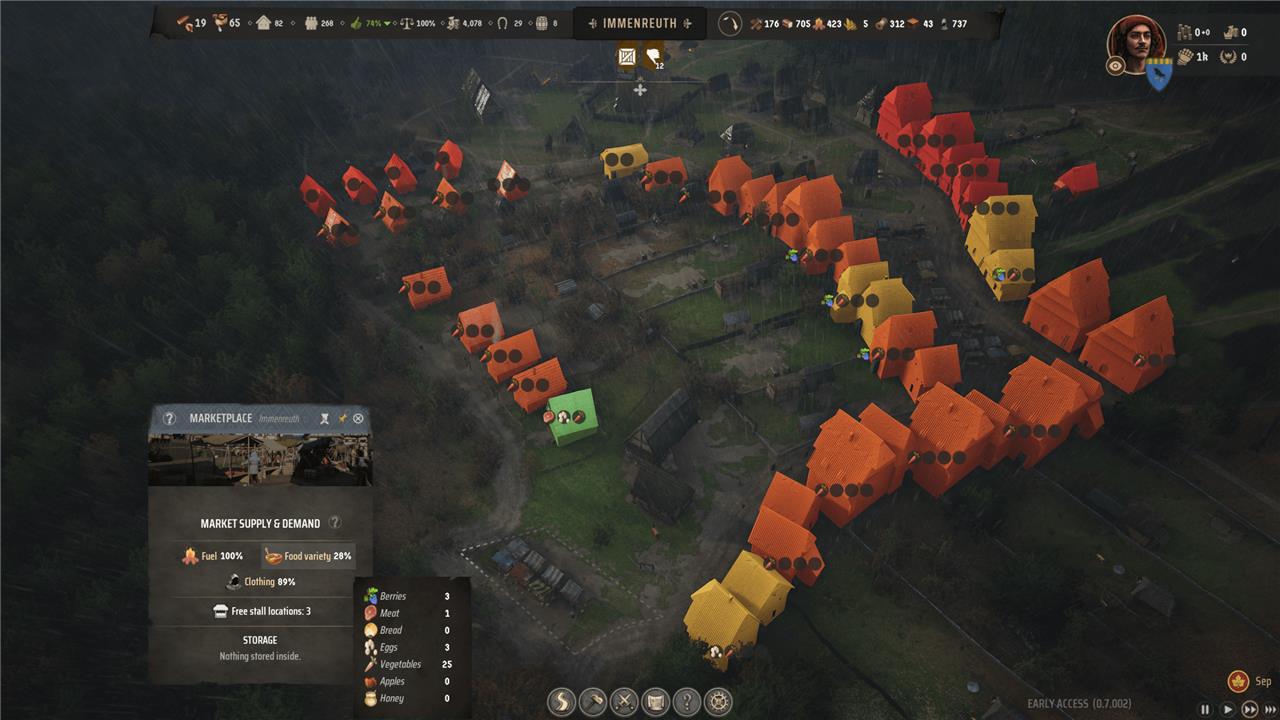
In order to keep everyone happy and their needs met – both to keep your approval from dropping and for upgrading Burgage Plots – you’ll have to have enough food and enough kinds of food for everyone to pick it up from the market before those plots closest to the market come back for the next month’s supply. In the image above, for example, you can see that almost everyone picked up vegetables for the month (except for the plots farthest out), but only the few plots directly touching a marketplace got any berries.
The requirements to upgrade a plot aren’t one-time checks. Those plots require those goods every month thereafter – put another way, now that they have access to two kinds of food, they expect it from then on. Upgrading from Level 1 to Level 2 doesn’t mean that the food requirements for that Burgage Plot increase by one food per family per month – they’ll survive on one – but their approval of you depends on having access to more.
Why aren’t my goods going to the marketplace?
If your goods aren’t reaching the marketplace in Manor Lords, it is often due to inefficiencies in how storehouses and granaries are managed. When these storage buildings hold a wide variety of goods and have too few families assigned, villagers spend excessive time collecting diverse items, leaving insufficient time to deliver goods to market stalls. Specializing storehouses to hold only one or two types of resources and assigning enough workers ensures timely stocking of market stalls and prevents shortages. Additionally, although the marketplace theoretically covers the entire region, in practice, outlying houses may not get supplied if there aren’t enough logistics workers or available stall space, so building local markets or increasing workforce can help. Sometimes, bugs or game mechanics, such as houses not registering properly with the market after upgrades, can also cause goods to not appear in the marketplace, requiring community troubleshooting or updates to resolve.
As with everything in Manor Lords, keeping everyone warm and fed involves a lot of moving pieces. Just growing or making food doesn’t always mean it’ll make it to the marketplace and then into your Burgage Plots (and then your families’ bellies).
First, check your granary and storehouse. Everyone will automatically drop their goods in those – different types of food get stored in each – but that doesn’t mean it’ll make it to a market stall. You might have to assign one family (or more, as your town grows) to the granary and storehouse. Those families will both go get stuff to store, but also set up stalls to sell that stuff.
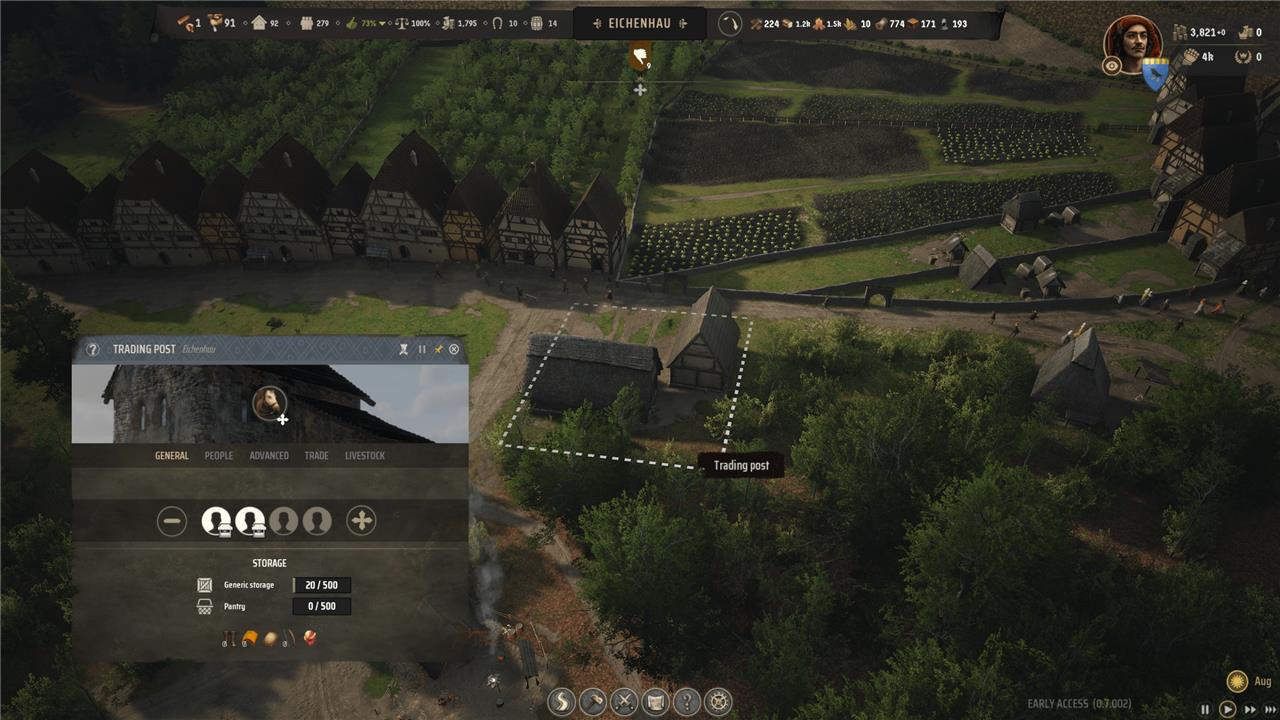
Additionally, check your trading post (if you have one). When you set up a trade route, you establish a desired surplus. This is a way to make sure you don’t export goods you want to keep. This desired surplus applies to the granary and storehouse, so, if you set the surplus to aim for too high at the trading post, you’ll inadvertently prevent those goods from making it to the marketplace.
Hovering over a marketplace plot will show you how many stall locations are unclaimed inside. If you’re running out – or even if your town is just spreading out too far – you can always add another marketplace plot. Manor Lords treats all of the marketplaces in a region as one unit, but the stalls get built wherever there’s people with stuff to sell and others who need said stuff. Spreading out your marketplaces makes it easier for families to get what they need.
How does the placement of marketplaces influence resource distribution in Manor Lords
The placement of marketplaces in Manor Lords critically influences resource distribution by determining how efficiently goods reach your villagers. Marketplaces should be positioned as close as possible to granaries and storehouses, which serve as the input points for resources like food, firewood, and clothing, to minimize travel time and ensure prompt stocking of market stalls. Proximity to housing primarily matters for firewood distribution, while other goods are delivered based on stall-to-plot proximity, prioritizing the closest burgage plots first.
A central, larger marketplace near the town center tends to optimize coverage and accessibility, allowing more burgage plots to be served effectively and simplifying management. Smaller, strategically placed satellite markets can be used to address specific needs, such as firewood supply in distant housing areas, by relocating stalls accordingly. The size of the marketplace determines how many stalls can be established, with each stall holding up to 50 units of goods, so planning the marketplace area to accommodate enough stalls for all resource types is essential to meet villagers’ demands and maintain high approval ratings.
In summary, efficient resource distribution in Manor Lords hinges on placing marketplaces near key storage buildings and housing clusters, balancing the number and size of marketplaces to ensure timely delivery and variety of goods to all burgage plots.
How does proximity to granaries affect resource delivery efficiency in Manor Lords
Proximity to granaries significantly enhances resource delivery efficiency in Manor Lords by reducing the travel distance for market workers who restock stalls with food and crops. Markets placed close to granaries ensure that food supplies are replenished quickly, minimizing delays and preventing shortages that could affect villagers’ satisfaction and productivity. The first granary, in particular, should ideally be adjacent to the first market to streamline the flow of food resources. While market workers have a broad range and resources are essentially teleported to houses, granaries near markets simplify logistics and help maintain a steady supply chain. This setup allows markets to prioritize delivering resources to the nearest burgage plots efficiently, ensuring timely distribution throughout the settlement. Overall, keeping granaries near marketplaces is a key strategy for maximizing resource management and maintaining a thriving manor.
