
From humble fields to bountiful harvests, mastering farming in Manor Lords is the secret to transforming your fledgling settlement into a thriving medieval powerhouse. But with fickle soil, seasonal cycles, and a hungry populace depending on your every move, will your crops flourish-or will your manor fall to famine? Discover the essential strategies and hidden mechanics behind successful agriculture in our definitive guide to farming in Manor Lords.
Our Manor Lords farming guide will explain how farming works, including finding the best place for your farm fields, how big to make them, how to rotate your crops, and how all of the crops are used.
How farming works in Manor Lords
Farming in Manor Lords revolves around a realistic seasonal cycle where plowing and sowing occur in autumn, with harvest typically beginning in September. Players build farmhouses and multiple fields, each managed by assigned families who tend to the crops. Crop rotation is crucial for maintaining soil fertility, often implemented on a three-year cycle with fields alternating between crops like wheat, barley, and flax, and fallow periods to restore the land. Field size should be balanced to ensure farmhands can complete all tasks efficiently, with one family managing about two-thirds of a morgen. Unlocking developments such as the heavy plow and assigning oxen can speed up plowing and increase productivity. Proper prioritization of fields and timely completion of plowing, sowing, and harvesting are essential to maximize yields and sustain the town’s food and crafting resources.
We’ll get into more specifics below, but let’s talk about all the pieces you’ll need to have an effective farm in Manor Lords.
First, you’ll need to find a fertile patch of land and place some fields on it. But the fields can’t be too big (see below) or else they won’t get planted in time for the crop to grow and you’ll miss out on an entire year of farming. You’ll also need to make sure you have farmers available during the times of year when farm work needs to be done – mostly just in the autumn.
Once it’s done, you’ll have a crop that doesn’t actually do your town any good – all of the crops in Manor Lords have to be processed by at least one (and usually several) other buildings before it becomes a useable good.
If all of that sounds complicated, that’s because it is. Let’s go through every step of farming in Manor Lords so you can get your farm up and running.
Fertility overlays tell you where to place farms
Fertility overlays in Manor Lords are essential tools that help you determine the best locations to place your farms. By accessing the construction menu, you can view color-coded fertility maps for different crops such as emmer (wheat), flax, barley, and rye. Green areas indicate high fertility, meaning these spots will yield better harvests, while red areas show poor soil suitability. Using these overlays allows you to strategically select plots that maximize crop productivity. Additionally, monitoring fertility helps in planning crop rotation and fallowing to maintain soil health and ensure sustainable farming yields over time.
When you hit the Construction button, you’ll have Overlay options on the left side of your screen that put a heatmap overlay on top of the map.
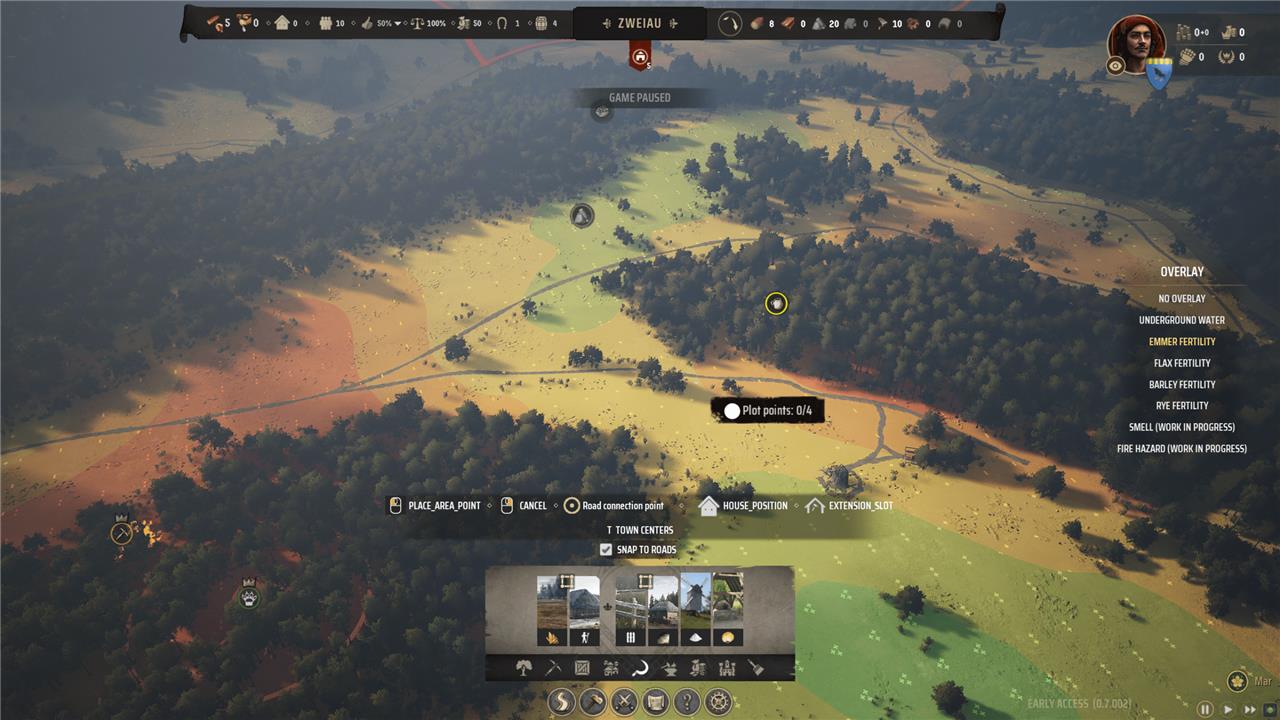
For farming, we’ll focus on emmer, flax, and barley fertility. The fertility the overlay is showing you is basically how much of a given crop that chunk of land will produce. Red means not much, yellow is average, and green is quite a bit.
Emmer (wheat) is what you’ll use to make bread, flax becomes linen for clothes, and barley can be turned into ale – all of which figure into upgrading your burgage plots and the settlement’s level.
Barley is (arguably) the most important crop, followed by emmer (wheat). Look for an area with at least yellow fertility that doesn’t overlap with other resources like wild animals or berry deposits.
Once you find one, we can start building fields.
Start with small fields
Starting with small fields in Manor Lords is crucial for efficient farm management and a successful harvest. While it might be tempting to lay out large plots immediately, smaller fields are much easier for your limited early workforce to handle, ensuring that each stage-plowing, sowing, growing, and harvesting-can be completed on time. If your fields are too large, your villagers may not finish the work before the seasons change, leading to reduced yields or even crop loss. By keeping your fields manageable, you give your farmers the best chance to fully tend to their crops, maximize output, and gradually expand as your settlement and labor force grow.
In the Construction menu, pick Farming and then choose a Field. This will let you place four points to define a plot of farmland.
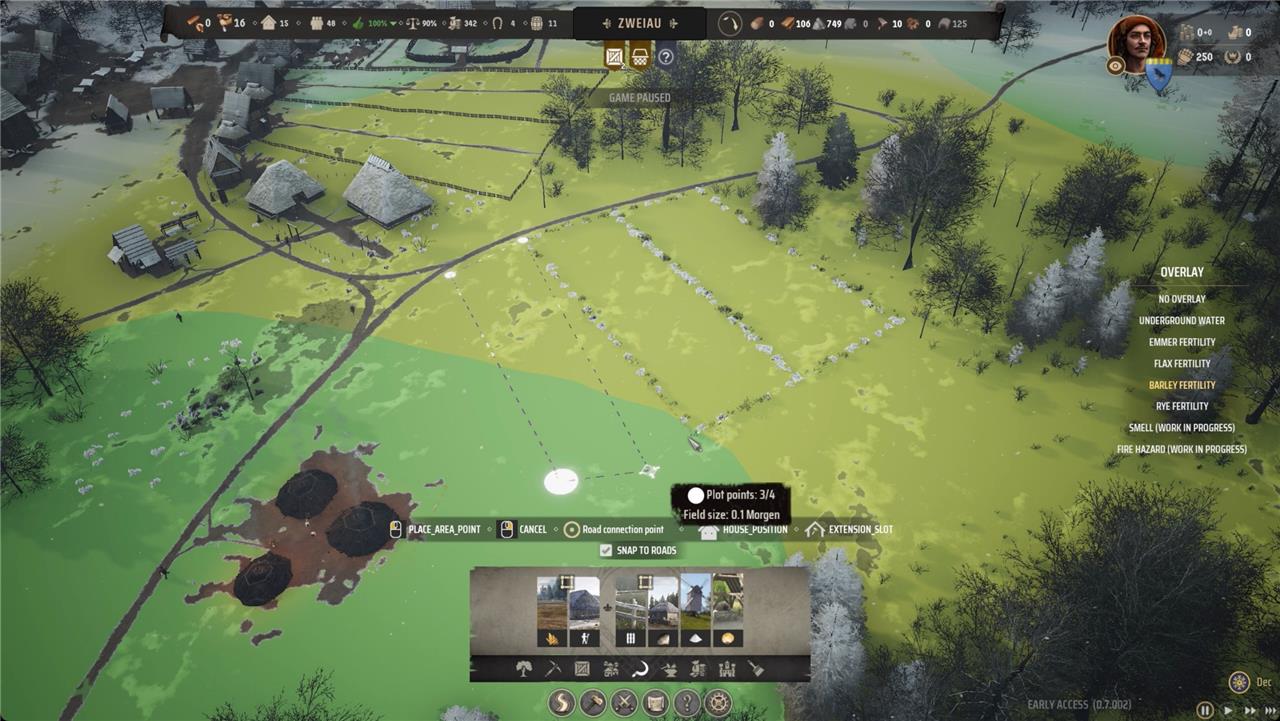
As you place your points, you’ll see the area of the plot measured in morgen. The specifics that particular unit of measurement aren’t worth getting into right now (and they’re confusing as hell). For our purposes, know that a single family working on a farm can manage – plow, plant, and harvest – about 2⁄3 morgen per year.
While the farm plots might look small, even just 0.6 morgen of wheat field grows enough wheat (to turn into grain to turn into flour to turn into bread) to feed a town of 100 people and still have a surplus.
When you’re ready to start farming, you’ll also need a farmhouse (3 timber). This is where you can assign a family to start working the fields. What they do, though, depends on the season.
Seasons determine what happens on a farm
In Manor Lords, the farming cycle is deeply influenced by the changing seasons, which dictate the key activities on the farm. Spring is the time for planting and tending to crops, allowing them to begin their growth. During summer, crops continue to mature and increase their yield. Autumn is critical as it marks the harvest season when crops are gathered, fields are plowed, and new seeds are sown to prepare for the next cycle. Winter halts all crop growth, causing any unharvested plants to die and leaving fields fallow until the next spring. Mastering this seasonal rhythm is essential for maximizing crop production and ensuring a steady food supply for your village.
What tasks your farm takes on depends on the season – there’s a bit of wiggle room on the dates, but the following is generally true.
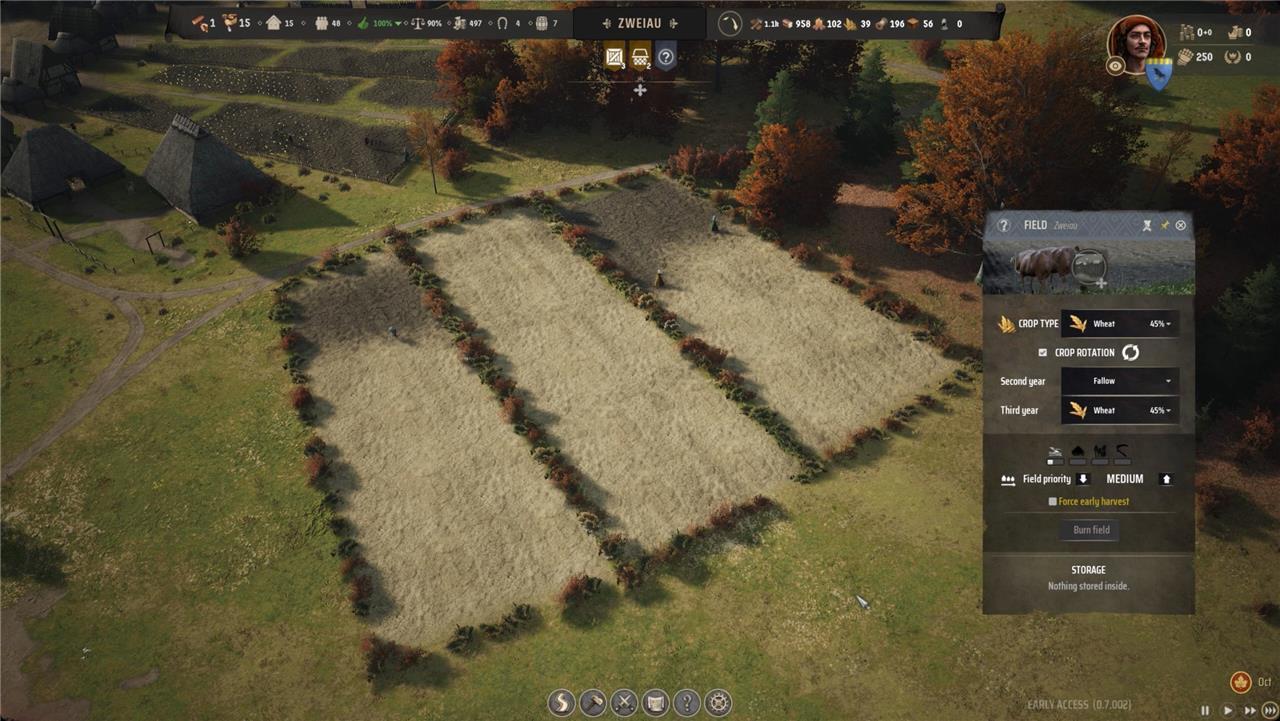
Starting in the autumn, the family assigned to a farm will look for a nearby field (basically any field in the region) and start to plow it. Plowing is followed by sowing, which also has to happen in autumn. If a field isn’t plowed and sowed by the time winter starts in December that field will be fallow for the year – you’ll also get a notification about it. Like we mentioned above, a family can harvest, plow, and sow about 0.6 morgen during a season.
For spring and summer, there’s nothing to do on the farm except watch the crops grow.
The following autumn, the family will harvest the crops, plow the fields, and then sow the next year’s crop. If the crop you just harvested was wheat (emmer), it’ll be taken to the farm where it’s threshed into grain.
Over time, planting the same crop over and over will reduce the fertility (and productivity) of a field. To avoid that, you’ve got a couple options, but the easiest is just to rotate your crops.
Rotate your crops to restore fertility
Rotating your crops is essential in Manor Lords to keep your fields fertile and your harvests reliable. Each time you grow the same crop on a field, it drains nutrients from the soil, gradually reducing its fertility and lowering future yields. To restore fertility, use the crop rotation system: alternate between different crops and leave fields fallow (unplanted) for a season. Letting a field rest allows the soil to recover its nutrients, boosting fertility for the next planting cycle. A common strategy is the three-field system-each year, plant two fields with different crops and leave the third fallow, then rotate their roles annually. This approach ensures you always have productive land, maintains soil health, and secures a steady food supply for your settlement.
When you click on a field, you’ll get a menu that allows you to pick what type of crop to grow the next year – wheat, flax, or barley. You also have the option to not grow anything at all and to let the field lie fallow. Setting a field to fallow for a year restores that field’s fertility.
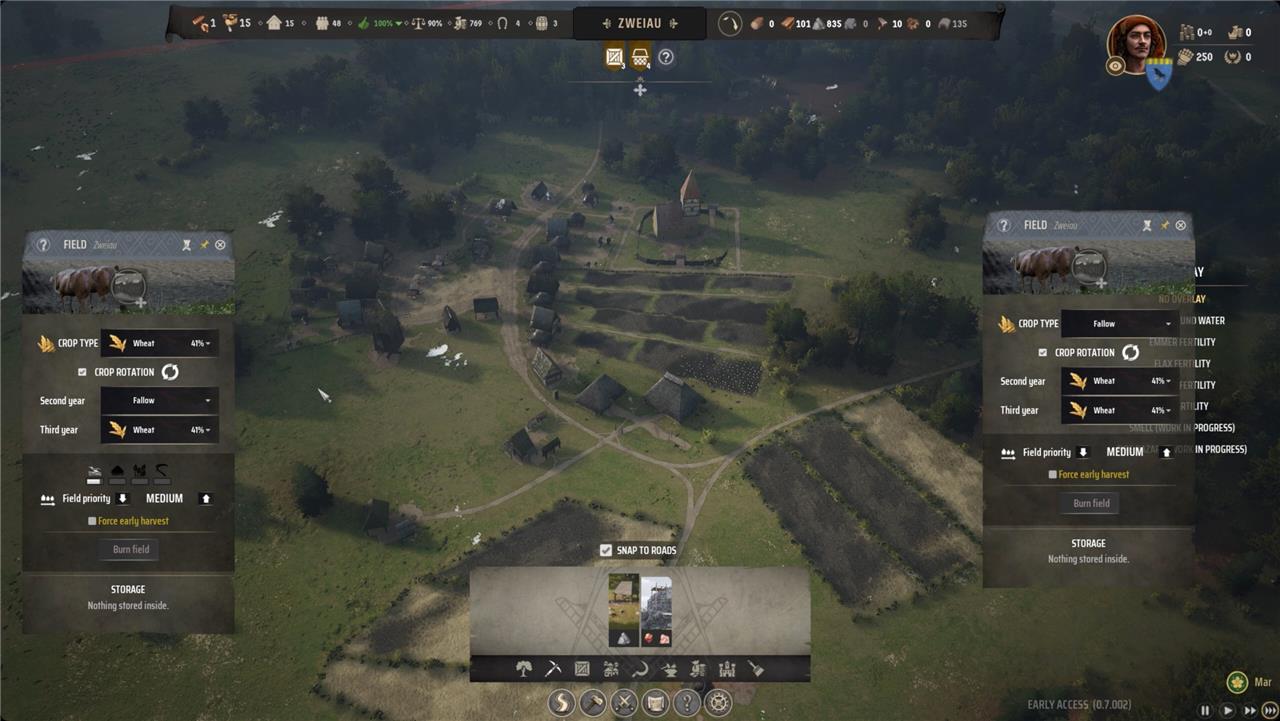
Setting a field to fallow means you won’t get any crops from that field for the (next) year, though. But, with a bit of planning, you can avoid that too. Instead of creating one big field, start your farm with three fields that are each (about) 0.3 morgen in size. When you open each field’s menu, click on the checkbox for crop rotation and then:
- Set the first field to wheat, wheat, fallow
- Set the second field to wheat, fallow, wheat
- Set the third field to fallow, wheat, wheat
This means that you’ll only ever have two fields with crops planted – for a total of 0.6 morgen worth of crops. That just so happens to be about how much a family can manage in a year. Meanwhile, you’ll always have one fallow field that’s resetting its fertility.
Unlock the heavy plow to farm faster
Unlocking the Heavy Plow in Manor Lords significantly enhances your farming efficiency by allowing you to assign an ox to your farmhouse. This upgrade installs a plowing station, enabling the ox to plow fields faster and transport harvested crops more efficiently. As a result, you can manage larger fields or more fields simultaneously, effectively doubling your farming capacity. For optimal use, shape your fields into long, thin stretches so the ox can plow in one continuous direction, minimizing time spent turning. Additionally, the Heavy Plow unlocks further farming developments like Fertilization and Bakeries, which help improve crop growth and processing.
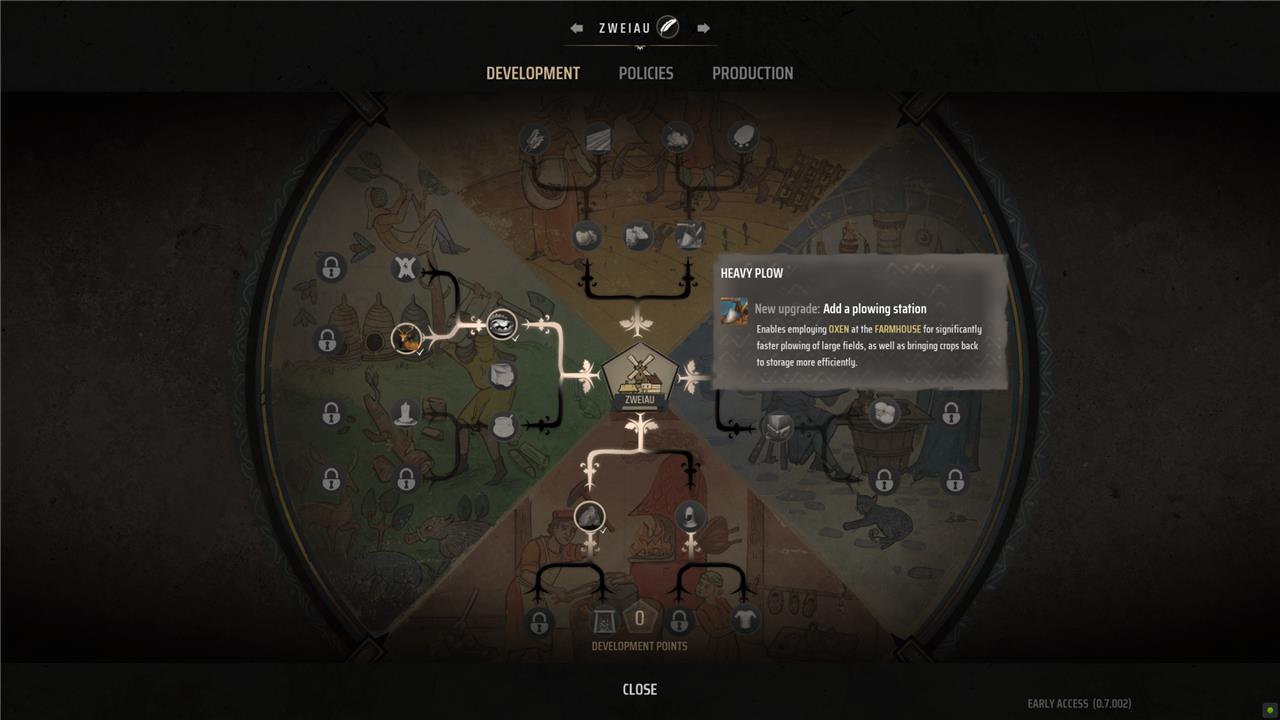
As you level up your town, you’ll earn development points that unlock new technologies for your town to use. One of the first you can get is the heavy plow. This lets you add a plowing station to your farm and use an oxen to plow and move crops. This increases the area a family can handle by quite a bit – to the point where you can basically double the size of your fields (or just have twice as many fields and crops).
How to use wheat, flax, and barley in Manor Lords
To use wheat, flax, and barley effectively in Manor Lords, start by selecting fertile land using the Construction menu’s fertility overlay, aiming for green or at least yellow fertility areas to maximize yield. Build farm fields by placing four points to define the plot size, keeping in mind that a single family can manage about two-thirds of a morgen per year. Plant your crops in autumn after plowing and sowing; wheat is primarily used for bread, flax for linen, and barley for malt and ale production. Rotate crops between fields and occasionally leave fields fallow to restore soil fertility, ensuring sustainable farming. Process harvested wheat into grain at the farm, then into flour at a windmill, and finally into bread at a communal oven. Flax is taken to a weaver workshop to produce linen, while barley is processed into malt at a malthouse and then brewed into ale at a brewery. Unlocking technologies like the heavy plow can increase your farming efficiency by expanding field sizes and workload capacity.
Each of the crops you grow don’t do anything for you in their raw form. They all have to be processed (at least once) before they’re usable.
- Wheat gets threshed at the farm and turned into grain. From there, you’ll need a windmill (4 timber) to turn it into flour and a communal oven (2 timber) to turn that flour into bread. At that point, it’ll get sold in the marketplace as food.
- Flax needs to be taken to a weaver workshop (4 timber) that will turn it into linen. Linen heads to the marketplace and satisfies your town’s need for clothing, but it can be processed further. A burgage plot (level 2) with an extension slot can be turned into a tailor’s workshop (5 Regional Wealth, 5 planks). That artisan workshop will make gambesons from just linen, but can also make clothes from linen and dye – which, in turn, comes from a dyer’s workshop (2 timber).
- Barley heads to a malthouse (4 timber) to become malt. From there, you’ll need a burgage plot (level 2) that’s been turned into a brewery to turn the malt into ale. Ale isn’t useful on its own, though, so you’ll also need a tavern (5 timber) with a family assigned to it so the ale gets distributed.
What are the most effective strategies for maximizing food production in Manor Lords
Most Effective Strategies for Maximizing Food Production in Manor Lords
-
Expand and Optimize Vegetable Plots: Large vegetable gardens are crucial as their size directly impacts yield. Players recommend maximizing the size of these plots and using crop rotation to maintain soil fertility and consistent harvests.
-
Supplement with Poultry and Apiaries: Adding chicken coops and apiaries (for honey) attached to homes increases food diversity and production. Apiaries especially benefit from having workers living nearby to maximize honey output.
-
Use Single-House Burgage Plots with Food Additions: Building single-house burgage plots rather than doubles allows more space for coops and vegetable patches per family, improving food output per household.
-
Employ Seasonal Workforce Management: Assign more workers to farming during planting and harvest seasons (spring and fall), then reduce farm labor in winter to optimize efficiency and resource use.
-
Focus on Key Crops Like Wheat and Apples: Wheat is essential for bread production, a staple food, while apples and berries provide supplementary nutrition and happiness boosts. Using the Heavy Plow and Orchard R policies enhances yields.
-
Manage Logistics and Storage Efficiently: Place granaries and pack stations close to food production sites to reduce transport time and prevent spoilage, ensuring food reaches your population swiftly.
-
Diversify Food Sources: Incorporate hunting, foraging (berries), and livestock to avoid over-reliance on a single food type. Trading between settlements can also help balance food surpluses and shortages.
-
Avoid Overexpansion: Expanding population and settlements too quickly can outpace food production. Build food infrastructure first and stabilize your village before rapid growth.
By combining these strategies-large, well-managed farms; diversified food sources; efficient logistics; and prudent population growth-you can sustain a thriving and well-fed medieval settlement in Manor Lords.
How can I best utilize trade to supplement my food production in Manor Lords
How to Best Utilize Trade to Supplement Food Production in Manor Lords
-
Build and Use Trading Posts: Establish trading posts early to enable imports and exports. You can sell surplus goods like planks, leather, or crafted items to earn gold, which can then be used to buy food items when your own production falls short.
-
Trade Between Your Own Settlements: If you have multiple settlements in different regions, trade food from areas with surplus to those with shortages. This internal trade is more cost-effective than importing from outside.
-
Unlock Trade Perks to Reduce Tariffs: Importing food can be very expensive due to tariffs. Acquiring the trade perk that removes or reduces tariffs will make food imports more affordable and efficient.
-
Set Trade Thresholds for Automated Imports: Use the trading post’s settings to automatically import essential foods like bread or grain when your stocks fall below a certain level. This helps avoid shortages without constant micromanagement.
-
Use Food Carts as Backup Food Sources: After unlocking the Foreign Suppliers perk, set up Food Carts in marketplaces to automatically buy and distribute food like bread. However, rely on them as a backup rather than your main food source because they can consume wealth quickly.
-
Prioritize Exporting High-Profit Goods: Focus on producing and exporting profitable goods such as planks, leather, or ale to generate steady income. This income funds your food imports and helps balance your economy.
-
Avoid Over-Reliance on Imports: While trade can supplement food production during tough seasons or growth phases, prioritize building a strong local food economy to reduce dependency on costly imports.
By combining efficient internal trade, strategic exports, tariff reduction perks, and automated import settings, you can effectively use trade to supplement and stabilize your food supply in Manor Lords.
