
Cyrus isn’t just another Supporter card in Pokémon TCG Pocket – he’s a ruthless game-changer who forces your opponent to bring their damaged Pokémon into the spotlight, turning their strategy against them. With the power to dictate which battered foe steps into the active position, Cyrus can dismantle even the strongest defenses and shift the meta in your favor. Whether paired with Darkrai ex or Magnezone, this cruel tactician is a vital addition for any deck aiming to dominate the competitive scene.
Cyrus is a super flexible card and has something to offer loads of decks. This Pokémon TCG Pocket guide explains why we think he’s a solid choice for so many looking to shake up their decks.
Why Cyrus is one of the best cards in Pokémon TCG Pocket
Cyrus is considered one of the best cards in Pokémon TCG Pocket because it offers a powerful and versatile disruption tool that can decisively shift the momentum of a match. By allowing players to switch one of the opponent’s damaged Benched Pokémon into the Active Spot, Cyrus exposes weakened targets that were previously protected, enabling easy knockouts and forcing opponents into unfavorable positions. Unlike similar cards, Cyrus gives the player the choice of which damaged Pokémon to bring forward, maximizing strategic advantage. This ability not only counters stall tactics but also synergizes well with high-damage Pokémon to finish battles efficiently. Its impact on the meta is so significant that Cyrus has become a staple in many competitive decks since its release in the Space-Time Smackdown expansion, often regarded as a game-changer and a must-have Supporter card for consistent success.
Cyrus’s card effect is pretty straightforward. Here is the verbatim description of what it does: “Switch in 1 of your opponent’s Benched Pokémon that has damage on it to the Active Spot.”
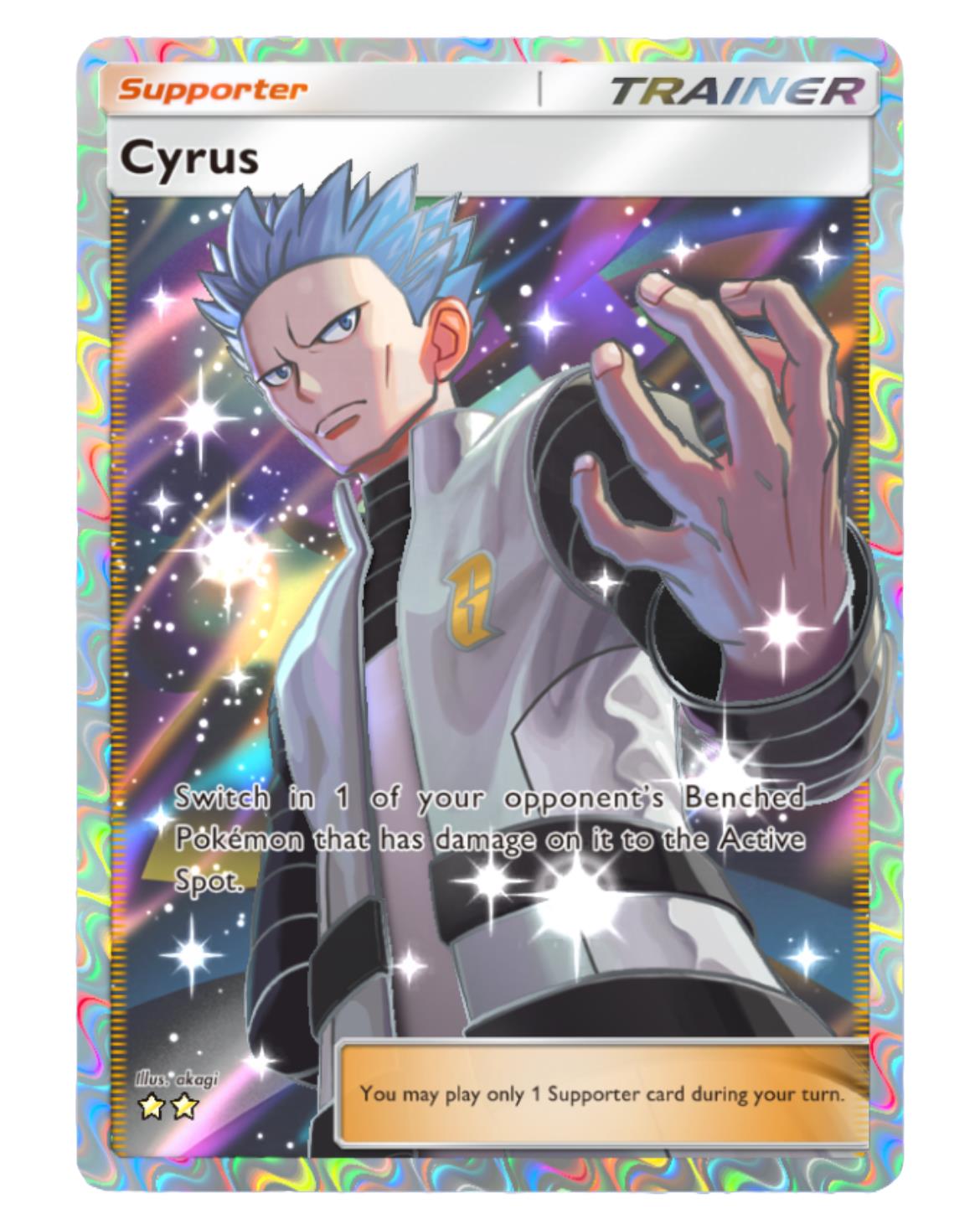
You can use Cyrus once per turn before you attack with your active Pokémon. When played, it allows you to pick a Pokémon with damage on it from your opponent’s bench and put it in the active spot. If your opponent has two or more Pokémon with damage on the bench, then you get to select which one to move to the active spot. It’s simple, but super powerful since it creates a game where you can’t save Pokémon from imminent elimination by bringing them back to the bench.
Of course, the bench hasn’t been “perfectly safe” for a while. Several existing cards – like Lumineon, Zebstrika, or Articunoex – can damage Pokémon on the bench directly. Lumineon’s Aqua Liner attack can do 50 damage directly to a bench Pokémon and Articuno ex’s Blizzard does 80 damage to the active Pokémon plus 10 damage to each benched Pokémon. Abilities like these aren’t to be taken lightly, but they’re a bit easier to counter on the bench since the damage output isn’t as high as a direct attack from another Pokémon. (I’ve saved Pokémon with healing cards like Potions and Erica before.)
In contrast, the Cyrus trainer card makes it impossible for people to tuck cards away onto their bench. You wanted to play a strong glass-canon type who can do damage and then sneak away? Too bad, Cyrus will drag them back out. You wanted to tank some damage and switch out as you prepare another Pokémon with energy? That’s also a no. Even stall decks that make use of Druddigon’s Rough Skin ability and the Rocky Helmet Tool Card also don’t fair well with Cyrus, since that strategy requires those Pokémon to take some hits to deal damage.
In the past, I’ve noted how great the Sabrina trainer card is. She can still be pretty useful in certain situations, but your opponent still gets to pick which Pokémon to switch in after you play it. Cyrus, on the hand, does not give a single shit. Just go grab any damaged Pokémon and finish em’ off. So if you’re looking for a trainer card to stuff your next deck with, I’d highly recommend Cyrus.
How does Cyrus’s ability to target damaged Pokémon change deck strategies
Cyrus’s ability to target and force damaged Pokémon from the opponent’s bench into the Active Spot fundamentally shifts deck strategies by enabling precise control over which weakened Pokémon your opponent must play next. This disrupts their game plan by exposing vulnerable targets for knockout, forcing opponents to use energy for costly retreats or lose key Pokémon. To maximize Cyrus’s impact, decks often include Pokémon and cards that spread damage across the opponent’s bench, such as Articuno ex or Palia ex, setting up multiple damaged targets to choose from. This synergy allows players to strategically pull out the most advantageous target for a decisive knockout, turning chip damage into game-winning opportunities. Additionally, Cyrus’s effect pressures opponents to carefully manage damage distribution and bench positioning, adding a layer of tactical complexity to matches. Unlike similar cards, Cyrus gives the player the choice of which damaged Pokémon to bring forward, making it a superior disruptor that can break through defensive setups and evolution strategies.
How does targeting damaged Pokémon influence my deck’s damage setup strategies
Targeting damaged Pokémon with Cyrus significantly influences your deck’s damage setup strategies by encouraging you to spread damage counters strategically across your opponent’s bench. This approach maximizes the number of viable damaged targets that Cyrus can force into the Active Spot, increasing your chances of knocking out weakened Pokémon efficiently. To achieve this, players often include Pokémon and attacks that apply consistent, low-to-moderate damage across multiple opponent Pokémon rather than focusing on a single target, setting up multiple damaged options for Cyrus to exploit. Cards that spread damage counters, such as those with attacks dealing small damage to all opponent’s Pokémon, become valuable as they create a broad field of vulnerable targets. This strategy forces opponents into difficult decisions about which damaged Pokémon to bring forward, often disrupting their defensive setups and energy management. Overall, your deck’s damage setup shifts from concentrating on one knockout to managing widespread damage to enable Cyrus’s ability to control the battlefield and capitalize on multiple weakened foes.
