
For decades, Sleeping Beauty has been dismissed as Disney’s prettiest but dullest fairy tale – yet those who accuse it of passivity or shallow storytelling are missing the subversive genius at its core, where the real heroes wear wings, not crowns.
Of all the Disney movies featuring passive female protagonists, Sleeping Beauty might be the most misunderstood. If you view it at face value – with Aurora, the titular Sleeping Beauty, as the center character – then Sleeping Beauty is a peculiar movie about a passive princess. Aurora drops out of her own movie halfway through, after being lured into a trap by a wicked fairy. She basically does nothing but sing sweetly, fall asleep, then get rescued. Almost every plot point in Sleeping Beauty is something that happens to her, not something she does.
As the three oldest Disney Princess movies, Sleeping Beauty, Cinderella, and Snow White and the Seven Dwarfs often get the brunt of modern criticism. None of these movies stray particularly far from their fairy-tale origins, which means the princesses in them don’t have much agency when compared to their modern counterparts. They have their own individual quirks, but modern princess protagonists just do more. As part of the Disney Princess brand, the older movies are routinely dismissed as being about women who wait around to be saved by princes, and who don’t actively take control of their stories.
A Century of Disney
Disney’s hundred-year legacy is a study in how storytelling shapes culture as much as it reflects it. Sleeping Beauty, released in 1959, distills that long history of artistic ambition and moral simplicity into a single, luminous frame. Behind Aurora’s stillness and the fairies’ quarrels lies Disney’s belief in beauty as order-every color, gesture, and melody working with precision. The film’s critics often miss how its fairy godmothers carry the narrative’s real weight, guiding fate with humor, grace, and quiet authority. In a century of Disney mythmaking, their small acts of care define what heroism truly means.
We’re deconstructing the monolith all year long
Read more
But when it comes to Sleeping Beauty, that description actually isn’t accurate at all. We just need to remember who the movie is actually about. Even though Aurora is a certified Disney Princess, she isn’t the main character. Neither is Phillip, the dashing prince who swoops in to save her. The main characters are actually her three fairy godmothers, Flora, Fauna, and Merryweather.
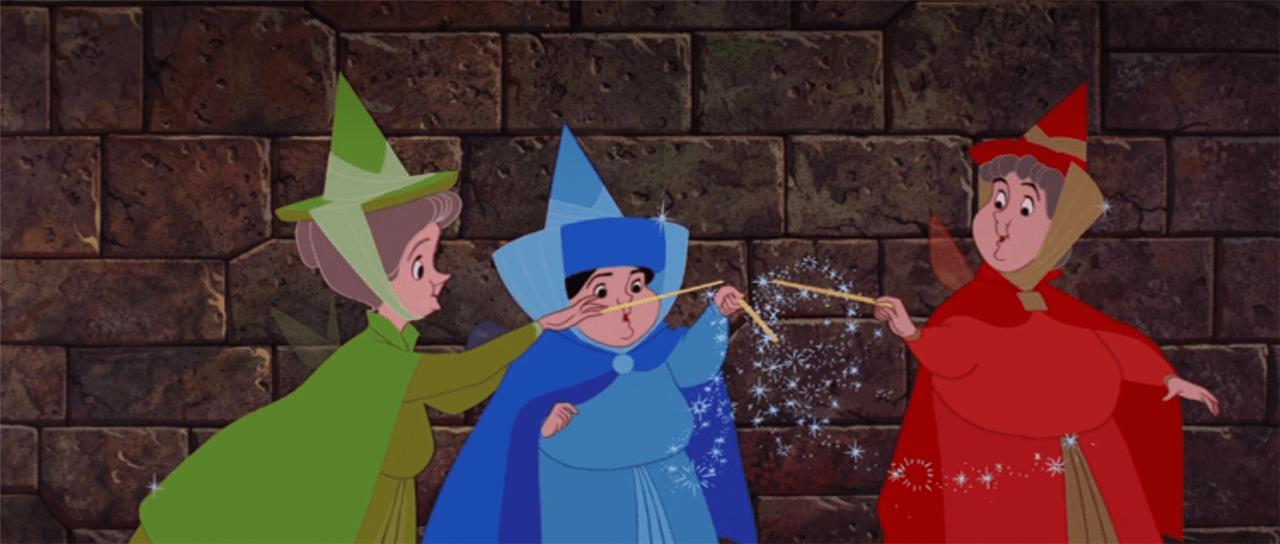
Amid all the hullabaloo about the Disney Princess brand, it’s easy to forget that. The three fairies are the ones who volunteer to protect the princess, and ultimately, they’re the ones who have to figure out how to foil the dark fairy Maleficent, who wants revenge on Aurora’s family because she wasn’t invited to Aurora’s christening. Defeating the big bad villain is usually the hero’s job. Aurora plays virtually no part in that.
The movie devotes a great deal of screen time to Flora, Fauna, and Merryweather’s adventures. They have distinct personalities: Flora is a bit bossy and overbearing; Fauna is emotional and sentimental; Merryweather is grumpy and stubborn. They struggle with raising a teenage ward. They process the grief of surrendering her to her parents after treating her like a daughter for so long. Eventually, they have to face the worst-case scenario when the fate they’ve been protecting her from does happen. But they bounce back, figuring out how to implement the failsafe they concocted years ago, which involves busting a prince out of a dungeon and using him to fight the dragon.
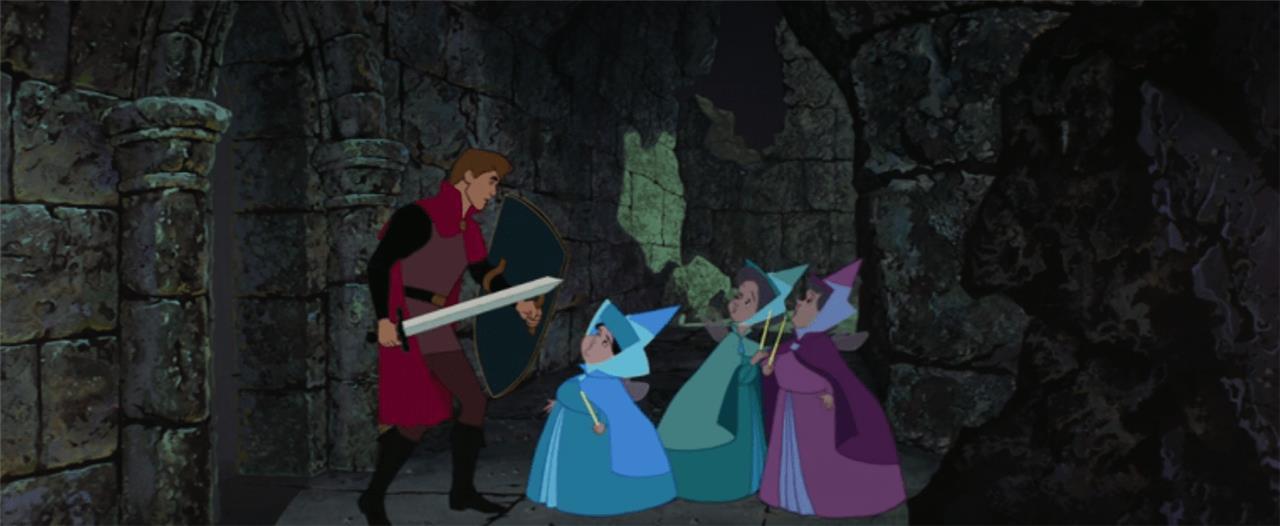
Phillip fans (if they actually exist) could certainly argue that they’re just supporting his hero story. But consider two big points: One, the fairies have far more screen time, and more personal motivation to save Aurora. And two, for the latter half of the movie, Phillip doesn’t even talk. Both he and Aurora are silent characters after she pricks her finger and collapses. All the discussion comes from the three fairies as they scheme to save the kingdom.
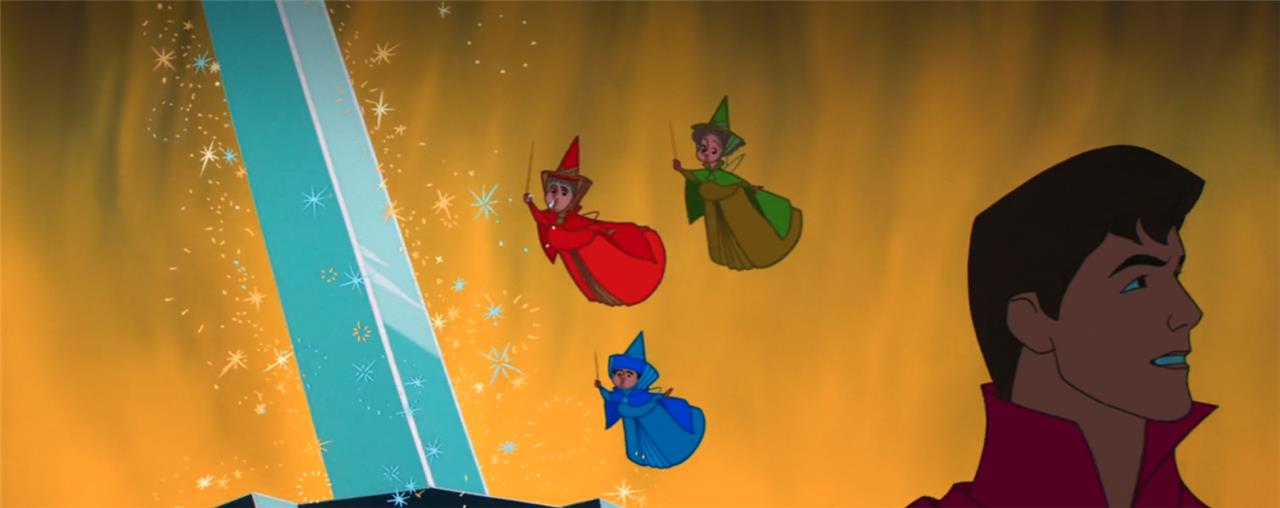
Unlike other Disney matriarchs, who briefly step in to offer worldly advice (like Pocahontas‘ Grandmother Willow) or to wave their magic wands and solve problems (like the Fairy Godmother in Cinderella), the three fairies stick around in the story, fighting the good fight every step of the way. Even though they’re technically waving their wands to get Phillip out of jail, he’s simply the means to their end. He is their avatar, providing them with the physical capabilities to storm the castle. Unlike most hero-enabler characters, they don’t disappear after freeing him. While Phillip slashes through a wall of thorny briars, they’re the ones actually dispelling Maleficent’s spells and clearing the obstacles. Phillip stabs the dragon, but they literally guide his sword to pierce its heart.
Disney heroines – particularly the princesses – face the burden of rapidly evolving audience expectations when it comes to fulfilling arcs for young women. Characters like Ariel and Belle were once considered progressive solely because they made their own choices, putting them steps ahead of their earlier Disney counterparts. When their films first debuted, they were praised as active agents in their own stories, unapologetically going after what they wanted.
But a decade or so later, many people criticized their stories for being romantically focused, with the characters throwing their dreams aside for men. Storylines that were groundbreaking in one time period don’t necessarily carry the same weight in the next generation. Looking back through modern lenses, these older movies understandably don’t hold up. But sometimes they get a lot of flak for problems that don’t actually exist, simply because we’re looking back on them in the wrong way.
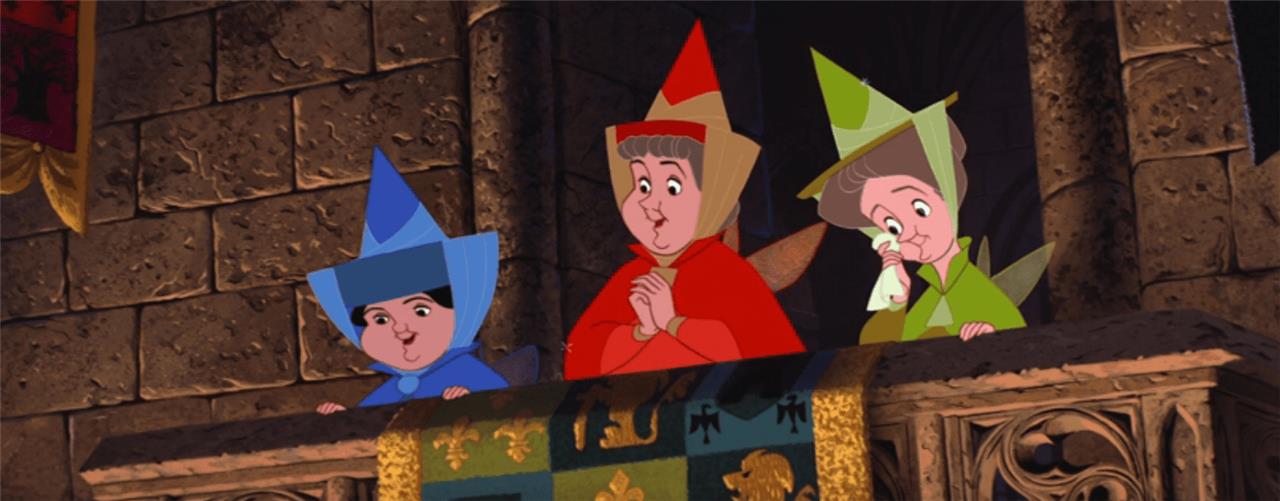
With Sleeping Beauty, we simply need to recalibrate our expectations for what makes a main character. Here, it isn’t the young woman, nor is it the young man. It’s the three older women. Through this lens, not only is Sleeping Beauty surprisingly groundbreaking in terms of women’s roles, it also gives the fairy tale an oddly modern edge.
It’s popular now to reimagine fairy talesthrough different angles, like Enchanted‘s playful dismantling of Disney movie tropes, or every modern update of Cinderella that attempts to flesh out the folk tale’s original heroine, to varying degrees of success. 2014’s Maleficent put a spin on Sleeping Beauty by telling the story from the villain’s point of view, but Sleeping Beauty itself already strayed from typical fairy-tale conventions.
After all, Aurora is on most of the merchandise, but the real stars of Sleeping Beauty are three older women, all with distinct personalities, who quibble about the best way to enact their plans, but are immensely capable at magic, and save not only a princess, but a whole dang kingdom. Forget about 1959; that’s rare to see in 2023.
How does Sleeping Beauty differ from original Perrault fairy tale
Disney’s Sleeping Beauty adapts Charles Perrault’s 1697 tale “The Sleeping Beauty in the Wood” but makes key changes for cinematic pacing and family appeal.
Plot Timeline
Perrault’s story spans over a century explicitly: the princess pricks her hand (not finger) at age 15 or 16, sleeps for 100 years while the castle is overgrown by trees (not thorns), and awakens when a prince-foretold in her dreams-simply kneels beside her, with no kiss required. Disney compresses this to one day around Aurora’s 16th birthday, has her prick her finger, and ends the curse via Prince Philip’s true love’s kiss after he battles Maleficent.
Fairies and Curse
Perrault features eight fairies at the christening-seven good ones granting beauty, wit, grace, dance, singing, and music, overlooked only because the eighth (forgotten, not snubbed for lack of gold plate) is presumed dead and curses out of resentment. Disney reduces this to three good fairies (Flora, Fauna, Merryweather) gifting beauty, song, and grace (with the third preempted), plus the iconic Maleficent as a dramatic, dragon-transforming villain who actively pursues the curse.
Aftermath and Ending
Perrault adds a dark second act post-wedding: the prince hides his ogre-mother-in-law queen, who craves human flesh and tries to eat the princess and her children (two born during sleep), before dying in a trap-ending with a moral poem, no “happily ever after.” Disney omits this entirely, focusing on romance, heroism, and a tidy fairy-tale close without cannibalism or extended family drama.
How does Disney version compare to Brothers Grimm Briar Rose
Disney’s Sleeping Beauty draws from both Perrault and the Brothers Grimm’s “Briar Rose” but alters the Grimm version significantly for drama and brevity.
Core Plot Differences
Grimm’s tale features 12 good fairies (plus a 13th overlooked one who curses the princess to prick her finger and die, softened to 100 years’ sleep), with the full century elapsing as briars engulf the castle, impaling prior princes who tried to enter. Disney shortens this to one night, uses three bickering good fairies versus the menacing Maleficent (no direct Grimm equivalent), and has Prince Philip hack through thorns after fairies arm him, defeating her dragon form-absent in Grimm, where the prince simply enters as briars part magically.
Awakening and Romance
In Grimm’s “Briar Rose,” the prince stumbles upon the sleeping castle, kisses the princess coincidentally as the 100 years end (no true love magic), and they wed immediately with twins already born-no prior meeting or courtship. Disney introduces Philip and Aurora’s childhood encounter, builds romance via song, and makes the kiss the curse-breaker after his heroic quest, emphasizing “true love’s kiss.”
Tone and Details
Grimm lacks Disney’s villains, songs, humor, or action spectacle, ending abruptly post-wedding without Perrault’s cannibalistic sequel but darker than Disney’s triumphant close; prior princes die gruesomely, underscoring fate’s inevitability. Disney nods to Grimm by naming disguised Aurora “Briar Rose” and amps visuals with medieval art styles, but prioritizes fairy agency and romance over Grimm’s fatalism.
