
In the relentless world of Monster Hunter Wilds, survival hinges on mastering the art of potion crafting-your lifeline amid ferocious monster battles. Whether you’re a seasoned hunter or just stepping into the wilds, knowing how to efficiently craft and wield potions can turn the tide of any hunt, keeping you alive when every second counts. Dive into our guide to uncover the secrets of potion-making, from gathering simple herbs to concocting powerful Max Potions, and learn how to use them seamlessly across PC, PlayStation, and Xbox platforms to dominate the wilderness.
This Monster Hunter Wilds guide serves as a comprehensive explainer on how to use potions and other healing items, including all the details you need about how to craft potions.
How to find herbs in Monster Hunter Wilds
To find herbs in Monster Hunter Wilds, explore various regions such as the Windward Plains, Scarlet Forest, Oilwell Basin, Iceshard Cliffs, and the Ruins of Wyveria where herbs commonly grow as green leafy plants highlighted with a green glow. Early in the game, you can easily spot herbs near the entrance of the Windward Plains Base Camp. Use the map to locate herb icons and set waypoints to have your Seikret mount automatically guide you to these spots. Additionally, after reaching Chapter 4 and High Rank, you can use the Village Intermediary NPC named Nata to retrieve herbs without traveling extensively. Herbs are a primary ingredient for crafting potions and are essential for healing during hunts.
Handily, you need very little to make the standard potion. The crafting recipe to make one potion is one herb.
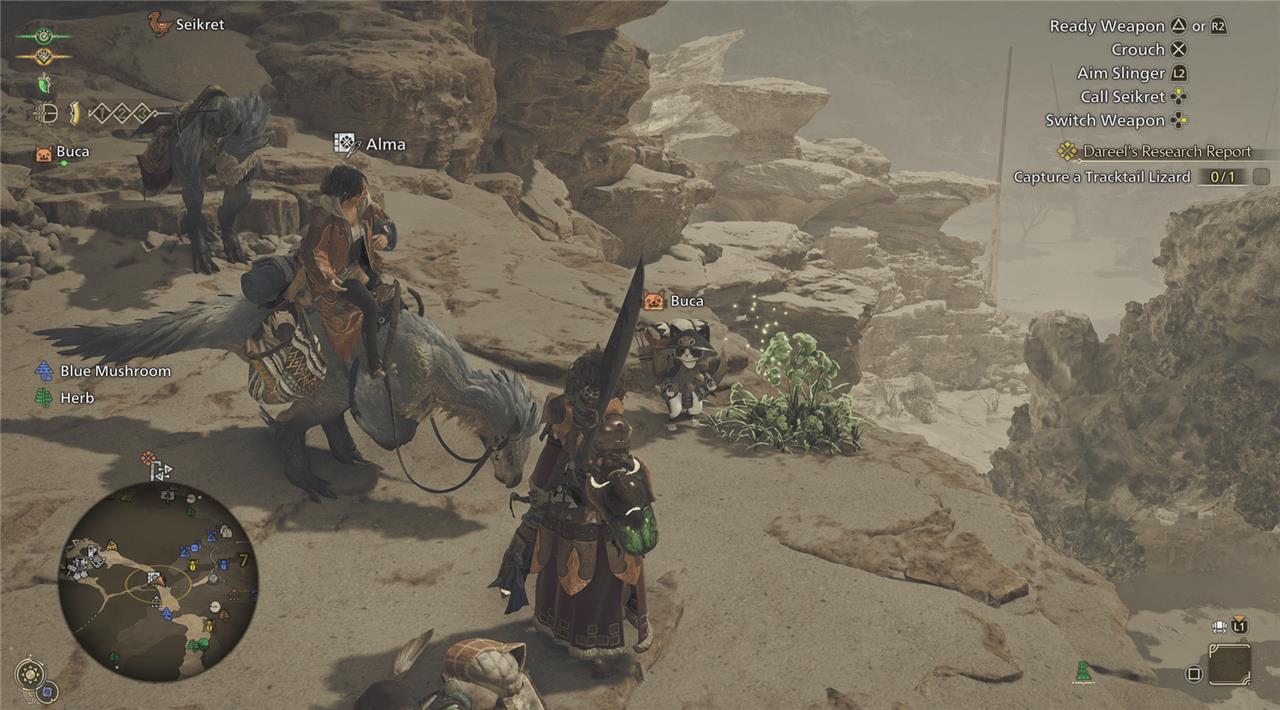
In the early game, you can find herbs scattered around Windward Plains. There is an herb plant just outside theWindward Plains base camp by the camp exit, for example.
Herbs look like a leafy plant that grows on the ground and are highlighted in green light. You will likely find loads of herbs by collecting plants as you explore various regions, however, you can use your map to find more.
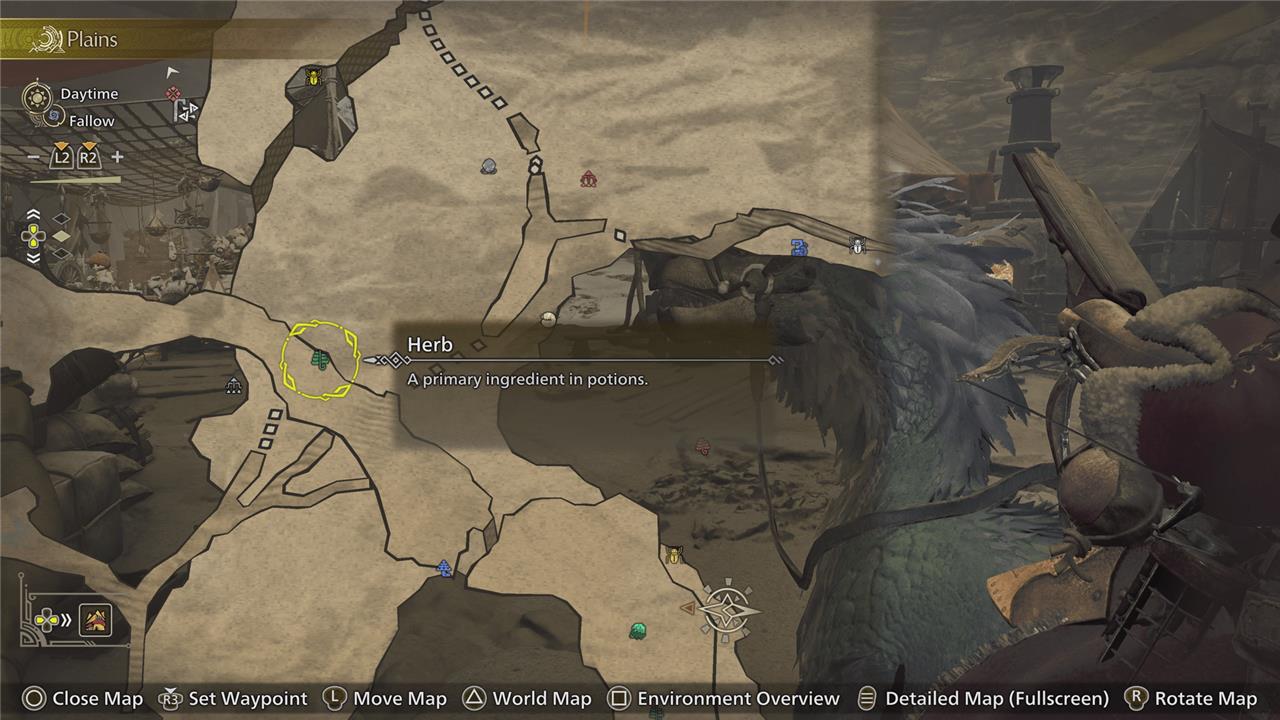
To find herbs, scan the map for icons that look like tiny plants. Some of the plant icons mark resources like ivy and other plants, though, so double-check your map to make sure that it’s actually an herb before trekking there.
If you have trouble navigating to any point of the map, press down the right control stick to mark it with a “Waypoint” and your Seikret will automatically run to it after you close the map.
How to craft potions in Monster Hunter Wilds
Crafting potions in Monster Hunter Wilds is straightforward and essential for survival during intense monster battles. To craft a basic potion, you only need to collect herbs, which are commonly found in areas like Windward Plains near base camps. Once you have herbs, open the start menu, select the ’Crafting List,’ choose the potion recipe, and craft it. The game also features an auto-crafting system that automatically creates potions when you gather the required materials, but you can manually craft potions anytime via the crafting menu. Besides basic potions, you can craft more advanced healing items like Mega Potions and Max Potions by combining specific ingredients such as honey, bitterbug broth, and mandragoras. Crafting at camps allows you to use all stored ingredients, while crafting in the field limits you to your current inventory. Managing your potion stock is vital, as you can carry a maximum of ten potions at once.
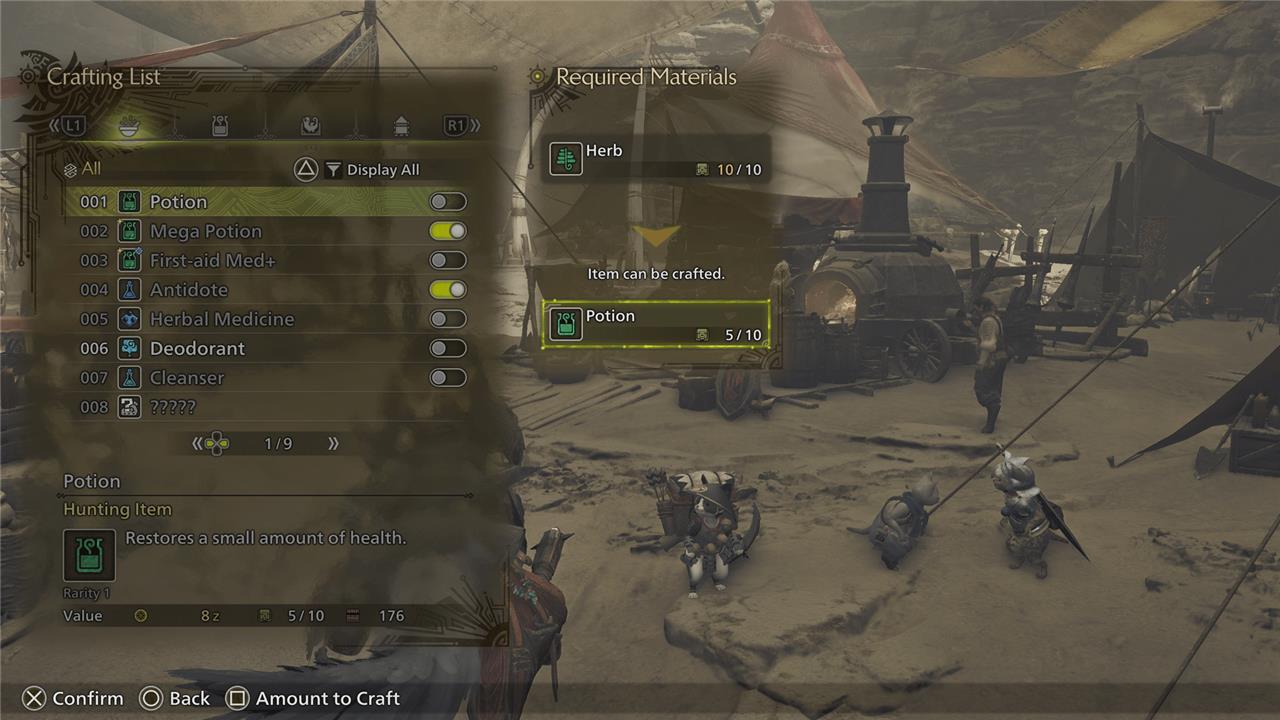
Monster Hunt Wilds uses an auto-crafting system where the game automatically creates certain items when you collect the necessary materials while exploring the world. The default game settings are set so that it will automatically craft potions and mega potions. In other words, if you don’t do anything, the game will immediately create potions when you collect the appropriate materials. Nice!
However, you can also manually craft potions and some other healing items. Here is how to do it:
- Open the “Items and Equipment” menu.
- The top option highlighted under this sub-section says “Crafting List.” Select it.
- This will prompt a menu that contains a full list of craftable items. The first item at the top of the list is the potion. Select it and press the button again to craft it.
- You now have a potion!
If it doesn’t work, check how many potions you have in your Item Pouch. The game won’t let you carry more than ten potions at a time so it won’t let you make more if you hit the max already. (You also just might be out of herbs as well.)
The previous steps apply to crafting other healing items, like mega potions and First-Aid Med as well. You just need different materials to craft each item. In addition to crafting, you also purchase potions from the Provisions Stockpile at any base camp for 66z each.
How to use potions in Monster Hunter Wilds
In Monster Hunter Wilds, using potions is straightforward and essential for survival during hunts. To use a potion, first ensure you have one in your item pouch. You can then access it through the item bar by holding the appropriate button (L1 on PlayStation, LB on Xbox, or mouse wheel on PC) and scrolling to the potion, then pressing the use button (Square on PlayStation, X on Xbox, or E on PC). Alternatively, you can use the Radial Menu to select the “Optimal Health Recovery” option, which automatically uses either a Potion or Mega Potion depending on your health loss. Potions can be crafted manually via the Crafting List in the menu or set to auto-craft when you gather the necessary materials, making it easy to maintain a steady supply during your adventures.
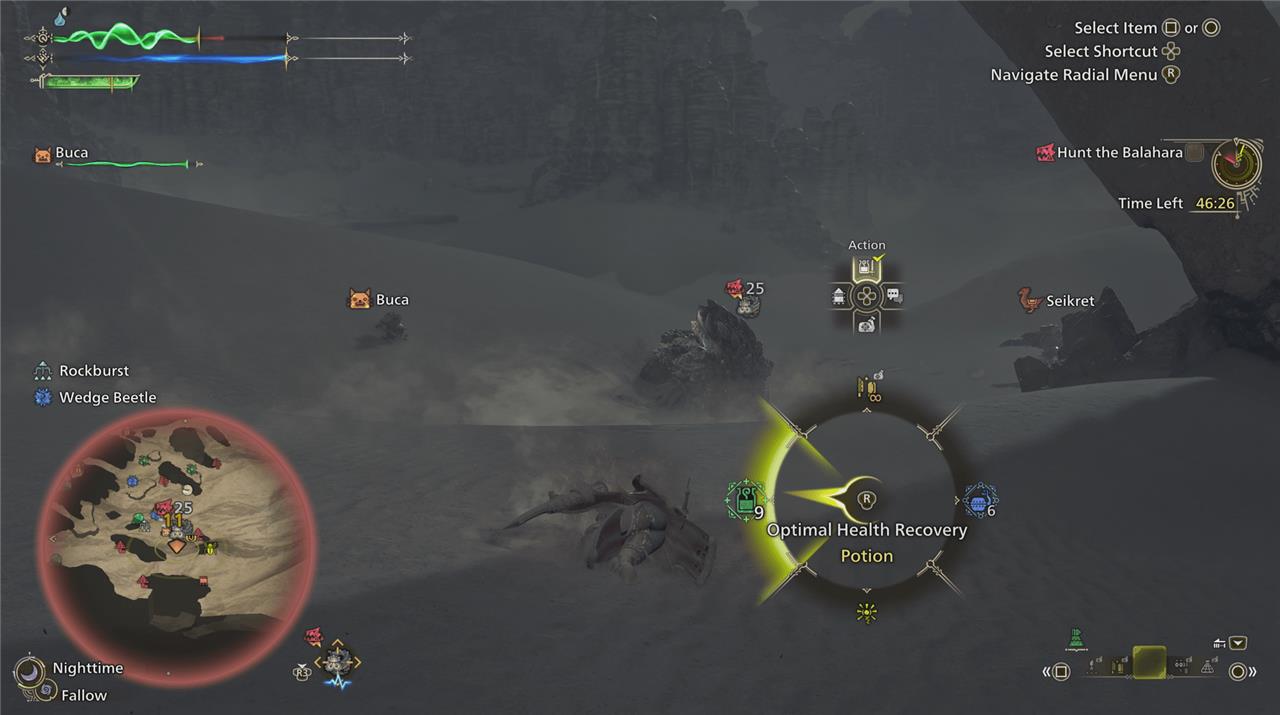
You have a couple of options that will allow you to heal and use potions while in the middle of combat. The first is the “Optimal Heal” option. Here is how to use the Optimal Heal to use potions and other healing items:
- Hold L1 to bring up the radial menu.
- As you continue to hold L1, push the right thumbstick to the left. This will navigate the cursor on the circular menu so that it highlights the option “Optimal Health Recovery.”
- Let go of the right control stick and your character will use the selected healing item, like a potion.
If your character didn’t heal, it’s possible you were interrupted. The radial menu doesn’t pause gameplay so the fight continues in the background. If a monster attacks you as you are trying to heal, it doesn’t work. You’ll know the potion or other healing item worked when your character glows green and your green health bar increases.
The “Optimal Heal” option on the radial menu appears to use the healing item that best corresponds with the amount of damage you need to heal. (AELGAMES tried to test this, but it ended up using regular potions each time, so we couldn’t verify which conditions prompted the use of which items.)
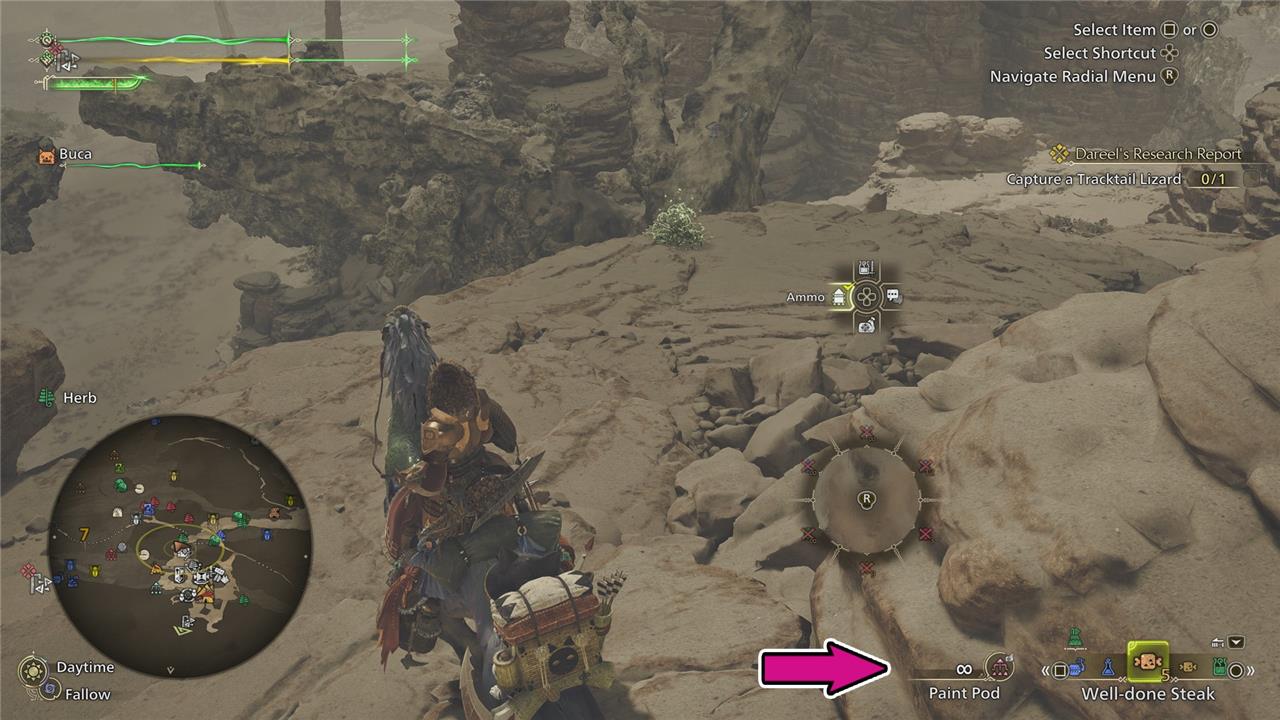
If you would like to select each healing item you use individually or use other healing items like a well-done steak (if you’ve cooked one), there’s another way to do it. Here is how:
- Hold L1. This will bring up the radial menu, but you are actually going to ignore it. Instead, look toward the bottom right-hand corner of the screen.
- As you hold L1, press the Square or Circle buttons (on PS5) to scroll through items in your Item Pouch. Keep pressing either option until you find the item you would like to use. (We used a well-done steak in the example above.)
- Once it highlights the correct option, let go of L1.
- Now that item is registered to the Square button. Press the Square button to use the item you chose. Your character will use said item and heal if you registered a healing item.
What secret herbs can boost potion crafting in Wilds
Several herbs and materials can significantly boost potion crafting in Monster Hunter Wilds:
-
Herb A primary ingredient for crafting basic potions, found in areas like Windward Plains.
-
Honey Combining honey with a potion creates a more potent Mega Potion, offering enhanced healing benefits. It can also be combined with Nitroshroom to make Energy Drinks or Bitterbug Broth for a Catalyst.
-
Bitterbug Broth Used to craft Catalysts, Immunizers, and Deodorants.
-
Blue Mushroom When mixed with Antidote, it makes Herbal Medicine, and with Godbug Essence, it makes Lifepowder.
-
Mandragora Needed along with a Catalyst to craft Max Potions and with Bitterbug Broth to create Immunizers.
-
Godbug Essence It can be combined with several items, such as a Fire Herb for Cleanser or a Might Seed for Demon Powder.
-
Nourishing Extract Used in combination with Armorskin for Mega Armorskin, with Demon Drug for Mega Demondrug, and with Immunizer for Ancient Potion.
-
Might Seed When used with a Catalyst, it makes Demon Drug, and when mixed with Godbug Essence, it makes Demon Powder.
-
Adamant Seed It can be combined with a Catalyst for Armorskin or with Godbug Essence for Hardshell Powder.
-
Dash Extract Used with a Catalyst to make Dash Juice.
-
Hot Pepper Use to make a Hot Drink.
-
Chillshroom Use to make a Cool Drink.
-
Smokenut Used with Bitterbug Broth to make Deodorant, and with Exciteshroom to make Farcaster.
-
Exciteshroom Combine with Smokenut to craft Farcaster.
-
Gloamgrass Bud Used with Godbug Essence to make Dust of Life.
Are there secret herbs that can enhance potion effects in Wilds
In Monster Hunter Wilds, certain rare or special herbs and materials can enhance potion effects, effectively boosting their potency or adding beneficial secondary effects. While the game does not explicitly label these as “secret herbs,” some ingredients are known to amplify or improve crafted potions:
-
Some crafting materials obtained from large monsters or rare plants can amplify the effects of medicines and potions, such as Parashroom, which induces special effects when used in crafting.
-
Combining honey with potions creates Mega Potions, which heal more than regular potions, effectively enhancing the healing effect.
-
Other materials like Bitterbug Broth, Godbug Essence, and Mandragora are used to craft advanced potions like Max Potions, Immunizers, and Lifepowder, which provide stronger or additional effects beyond basic healing.
-
While no explicitly “secret” herbs are detailed in Monster Hunter Wilds, exploring rare gathering spots for uncommon herbs and monster parts will yield ingredients that enhance your potion crafting and usage.
Thus, the key to boosting potion effects lies in finding and using these rarer ingredients alongside basic herbs to craft more powerful consumables.
