
Dolly Parton’s timeless voice once again stole the spotlight in 2023 with the year’s most unforgettable needle-drop: her poignant rendition of “I Will Always Love You” playing over the closing scene of Sofia Coppola’s Priscilla. This perfect musical moment not only captured the bittersweet farewell of Priscilla Presley leaving Graceland but also reminded us why Dolly’s songs remain cinematic gold, resonating deeply across generations and stories alike.
Sofia Coppola is an immaculate stylist, tastemaker, and music fan whose movies are known for their impeccably curated soundtracks. She’s responsible for some of the great needle-drops of the 21st century: Think of the numbed, aching romance of The Jesus and Mary Chain’s “Just Like Honey” at the end of Lost in Translation, or the punky frivolity of Bow Wow Wow’s “I Want Candy” scoring the shopping spree in Marie Antoinette.
No director is better suited for the challenge of putting together a soundtrack for an Elvis movie without having the rights to use any Elvis songs. Sure enough, the soundtrack to her Priscilla Presley biopic, Priscilla, is cunning and gorgeous. It mixes period (or period-ish) hits with anachronistic, moody indie to conjure both the rockin’ decadence associated with Elvis and an appropriate atmosphere – somewhere between wistful and stifling – for a movie about a young woman imprisoned by a dream come true. The woozy stomp of the Ramones’ cover of “Baby, I Love You” that opens the movie sets the tone perfectly.
But Coppola saves the very best for last, even though the song in question sadly isn’t included on the official soundtrack album. At the end of the movie [Ed. note: Historical spoilers ahead!], Priscilla summons the self-possession to leave the controlling, self-absorbed Elvis, and Coppola shows her driving out through the gates of Graceland, their daughter, Lisa Marie, in the back seat. The tune Coppola sets this scene to could not be more perfect: Dolly Parton’s original 1974 recording of her immortal breakup song, “I Will Always Love You.”
It’s an exquisite choice that works on multiple levels, and it has even more resonance when you know some of the song’s backstory. Taken purely at face value, “I Will Always Love You” could scarcely be more appropriate. It’s a beautiful song, with a lovely, keening vocal from Parton. It’s sentimental, sorrowful but affirming, lyrically right on the button, and period-appropriate, give or take a couple of years. It’s the sound of a woman kindly but firmly drawing a line marking the end of a relationship with a mixture of regret, steely resolve, and not entirely convincing self-effacement (“If I should stay / I would only be in your way [.] So goodbye, please don’t cry / We both know that I’m not what you need”).
But this song also has a history with Elvis. Parton often mentions in interviews that Elvis loved “I Will Always Love You,” and once asked if he could record it. (It’s easy to imagine how magnificently theatrical it might have been in Elvis’ hands during his 1970s Vegas pomp period – the Elvis of “Suspicious Minds” and “Always on My Mind.”) But Elvis’ grasping manager Colonel Tom Parker demanded “at least half” of the publishing rights on the song in return. (And he made that demand as they were in the studio, ready to record it!) Parton, always a canny financial manager, refused. She got the last laugh when Whitney Houston recorded her barnstorming power-ballad version in 1992 for the movie The Bodyguard. Houston’s recording became an evergreen global smash, earning Parton a fortune in royalties.
In that context, the very existence of the song, not to mention Coppola’s use of it in the movie, is a feminist middle finger to the apparatus that surrounded Elvis and sought to control everything in his orbit – including Priscilla herself, who the film shows being groomed as a potential girlfriend for the star from the painfully young age of 14.
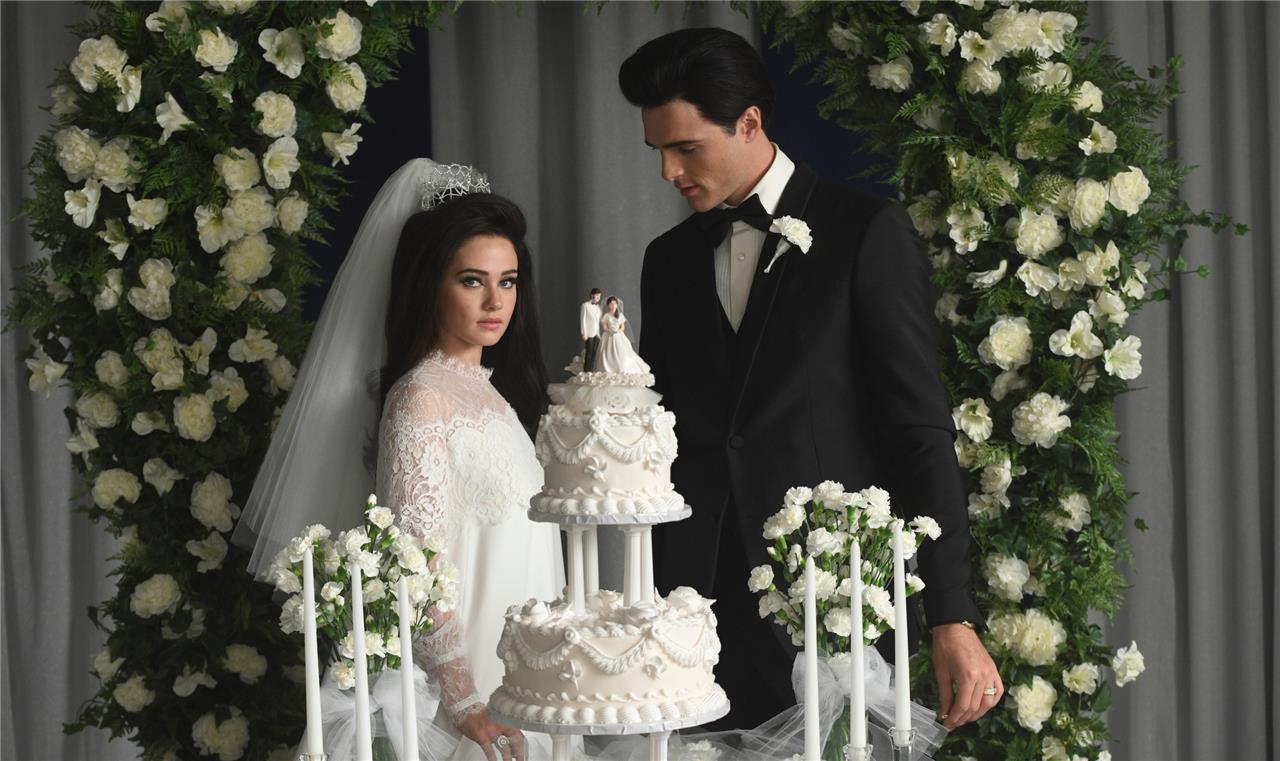
According to Parton, the song was personal to Elvis and Priscilla, too. She recently told the BBC: “I talked to Priscilla not very long ago. She said, ’You know, Elvis sang that song to me when we were walking down the courthouse steps when we got divorced.’” It’s a striking image.
Aside from its connection to Elvis, there’s one final layer to “I Will Always Love You” that resonates even more deeply with Priscilla. Parton wrote the song not about the end of a romantic relationship, but about the termination of her professional partnership with Porter Wagoner, a paternalistic older country singer who made Dolly famous by featuring her on his TV show, after which they became popular as a duo. According to legend, Parton announced her decision to go solo to Wagoner by singing the freshly minted song to his face in his office, which must have been devastating.
“I Will Always Love You,” then, is more than just a breakup song. It’s a woman’s announcement that she intends to be by herself and control her own destiny – a statement that, in Parton’s case, now echoes with five decades’ worth of hard-won proof. By playing the song at the end of her movie, Coppola brings all that significance and history, all that heartache and pride to bear on Priscilla Presley’s strange, sad, but ultimately hopeful story.
Priscilla is streaming on Max and is available for premium rental or purchase from Amazon, Vudu, and other digital retailers.
5 more great needle-drops from 2023
Here are five more standout needle-drops from 2023 that elevated their scenes with perfect musical choices. In M3GAN, David Guetta and Sia’s “Titanium” underscored a chilling yet danceable moment that captured the film’s eerie energy. Bottoms featured Charli XCX’s “party 4 u,” adding a vibrant pop edge to its youthful chaos. The film BlackBerry used Joy Division’s “Love Will Tear Us Apart” to cleverly portray a key character’s emotional turmoil. Theater Camp brought Lil Nas X’s “Montero (Call Me By Your Name)” into a heartfelt, theatrical context that resonated with many. Lastly, Yellowjackets season 2 closed its premiere with Tori Amos’ “Cornflake Girl,” a haunting track that perfectly set the tone for a story steeped in betrayal.
Radiohead’s “Everything in Its Right Place” in The Creator
Sometimes, a great needle-drop is just about hearing a cool song played really loud on a massive sound system over epic imagery.
Kavita Krishnamurthy and KK’s “Maar Daala” in Polite Society
This Bollywood banger, from the 2002 movie Devdas, inspires an awesome dance sequence in Nida Manzoor’s comic martial-arts romp.
Bacao Rhythm & Steel Band’s “PIMP” in Anatomy of a Fall
What is a steel-drum cover of a crass 50 Cent song doing in a chilly French morality play? If you know, you know. If you haven’t seen it yet, just you wait.
Indigo Girls’ “Closer to Fine” in Barbie
Elder millennial nostalgia is a thing, and Greta Gerwig knows just how to send up her generation’s awkward sincerity in a totally loving way.
How did Dolly Parton’s songs elevate 2023’s best movie moments
Dolly Parton’s songs elevated 2023’s best movie moments by perfectly capturing the emotional core and themes of the films they accompanied. For instance, her original song “Girl In The Movies” in Dumplin’ narrated the protagonist’s internal struggle with self-worth and aspiration, serving as a poignant emotional anchor that evolved with the character’s journey. Her rendition of “When Love is New” in Songcatcher seamlessly blended with the film’s Appalachian folk soundtrack, enhancing the haunting and authentic atmosphere. Additionally, her classic “Put It Off Until Tomorrow” in The Devil All the Time underscored complex themes of loneliness and hurt, deepening the narrative’s emotional impact. Beyond these, Parton’s iconic “9 to 5” remains a cultural anthem, embodying themes of empowerment and social commentary that resonate both in film and beyond, demonstrating her music’s enduring ability to elevate storytelling.
How did Dolly Parton’s “9 to 5” become a symbol of social change in movies
Dolly Parton’s “9 to 5” became a symbol of social change in movies by giving voice to the daily struggles of working women and spotlighting workplace inequality at a pivotal moment in feminist history. Released alongside the 1980 film 9 to 5, the song captured the frustrations of women who felt overworked, underpaid, and disrespected, transforming these grievances into a catchy, empowering anthem that resonated widely. The film and song together brought issues like sexual harassment, unequal pay, and lack of workplace respect into mainstream conversation, legitimizing the demands of the growing women’s workforce and fueling public debate on gender equality.
Musically, the song’s blend of country, pop, disco, and rhythm and blues broadened its appeal beyond traditional country audiences, helping Dolly Parton cross over into a cultural icon and paving the way for future female artists. The song’s opening typewriter-like rhythm and lyrics-from ambition to class conflict to collective power-encapsulated the working woman’s experience and fostered solidarity among listeners. As a cultural artifact, “9 to 5” served as a feminist rallying cry akin to a #MeToo moment of its era, shining a spotlight on systemic workplace oppression and inspiring ongoing advocacy for reforms like equal pay, childcare, and flexible hours, issues still relevant decades later.
In sum, “9 to 5” elevated the film’s message and became a lasting anthem of female empowerment, social justice, and workplace reform, making it a landmark in both cinematic and cultural history.
