
The obsessive gamer’s guide to chronic pain peripherals threads a cramped coil of sprinting reflexes and aching wrists, revealing how ergonomic weapons, tempered by relentless play, can turn pain into performance without surrender.
Two years ago, I seriously hurt my back. I’ve always been prone to injury; I inherited hyperflexible joints from my mom. Now I’ve inherited the back pain, too. Recovery has been a nonlinear process that has involved radically altering the way I live my life, with the help of a physical therapist I’m fortunate to have found. I now live by a common chronic pain axiom called “spoon theory.” Every day, I have a number of “spoons” at my disposal – a measurement of my energy, where each spoon signifies the ability to do one task. Sometimes I wake up with few spoons to spare. Sometimes I overspend my spoons and must live for weeks in recovery, with no spoons at all.
Have you ever thought to yourself, I want to get better at games, but I don’t want to destroy my life? We’re here to help with a special week dedicated to all things video games and health.
Playing video games used to replenish every spoon in my drawer – it was a restorative, passive hobby like reading or doing a puzzle. But all of these activities have something in common: They involve sitting, crouching, and craning my body for hours at a time. After my back injury, I realized I had to rebuild my idea of rest, and that I needed to factor ergonomics into nearly every aspect of playing games, especially because I have a tendency to get sucked in. Vanquishing an Elden Ring boss or completing a Celeste section is an incredible emotional high, but it makes my body feel like a putrid sack of flesh. Nowadays, I think seriously about the tools I use, and the positions I sit in (or pretzel my body into) when I become obsessed with a game.
I’ve assembled some of my favorite “hacks” for gaming with chronic pain. Because chronic pain is an individual experience, your mileage may vary. But these tools and tricks have helped me enjoy playing games in the most pain-free way possible since my injuries. I hope they help you, too.
The best “peripheral” is actually just remembering to move around
The best peripheral is simply moving your body: regular breaks, stretching, and shifting posture can dramatically reduce pain and fatigue, so you stay sharper and more focused during long sessions.
If product recommendations are your objective, feel free to move on to the next section! But I wanted to start off here, because this bit of advice does not require spending any money.
You can buy every ergonomic product in the world, but there is unfortunately nothing ergonomic about staying in one position for hours on end – whether you’re sitting or standing – if you do not have to. The problem is that many of us are in environments and jobs where we don’t have the option to change our position often. So, my best advice for someone who is gaming intensely and has the ability to change their position: Every 30-60 minutes, get up and take a few paces in your room, or stretch your arms and legs. This is a disruptive and unglamorous bit of advice, but it has made the biggest difference for my back pain. I like to set a timer to help me remember to move.
Less expensive products and solutions
Affordable comfort doesn’t always require deluxe gear. Many players ease pain using budget-friendly options like memory foam cushions, low-cost wrist supports, or adjustable stands made from simple materials. Some smaller brands offer keyboards or controllers with decent ergonomics at a fraction of the usual price. Repurposing household items-like a rolled towel for lumbar support-can also relieve tension during longer sessions. The goal is to find small upgrades that reduce strain without draining your wallet.
Find the right video game controller
Finding a controller that reduces strain can make gaming with chronic pain far more comfortable. Models with customizable button layouts, lighter weights, and adjustable grips help minimize pressure on joints and muscles. Some players prefer offset thumbsticks or trackball-style controllers to ease wrist rotation. Testing different shapes and materials before committing can help identify what supports your play style without causing fatigue.
Controllers have different perks, like haptic feedback, button layout, or aesthetic. But because their sizes and shapes all vary somewhat, there’s also a chance that one of these controllers will feel more comfortable in your hands than another.
For me, the Nintendo Switch Pro Controller and the DualSense PS5 controller feel best. The Joy Cons feel terrible, and the Xbox Series X controller (even though I have a very cute one with a Pride design on it) makes my hands cramp to high heavens. As a result, I have made sure the most comfortable controllers are synced with my gaming setups. Those are the only ones I use.
You might be surprised how versatile your favorite wireless controller can be. In the era of corded controllers, you were stuck with whichever one worked with your console. These days you can get an Xbox controller to work with a PS5 – it takes some extra work, but it is possible.
There are also accessible controllers designed for a range of capabilities. The Xbox Adaptive Controller is great for fully customizing your controller setup according to what is most comfortable, or what matches your movement abilities.
Protect your neck when using handhelds
Neck strain is common among handheld gamers who tilt their heads forward for long sessions. Keep the screen at eye level where possible, using a stand or pillow prop to avoid constant neck flexion. Take frequent breaks to roll your shoulders, stretch your neck, and adjust posture. Investing in a supportive chair with head and neck support can also reduce tension buildup. Small posture tweaks make long sessions far more comfortable without cutting into playtime.
I love my Nintendo Switch, but I hate what it has done to my neck. As a kid, I could hunch over my Game Boy Advance SP for ages. These days, I know I will pay it back in pain throughout the coming week, if not longer. I speak from experience; using my Switch in handheld mode, I spent hours trying to beat the Watcher Knights in Hollow Knight, only to find I couldn’t turn my head to the left for the week after. Beating the Watcher Knights felt good. Actually taking care of myself would have felt even better.
I love my Nintendo Switch, but I hate what it has done to my neck
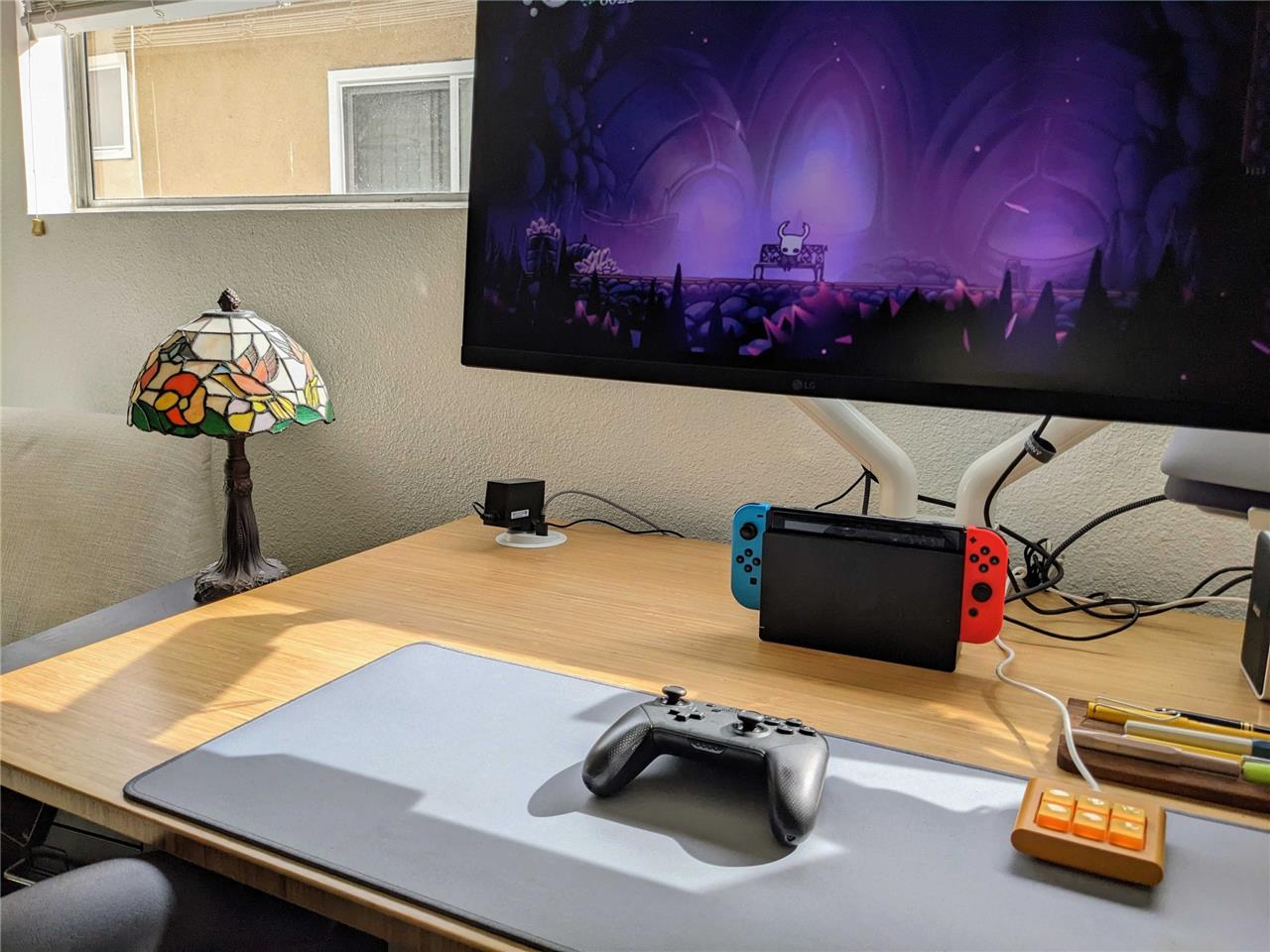
I’ve been kinder to my body since then, and that’s involved a few fixes. At this point, I almost always mount my Switch on something while I play, and I use a Nintendo Switch Pro Controller – even when I’m not using the Switch with a television or monitor. I use a tablet arm mount, play stand, or pile of books to stick the screen onto or against. If you travel frequently, I would recommend an airplane tray table Switch clip. I use it to put the screen at eye level in the same way.
Even if the handheld console doesn’t have detachable controllers – like a Switch Lite or Steam Deck – I still use a tablet arm mount and a separate controller whenever possible.
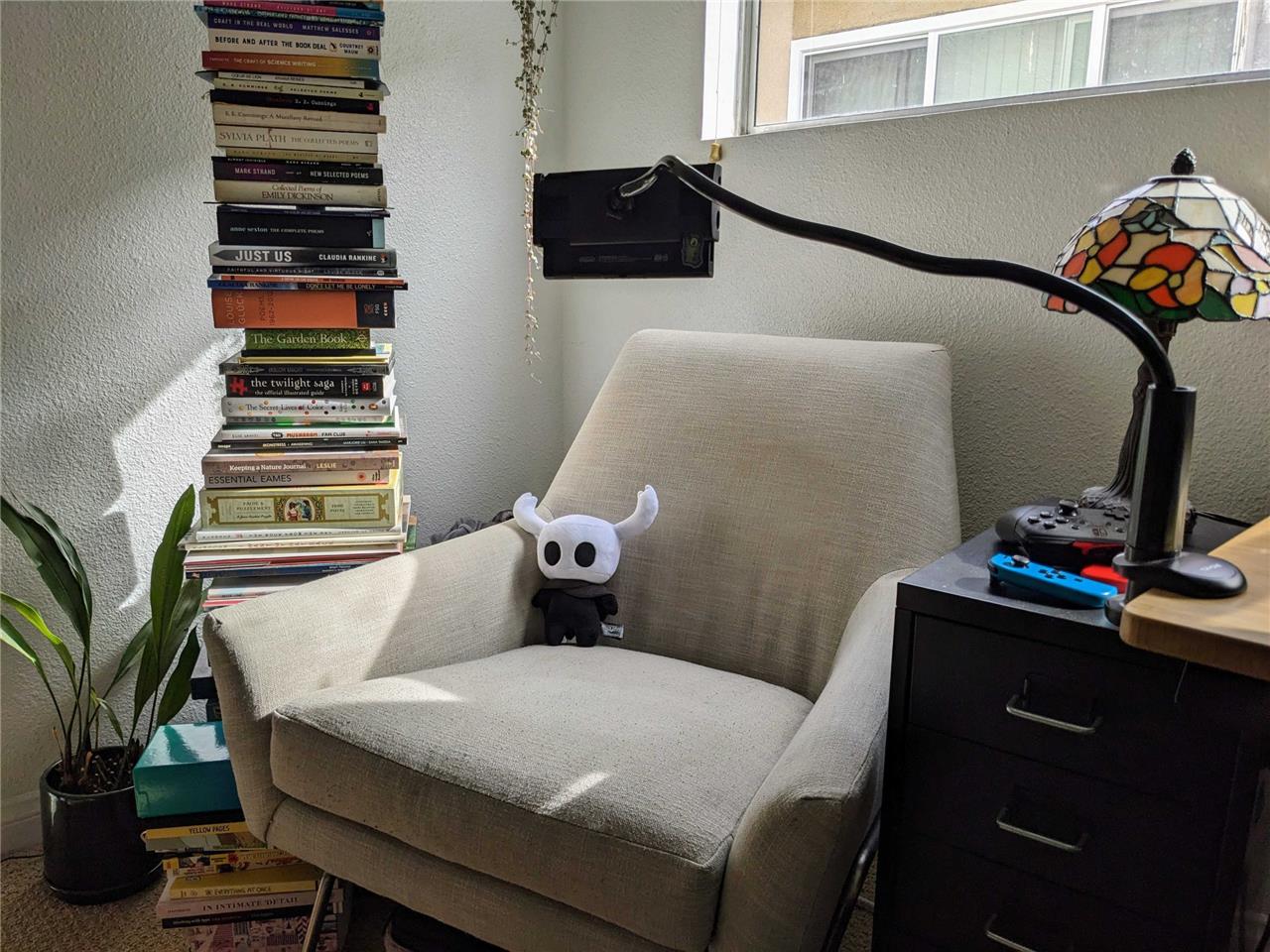
If I don’t have a separate controller available, I’ll do my best to make sure I’m changing how I’m holding the handheld and the angle of my neck every 30 minutes or so. If I’m sitting at a kitchen table, coffee table, or desk, I’ll place my elbows on the surface, and instead of hunching my neck and scrunching my shoulders, I’ll move the console up to eye level. If I’m on a sofa or armchair, I will bring out my favorite wooden lap desk that I also use for hobbies like painting and do the same. On days when my wrists are tired, I have used a wrist brace, too.
I have also tried a pair of prism glasses – ones that let you look forward but see at a 90 degree angle downward – similar to what surgeons and cross stitchers use. They have a learning curve, but I’ve found them really useful for long Stardew Valley play sessions, where I’m less focused on dexterity than I am on investing time into grinding.
Fix your desk setup
A balanced desk setup can spare your joints a lot of strain during long sessions. Keep your monitor at eye level, use a chair that supports your lower back, and rest your forearms parallel to the keyboard. Small details, such as wrist rests, adjustable arm supports, and a stable footrest, help reduce tension. Give cables and accessories their own space so you can move freely without twisting or reaching awkwardly. A tidy, ergonomic layout keeps your focus on the game instead of the discomfort.
If you are a PC gamer, there is a whole host of modifications you can make so that your setup is more ergonomic. (Here’s a more complete guide to ergonomic PC gaming setups.)
One of the less expensive fixes is to adjust your monitor up to eye level, or put your laptop on a stand or a stack of books. Your laptop or computer screen should be about an arm’s length from your face, and the top of it should be just a few inches above your eyes.
<
If you’re using a chair with adjustable height, another important adjustment is to make sure your chair is at the height where your elbows are at a 90 degree angle when you are typing. If your feet are dangling off the floor, you can use a stack of books, or something similarly affordable, to support your legs so that your knees are also at a 90 degree angle.
To prevent eye strain and headaches, make sure your screen’s brightness isn’t jolting in comparison to the light in the room around you.
The items that are absolutely worth investing in
Invest in a fully adjustable ergonomic chair, as lumbar and neck support can make or break long gaming sessions. A high-quality vertical or trackball mouse helps reduce wrist strain, while a split or low-force keyboard lessens tension in the forearms. Noise-cancelling headsets with soft ear padding reduce pressure on sensitive areas, and a monitor arm keeps your screen at eye level to avoid neck pain. Investing in these few items pays off with comfort that lasts through every match or mission.
These are the pieces that I would classify as worth finding in a version that feels suited to your body, or some type of “premium” version of them. While much of this is expensive to buy new, certain items can be found in great quality used or from office liquidation stores.
A good chair with adjustable settings
A supportive chair with adjustable settings can make long gaming sessions far more comfortable and reduce the strain that leads to chronic pain. Height, recline angle, lumbar support, and armrest adjustments help match the chair to your body’s natural posture rather than forcing you to adapt to it. Pairing these settings with ergonomic habits-like keeping your feet flat and screens at eye level-can prevent tension from building in your lower back and shoulders. A good chair won’t eliminate pain overnight, but it creates a stable base that helps your body endure extended play without paying for it later.
Sticker price-wise, this is the most expensive item on the list. It’s complicated by competing definitions of what the “best” ergonomic chair is. Though there are lots of “best” lists out there, everyone’s body is different, and what feels comfortable will vary by person. Ideally, you could try to find a store that lets you test different chairs. Sometimes furniture stores will have models on the floor that you can test without committing to buying anything.
In the context of an office chair, ‘ergonomic’ is a fancy way of saying adjustable
Regardless of whether you can try out the chair ahead of purchase, you should consider three main criteria: how adjustable it is, its dimensions, and the return policy (if you’re buying it new). In the context of an office chair, “ergonomic” is a fancy way of saying adjustable – the chair should have settings that allow it to conform to your body, and to accommodate changes you’ll make to your sitting posture through the day. Look for a chair with adjustable height, lean tension (which will allow you to rock back, adjust how easy it is to do so, and lock the position at different points), and lumbar support (high-end chairs will let you adjust lumbar tension). Adjustable armrests are also great.
Unfortunately, most standard “gamer chairs” don’t really do this, with the exception of specific ergonomically designed models, like the Embody Gaming Chair. That said, if you have a beloved gaming chair that already works for you, I will not fight you!
Lastly, make sure the size is right. The Aeron, for example, comes in more than one size and height. Though it is one of the most expensive chairs, it is also one of the most popular, and it’s often available through office liquidation stores, outlets, or Craigslist.
A mouse that won’t hurt you
A lightweight, low-profile mouse can make hours of play feel less punishing on sore wrists and fingers. Prioritize models with adjustable sensitivity and quiet clicks, paired with a symmetrical shape that keeps your grip relaxed. Wireless options reduce cable drag, while textured grips help prevent tension from building in your hand. Combined with the right wrist rest, a well-balanced mouse can keep you competitive without aggravating chronic pain.
It took me an embarrassingly long amount of time to get myself a better mouse, because I didn’t think there was anything “wrong” with my old one. It’s true that the previous one worked. But when I finally upgraded to an ergonomically designed one, a layer of wrist pain peeled away. You love to see it.
If your wrists hurt, you might also look into a wrist rest or an ergonomic keyboard – for example, a split board, or a keyboard angled in a more natural position for your wrists.
Be attentive and creative
Experiment with different setups and pay close attention to what your body tells you. A slight angle change in your controller grip, a softer wrist rest, or a customized button layout can ease strain and extend comfort through long sessions. Creativity pays off here-try mixing accessories from different brands or even modifying your chair height to reduce pressure points. The goal is to build a space that feels natural, responds to your limits, and keeps playtime enjoyable rather than exhausting.
Some of my favorite ergonomic fixes have felt silly in hindsight – and yet they’ve solved some of my worst pain problems. My favorite ridiculous “chronic pain tool” has been a simple pair of fluffy socks. I realized that my back pain spiked when I sat cross-legged. The best solution was to keep my feet warm so I wouldn’t tuck them under my legs subconsciously.
I’m not actually recommending fluffy socks as a “gaming peripheral.” My point here is to be observant and conscientious about what is causing you pain, if and when you can, and to embrace accessible solutions or modifications when those options arise. It can be hard to be conscious of your body when you’re focused on gaming (often I play games specifically to distract myself from how crappy my body feels). When I’m engrossed in a game, I hardly notice the weird and uncomfortable positions I put myself in. So I designed my gaming setups with that in mind, making it easier to take care of my body.
Best ergonomic chairs for gamers with back pain
Ergonomic chairs with strong lumbar support and adjustability are essential for gamers suffering from back pain during long sessions. Top picks from recent reviews prioritize built-in spinal alignment, breathable materials, and customizable features to maintain posture.
Top Recommendations
-
N-GEN Gaming Chair: Balances comfort with high-density foam, adjustable lumbar cushion, and a pull-out footrest for all-day support; ideal for comprehensive back relief.
-
Razer Enki: Features a built-in lumbar arch mimicking the spine’s curve, 152° recline, and dual-density cushioning for extended gaming without strain.
-
Razer Iskur V2: Offers pro-grade posture support via contoured foam and a wide seat, promoting natural alignment even without extra adjustments.
Budget-Friendly Options
Yaheetech provides contoured backrests and lumbar pillows at entry-level prices, while GTRACING adds mesh for breathability and 135° recline with a footrest. OLIXIS suits small spaces with flip-up armrests and ergonomic curves under 275 lbs capacity.
Premium Ergonomic Picks
Herman Miller Embody excels with advanced spine support and cooling foam for premium users, though pricey. Secretlab TITAN Evo includes adjustable lumbar and multi-density foam for style and relief. Autonomous ErgoChair Ultra 2 focuses on posture via adaptive backrests and 4-layer cushions.
Key Features to Prioritize
Look for 4-way lumbar adjustments (like AndaSeat Kaiser 4), synchro-tilt mechanisms, and height-tunable seats to match your setup and body. Test weight capacity, recline range up to 152°, and materials like mesh or PU leather for cooling during marathons. Pair with desk height alignment for optimal elbow positioning at 90 degrees.
N-GEN Gaming Chair pros and cons and price
The Neo Chair N-GEN stands out as an affordable ergonomic gaming chair with solid back support features for chronic pain relief. It earns high marks for comfort during extended sessions, backed by a 4.7-star rating from over 240 reviews.
Key Pros
-
Exceptional lumbar support and adjustable headrest reduce neck and back strain, ideal for gamers with pain.
-
Includes a retractable footrest, ergonomic linkage armrests that move with recline, and 360° swivel for versatile positioning.
-
Easy assembly, sturdy steel base with 300 lb capacity, SGS-certified height adjustment, and smooth-rolling wheels enhance usability.
-
Premium PU leather feels luxurious and promotes better posture; reviewers praise all-day comfort for PC gaming or work.
Key Cons
-
Footrest feels flimsy or less stable during prolonged use, per some feedback and comparisons.
-
Padding may wear down faster than premium models, and PU leather lacks breathability in hot environments.
-
Recline (up to 155°) and tilt mechanisms aren’t as smooth as high-end chairs; assembly can take time for some.
Pricing
Currently on clearance at Walmart for $98.96-$122.20 (down from $179.98), with Amazon deals as low as $99 (from $139) noted in late 2025 promotions. Prices vary by color (e.g., Black, Red, Blue) and retailer; check for free shipping and returns.
