
Ready to transform a humble hamlet into a bustling medieval town? In Manor Lords, growing your village is more than just stacking buildings-it’s about mastering a complex web of infrastructure, resource management, and strategic upgrades. Dive into our guide to learn how to cultivate fertile lands, build essential structures, and elevate your settlement from a small village to a thriving town that stands the test of time. Your journey to lordship starts here.
OurManor Lords town-building guide will walk you through taking a settlement from the start of a game, through the village settlement levels all the way up to a (small) town. We’ll also explain what to build first, and how to move around your (limited) families to get work done.
How to increase your settlement level from a village to a town
To increase your settlement level from a village to a town in Manor Lords, you need to focus on building and upgrading Burgage Plots, which serve as the core housing units in your settlement. Starting from a small village, you must construct at least 10 Level 1 Burgage Plots, 7 Level 2 Burgage Plots, and 3 Level 3 Burgage Plots to reach a small town. Each Burgage Plot upgrade requires meeting essential prerequisites such as access to water (wells), a sufficiently leveled church, and the availability of fuel, food, and clothing stalls in the marketplace. Upgrading plots consumes resources like timber, planks, stone, and rooftiles, and also depends on your settlement’s infrastructure and supply chains. As you fulfill these conditions and upgrade the required number of plots, your settlement will automatically progress to the next level, granting you Development Points to invest in further growth and technologies.
To advance in Manor Lords, you’ll need to increase your settlement level. This is a measure of how many burgage plots you have built and how upgraded they are. Each time you advance a settlement level, you’ll get a development point to spend on unlocking a new technology for your town.
- Small Village: have 5 burgage plots (level 1)
- Medium Village: have 5 burgage plots (level 1 or higher) and 2 burgage plots (level 2)
- Large Village: have 10 burgage plots (level 1 or higher) and 5 burgage plots (level 2)
- Small Town: have 10 burgage plots (level 1 or higher), 7 burgage plots (level 2 or higher), and 3 burgage plots (level 3)
- Medium Town: have 10 burgage plots (level 1 or higher), 10 burgage plots (level 2 or higher), and 10 burgage plots (level 3)
- Large Town: have 30 burgage plots (level 1 or higher), 20 burgage plots (level 2 or higher), and 15 burgage plots (level 3)
Those requirements overlap, so all of the level 2 plots count toward the level 1 or higher requirement, and all of the level 3 plots count toward both level 1 and level 2. That means you can reach a medium town with only 10 burgage plots (but you’ll have to be constantly creative with moving families around for jobs).
Use those requirements as a guideline for how many plots you should have. If you grow too fast, your town won’t be able to keep up with the villagers’ demands. Try to stay close to the minimum number of burgage plots you need.
We should also note that plots under construction don’t count toward any of the requirements; they kind of get put on pause until the construction is complete. That’s why it might look like your total number of plots drops while you’re in the process of upgrading them.
For our purposes, let’s focus on getting a town from the starting settlement up to a Large Village. And that starts with.
Plan for farming (but don’t start farming)
Before you start farming in Manor Lords, it’s crucial to plan carefully by selecting fertile land and reserving it for future farm plots without immediately beginning cultivation. Use the fertility overlay in the Construction menu to identify optimal spots, ideally with at least moderate fertility, avoiding overlap with other resource deposits. Place farm plots early to protect valuable farmland from accidental construction, but hold off on actual farming activities until your infrastructure and population are ready to support it. This strategic reservation ensures you have the best land secured for efficient crop production when the time comes to sow and harvest, aligning with the game’s seasonal farming cycle and maximizing your village’s growth potential.
Before anything happens, pause your game, zoom way out, and hit the Construction button. On the left side of your screen, you’ll have Overlay options that put a heatmap overlay on top of the map.
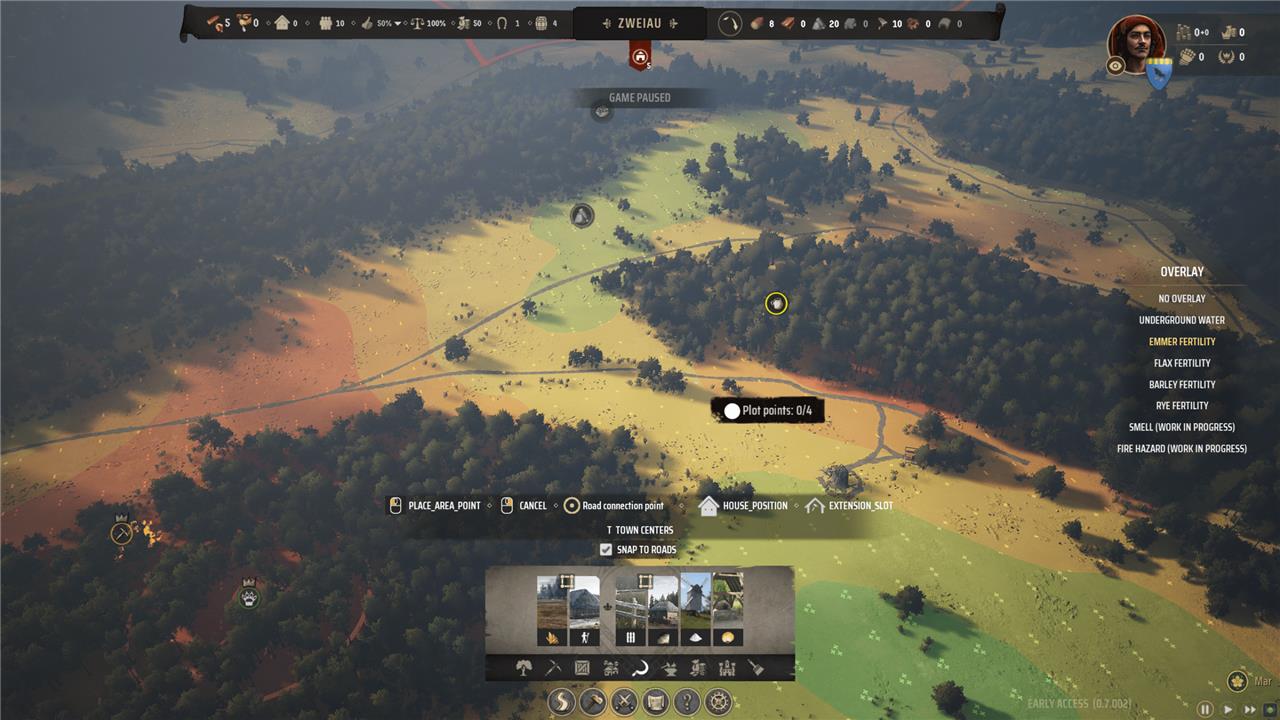
For now, focus on emmer (wheat), flax, and barley fertility. The fertility the overlay is showing you is basically how much of a given crop that chunk of land will produce.
In the Construction menu, pick Farming and a Field. This will let you place four points to make a plot of farmland. Go ahead and build your first few farm plots. We’re not going to use them for a while, but they will just sit there until you build a farm and assign a family to it. Getting them placed early just means you don’t accidentally build over fertile farmland.
Set up a granary and storehouse
To effectively grow your village in Manor Lords, setting up a granary and storehouse early on is essential. The granary stores all food resources and ale, protecting them from weather damage and ensuring timely distribution to the marketplace, which helps prevent starvation and maintains population approval. It can initially hold 500 units and can be upgraded to a large granary with a capacity of 2,500 units. The storehouse, on the other hand, stores non-food items like firewood, clothes, and tools, and should be placed near resource-refining buildings to minimize travel time. Assigning families to both buildings enables workers to transport and distribute supplies efficiently throughout your settlement. Upgrading these buildings and strategically placing them near resource sources and markets optimizes logistics and supports steady growth of your town.
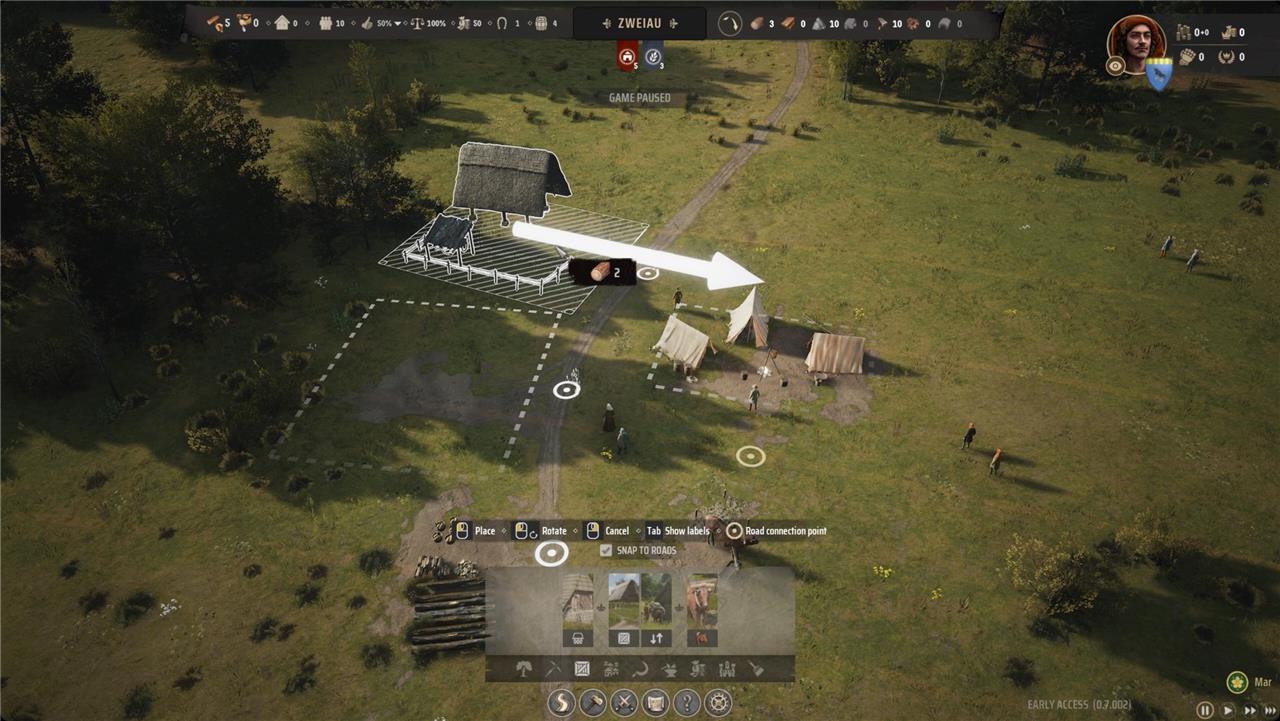
With the farmland set aside, it’s time to turn to your town. Lay down a road roughly where you want to start – preferably near where your settlers got dropped. Place a granary (2 timber, 10 stone) and a storehouse (2 timber). Once they’re constructed, assign a family to each one.
Those families will grab all of the supplies that were unceremoniously dumped on the ground and store them safely. Once the two stacks of supplies are retrieved, unassign the families (for now). You’ll need them elsewhere, like to.
Gather resources
To successfully grow your village and build a thriving town in Manor Lords, the first step is to gather essential resources efficiently. Start by constructing a logging camp and a woodcutter’s lodge to ensure a steady supply of timber, which is crucial for building and upgrades. Establish hunting camps and forager huts to provide food and other materials, assigning families to each resource site to maximize productivity. Build roads connecting these resource points to your settlement to speed up transportation. Additionally, setting up storage buildings like granaries and storehouses protects your gathered goods from spoilage and weather damage. Prioritizing these resource-gathering structures early lays a solid foundation for expanding your village into a prosperous town.
At this point, you should have about 4 timber left from your starting supply. That’s enough to build everything you need to gather resources with one left over.
- Logging camp (1 timber) – place this in a forest where there’s plenty of, you know, timber
- Woodcutter’s lodge (1 timber) – place this in another chunk of forest
- Hunting camp (free) – place this near to (but not inside) the red circle around a wild animals icon
- Forager hut (1 timber) – place this near the berry deposit icon
As those get built, assign one family to each. That leaves one family unassigned to handle any construction you need to do while bringing in timber, firewood, meat, hides, and berries. Draw in some roads to speed up travel between your town and all the various camps you just built.
Build a marketplace
In Manor Lords, building a marketplace is essential for the growth and prosperity of your village. The marketplace acts as the central hub where villagers acquire vital goods such as food, firewood, and clothing, which are necessary for their daily needs and for upgrading their homes. To build a marketplace, select it from the Residential tab in the construction menu and define its size by placing four corner points; larger marketplaces accommodate more stalls and thus more goods distribution. Position your marketplace close to key resource buildings like the granary and storehouse to maximize efficiency. Market stalls are automatically established by families working in these resource buildings, so staffing them adequately ensures a steady supply of goods. Properly managing your marketplace boosts villagers’ approval, supports population growth, and enables the development of advanced workshops, ultimately helping your village evolve into a thriving town.
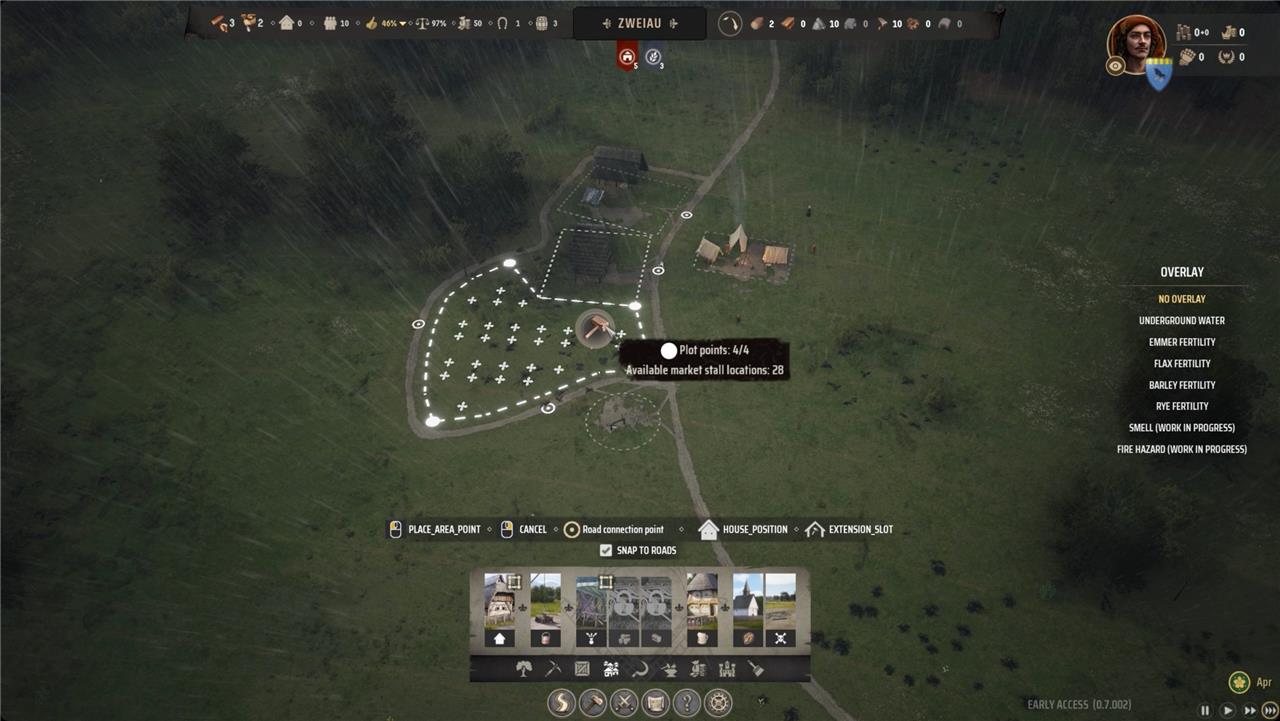
Next, it’s time to prepare for your town’s heart: the marketplace. Marketplaces are where all of your town’s good come to get passed out to the villagers. The actual mechanics of how goods are distributed is a little confusing, but you basically want your marketplace in the center of your town with burgage plots branching off of it.
Build two burgage plots with vegetable gardens and another hitching post
To build two burgage plots with vegetable gardens in Manor Lords, start by selecting spacious plots with large backyards to maximize garden size. Place the burgage plots close to your marketplace for easy resource access and upgrades. After constructing the plots, upgrade them to level 2 to unlock backyard extensions. Then, use the plot’s menu to pay 15 gold to add the vegetable garden extension, which allows the families to produce vegetables that will be sold at the market. Building multiple burgage plots with vegetable gardens increases your village’s food supply efficiently. Additionally, place another hitching post nearby to facilitate the transportation and management of goods, enhancing your settlement’s overall productivity and connectivity.
Starting with the road around (or near) your marketplace, draw out two burgage plots that are wide enough for expanded living space on each plot (this should cost 4 timber total). Make them pretty deep as well so they’ve got a big backyard extension slot – we usually aim for about four or so times longer than wide.
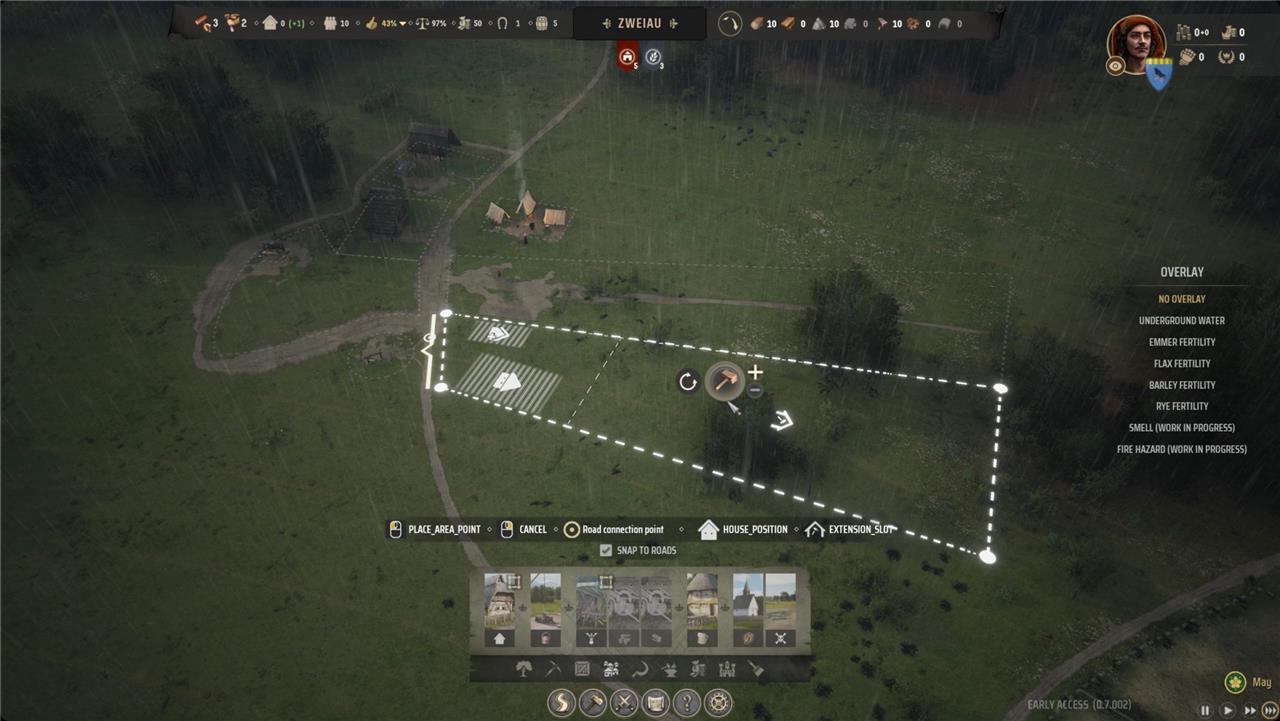
As these get built, build a vegetable garden on each, and then build the expanded living space. The garden takes no time to create, but the second house takes a while, so doing the garden first means you get plants in the ground without having to wait. These two backyard vegetable gardens will supply enough vegetables for your town for a long time.
Meanwhile, place a second hitching post (1 timber) and then order another ox for 25 Regional Wealth. That will finish off the Regional Wealth you started with, but that second ox will be a huge help in moving around construction supplies.
Build three more burgage plots
To build three more burgage plots in Manor Lords, focus on placing reasonably sized plots that are wide enough to accommodate multiple families, maximizing your settlement’s housing capacity. Start by selecting the Burgage Plot from the Residential tab in the Construction menu, then define the plot area by placing four points. Adjust the number of houses per plot using the + and – buttons to balance space for extensions and family capacity. Wide plots allow you to pack in more families, which is crucial for growing your population and advancing your settlement level. Ensure you have enough timber resources, as each burgage plot requires two timber to build. Maintaining the needs of your settlers in these plots will help increase approval and enable plot upgrades, contributing to your village’s growth into a town.
Now you can build three more reasonably sized burgage plots. Keep them wide so you can pack in more families with expansions, but you don’t have to worry about the extensions so much – just make sure they have them.
Build a charcoal kiln, well, sawpit, and tannery
To build a charcoal kiln, well, sawpit, and tannery in Manor Lords, start by unlocking the necessary development skills such as Charcoal Burning to enable the charcoal kiln. Construct the charcoal kiln near your timber and firewood supply to efficiently convert firewood into charcoal, which is essential for fuel during winter. Assign families to operate the kiln to maintain steady production. For a well, choose a strategic location to provide your villagers with reliable access to water, supporting both daily needs and farming. Build a sawpit near your woodcutting operations to process timber into usable planks, facilitating construction and upgrades. Finally, establish a tannery to process animal hides into leather, which is vital for crafting and trade. Position these buildings thoughtfully within your settlement to optimize resource flow and support your village’s growth into a thriving town.
With five burgage plots (level 1) built, you’ll get your first development point. There are a lot of pros and cons to each of the options for where to spend it, but for simplicity, unlock charcoal burning. This lets you build a charcoal kiln (2 timber) that turns 1 firewood into 2 charcoal – basically doubling the amount of fuel you have available. (If you’re low on unassigned families, you can swap one family back and forth between the woodcutter’s lodge and the charcoal kiln.)
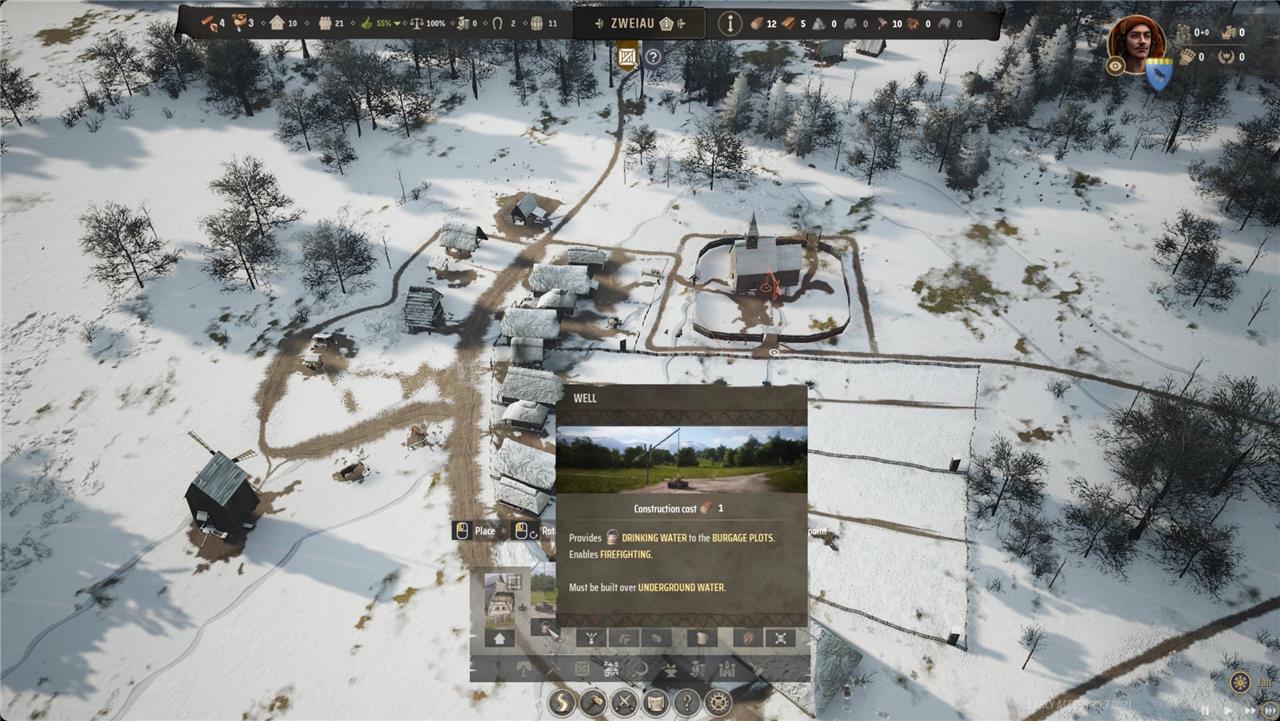
Hit the Construction button and use the underground water overlay to find a spot for your town’s well (1 timber). We kind of forgot about a well (whoops), so the above image is slightly out of order.
Next, we need to turn some timber into planks, so build a sawpit (2 timber). Assign a family when it’s built – you can pause the logging camp and use them if you need to – and let them work. Watch your supplies and, when you hit 20 planks, pause the sawpit. Then you can set that family back to logging.
Build a tannery (4 timber) as well. This will take all the hides your hunters have been collecting and turn them into leather. And leather is all you need to satisfy your burgage plots’ need for clothing.
Build a wooden church
To build a wooden church in Manor Lords, you need to gather essential materials including 5 lumber, 20 planks, and 10 stone. Lumber is obtained from logging camps, while planks are produced in saw pits, typically yielding five planks per lumber. Stone is mined from deposits on the regional map. Once you have these resources, you can construct the wooden church anywhere within your settlement, as its area of influence covers a wide range, fulfilling the church level requirements for nearby burgage plots. After construction, assign a family to the church to conduct sermons and manage burial duties, which helps maintain the approval and happiness of your villagers. Upgrading the wooden church later to a stone church will require additional materials like roof tiles and will further enhance its benefits for your growing town.
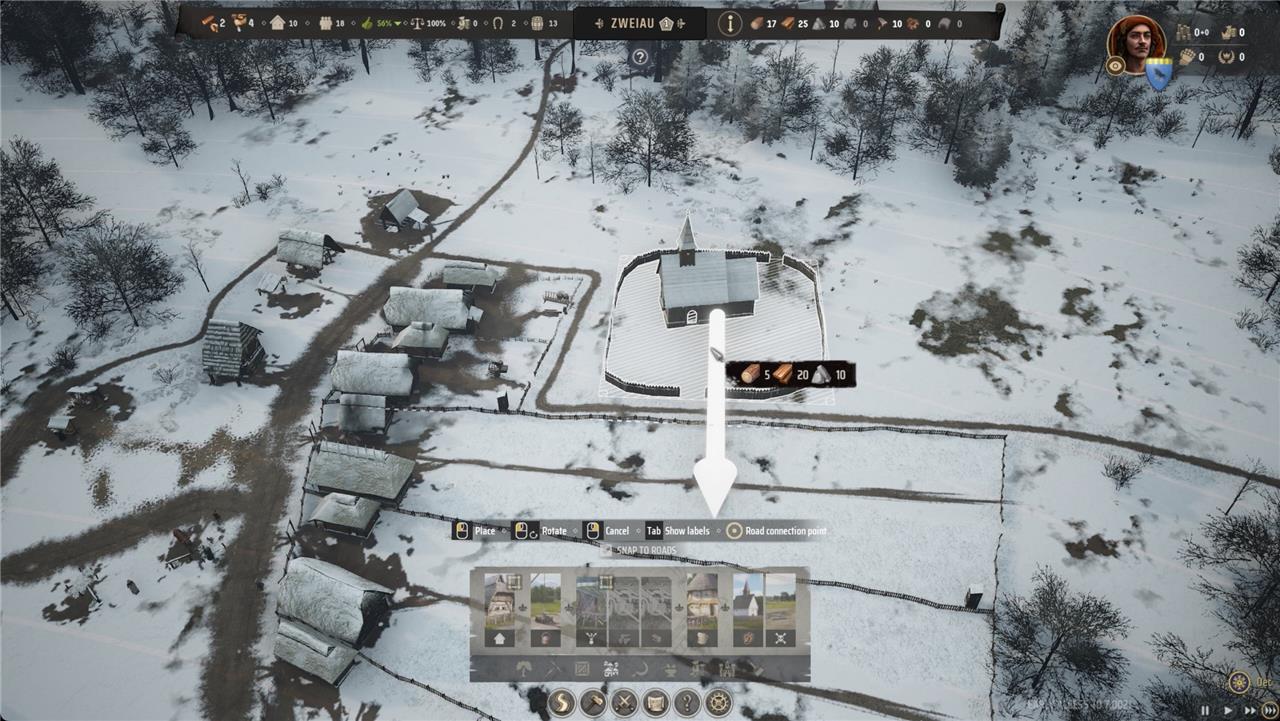
With the 20 planks from your sawpit safely stored, build a wooden church (5 timber, 20 planks, 10 stone). This should use up the last of your starting stone.
Upgrade your burgage plots
Upgrading your burgage plots in Manor Lords is essential for growing your village and boosting your town’s economy. Starting from Level 1, these plots serve as basic housing for families, but as you upgrade them to Level 2 and beyond, you unlock additional features such as backyard extensions for workshops like blacksmiths, breweries, and tailors. These upgrades require meeting specific infrastructure needs, including having a nearby church, well, market stalls for food, fuel, and clothing, and later a tavern with ale supply for Level 3. Upgraded burgage plots not only improve living conditions but also generate more Regional Wealth and allow families to take on artisan professions, significantly contributing to your settlement’s development and prosperity.
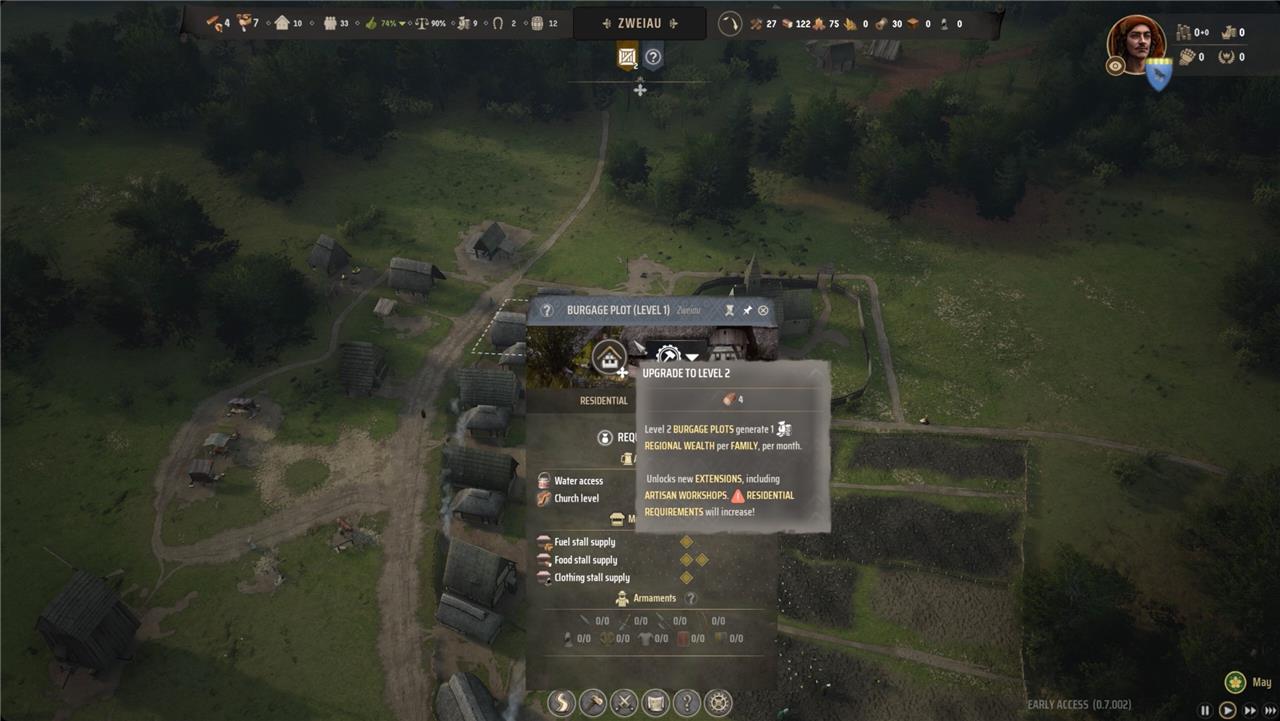
Once the church is constructed (you don’t even have to assign a family to it), you’re ready to start upgrading your town’s five burgage plots. Each upgrade costs 4 timber and all of the plot’s requirements have to (currently) be met. If you’re running low on anything, you might have to time your upgrade around when supplies hit the marketplace.
Once your first two plots upgrade to burgage plot (level 2), you’ll get another development point. The heavy plow is a safe bet here if you’re looking to get into farming (and have fertile land available), but trapping is another good option since it increases the supply of meat to your town.
Level 2 plots also unlock new workshops for the extensions. Don’t worry about those right away. Instead, watch as your burgage plots start to earn Regional Wealth. Once you get up to 25 Regional Wealth, build some chicken coops in backyards (you’ll need several). This will supply the marketplace with eggs, satisfying (or starting to satisfy, at least) another food type requirement.
Keep growing your town
To keep growing your town in Manor Lords, focus on gradually upgrading your burgage plots while carefully managing resources and infrastructure. Start by securing fertile land for farming and building essential structures like roads, granaries, and storehouses to support your population. Assign families to resource-gathering jobs and ensure a steady supply of food and fuel, especially before winter. As your settlement grows, upgrade homes with artisan trades and expand your marketplace to distribute goods efficiently. Maintain a balance between population growth and resource availability, expanding slowly to avoid collapse and ensuring you have enough jobs for all families. This strategic approach will help transform your village into a thriving town capable of supporting a larger population and more complex industries.
At this point, your settlement is a Large Village. The next step is a Small Town, but, for the next round of upgrades, you’ll have to set up a lot more infrastructure. You’ll need a stonecutter camp, clay from a mining pit that gets turned into rooftiles at a clay furnace, and a farm for barley along with a malthouse, brewery, and tavern. You’ll also need a steady supply of at least three kinds of food. And you’ll have to turn one of your burgage plots (level 2) into a cobbler.
How can I efficiently transform my village into a thriving town in Manor Lords
To efficiently transform your village into a thriving town in Manor Lords, start by carefully planning your initial layout: place your Logging Camp near abundant trees and establish a central hub with key buildings like the Storehouse, Granary, Well, and Marketplace close together to minimize travel time and boost efficiency. Focus early on building 3-5 Burgage Plots with Living Space Extensions to house villagers comfortably, which increases approval and prevents unrest. Assign villagers to seasonal tasks to maximize productivity-during winter, reassign farm workers to resource gathering or construction projects like windmills and communal ovens to prepare for spring farming.
Prioritize building a Church early to significantly boost villager happiness and unlock further advancements. Expand your road network to connect new housing and production buildings, ensuring smooth movement of goods and people. Increase transport capacity by adding Hitching Posts and build a Trading Post near the map edge to sell surplus resources and generate Regional Wealth, which is crucial for upgrades. Diversify food production with Goat Sheds and establish a Tannery to process leather, supporting both economy and villager needs. As your population grows, continuously upgrade and add Burgage Plots to prevent homelessness and maintain high approval ratings.
Finally, balance resource production and population growth carefully to keep villagers fed, happy, and productive. Use side businesses in upgraded homes to increase resource variety, and strategically place artisan trades near markets for maximum efficiency. This holistic approach will help you steadily grow from a small village into a bustling, well-organized medieval town.
What are the most effective ways to optimize resource allocation during growth
To optimize resource allocation effectively during growth, focus on several key strategies:
-
Align resources with strategic goals: Prioritize allocating resources to initiatives and projects that directly support your long-term objectives and have the highest potential impact on growth.
-
Conduct thorough resource audits: Regularly assess your available financial, human, and material resources to identify gaps, inefficiencies, or underutilization, enabling informed allocation decisions.
-
Prioritize high-impact areas: Use frameworks like the 80/20 rule to focus most resources on the 20% of activities that generate 80% of results, ensuring maximum return on investment.
-
Adopt flexibility and adaptability: Build nimble processes that allow you to reallocate resources quickly in response to changing conditions or new opportunities, such as quarterly reviews and agile resource management.
-
Use data-driven decision-making: Leverage analytics, key performance indicators, and scenario planning to guide resource distribution objectively, reducing bias and improving outcomes.
-
Foster collaboration and communication: Ensure cross-team coordination and transparency around resource needs and constraints to optimize utilization and avoid bottlenecks.
-
Continuously evaluate and adjust: Monitor resource usage and project performance regularly, making adjustments as needed to maintain alignment with goals and improve efficiency.
-
Make room for innovation: Allocate a portion of resources to experimentation and new initiatives, balancing risk with the potential for breakthrough growth.
By systematically applying these principles, you can maximize productivity, minimize waste, and strategically fuel sustainable growth.
