
In the medieval world of Manor Lords, mastering trade is the key to transforming your fledgling settlement into a thriving hub of wealth and influence. But how do you navigate the complexities of setting up trade rules, managing imports and exports, and establishing lucrative trade routes? This guide unravels the essentials of trading-from building your first Trading Post to securing steady merchant visits-arming you with the knowledge to dominate the economic landscape and ensure your town’s prosperity and survival. Dive in and learn how to turn surplus goods into a flourishing economy in Manor Lords.
Our Manor Lords trade guide will explain all the steps to setting up a trading post, the rules for importing and exporting, and how (and why) to establish trade routes.
How trade works in Manor Lords
Trading in Manor Lords revolves around constructing a Trading Post and assigning a family to operate it, enabling the import and export of goods essential for your settlement’s survival and growth. Through the Trading Post’s Trade tab, players can set trade rules for various goods-choosing to import, export, or maintain full trade to keep desired surpluses. Importing consumes regional wealth to bring in needed resources, while exporting sells excess goods to generate wealth. To enhance trade efficiency, players can purchase horses for faster transport and establish trade routes, which guarantee regular merchant visits and higher trade volumes, especially for major processed goods. Additionally, pack stations allow for direct goods exchange between player-owned regions without using wealth. Mastering these mechanics is key to maintaining a prosperous economy in Manor Lords.
As you play Manor Lords, a travelling merchant will periodically wander through your town. These merchants visit your trading post – if you have one – and try to either buy or sell goods to match rules that you establish.
You’ll be able to import (pay Regional Wealth to bring in), export (send out goods in exchange for Regional Wealth), or full trade (either import or export to get your current surplus to match your desired surplus – more on this below).
Down below, we’ll also touch on the other kind of trading you can do at a pack station.
How to build a trading post
To build a Trading Post in Manor Lords, first open the Trade tab in the building menu and select the Trading Post, which costs 4 Timber to construct. It is best to place the Trading Post on King’s Road or another main road to ensure traders can easily reach it. After building, assign at least one family to work there, as they will manage trade activities and interact with visiting merchants. For efficient trading, build a stable nearby to house horses, which can be assigned to the Trading Post to speed up trade routes. The Trading Post can store up to 500 units each of generic and pantry goods, facilitating import and export operations. Once set up, you can configure trade rules and establish trade routes to optimize your town’s commerce and generate Regional Wealth.
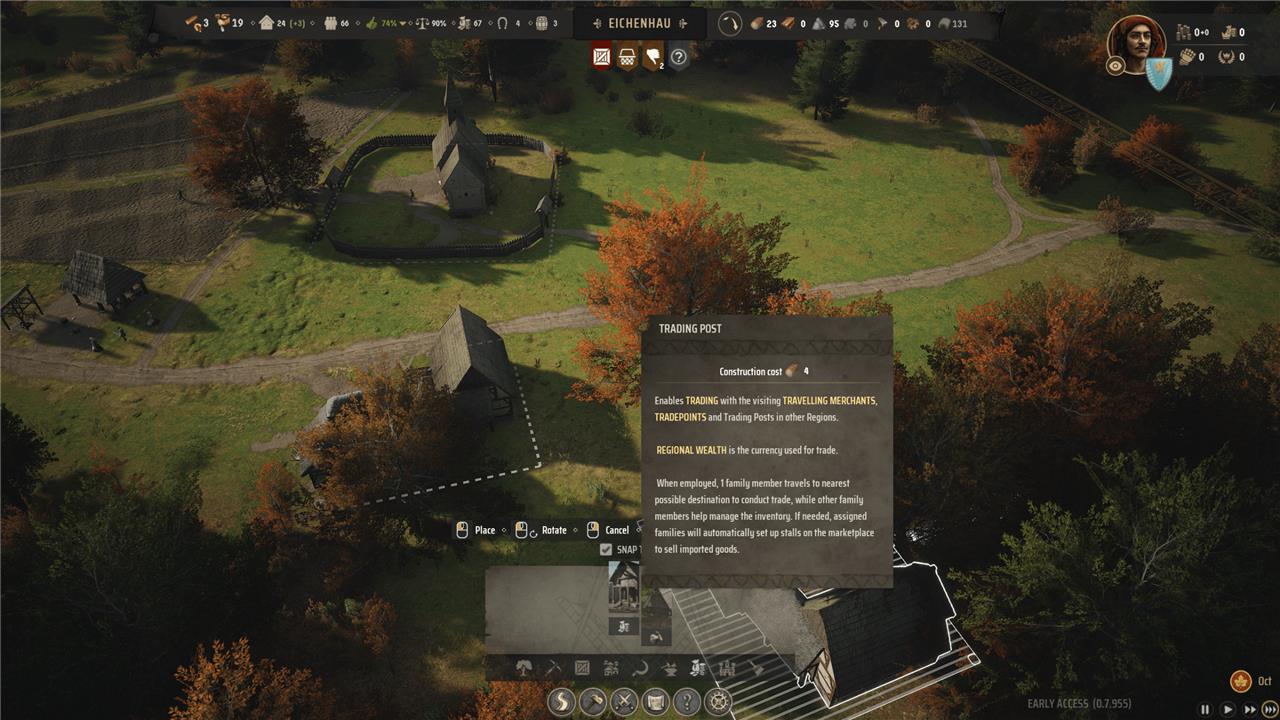
The first step in setting up trade is just to build a trading post (4 timber). There, you can assign families to work at it – they’ll both head out to sell (export) good and also set up marketplace stalls to distribute the goods you import. You can also order a new horse for 30 Regional Wealth that will speed up transit times for your traders,
but you can only have two horses assigned.
On the trading post’s Trade tab, you’ll be able to set up the rules for your import-export business, including establishing trade routes.
How trade rules work, including ’set rule to no trade’ explained
Trade rules in Manor Lords determine how specific resources are handled at your Trading Post, controlling whether goods are imported, exported, or not traded at all. Each resource starts with the default “No Trade” setting, which means it will neither be bought nor sold. To enable trading, you need to open the Trading Post interface and change the trade rule from “No Trade” to one of the other options: “Import” to buy the resource until a set surplus is reached, “Export” to sell the resource until the surplus is met, or “Full Trade” to both import and export the resource to maintain a desired amount. Setting these rules allows you to manage your settlement’s resource flow efficiently, ensuring you have enough supplies or gain regional wealth by selling excess goods. Remember, trade rules apply individually to each resource and require a family assigned to the Trading Post to operate.
When you click on a trading post’s Trade tab, you’ll get a menu of all of the goods your town can have broken into six categories: construction, crops, food, crafting materials, commodities, and military.
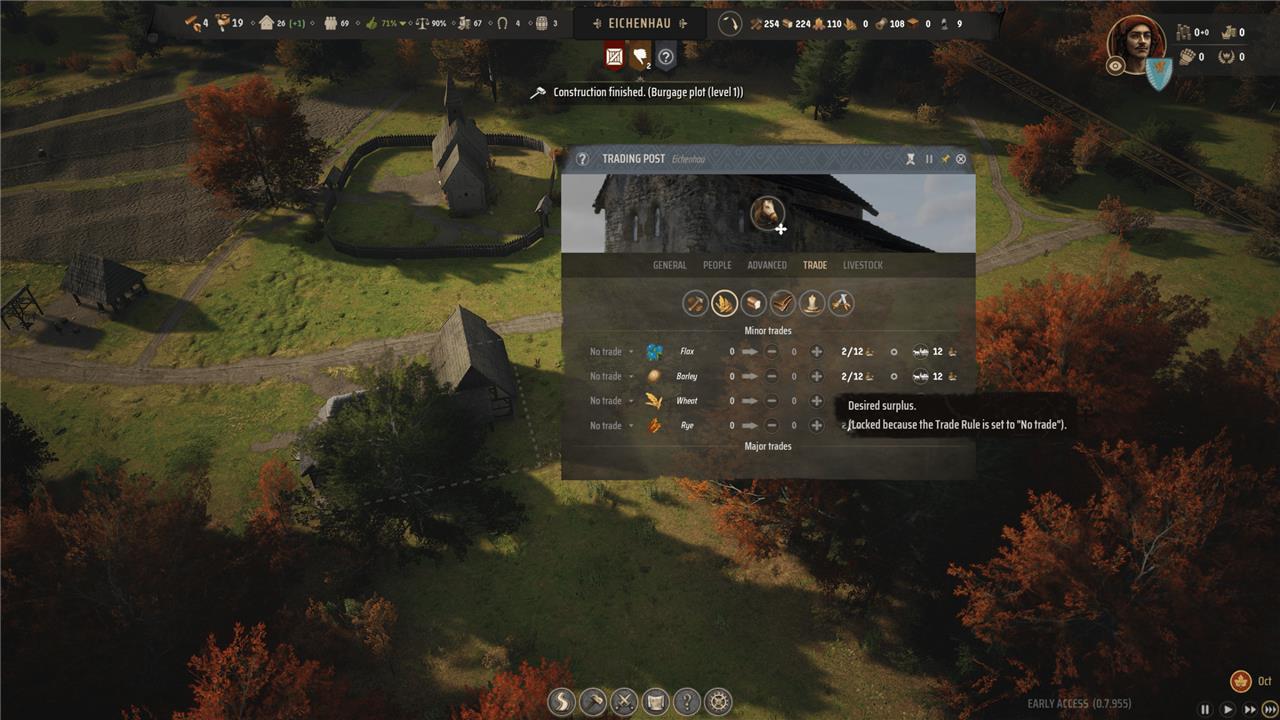
Below the categories, you’ll see a bunch of numbers and other information. Starting from the left, you can choose to import that specific good (pay Regional Wealth to get more), export it (send out that good in exchange for Regional Wealth), full trade (either import or export), or set it back to no trade (no trading of that good in either direction).
Next to the good, you’ve got a place to set your desired surplus. This is how many extra of that good you want to have on hand – surplus is calculated after the current construction and marketplace demand. For exporting, the trading post will send out that good until it gets down to that number. For importing, the trading post will bring in that good until you hit the number. For full trade, it’ll try to keep the surplus right at that number.
To the right of that, you’ll see the (current) export price followed by the import price (importing is always higher). Right next to that, there’s an indicator for the global market supply – basically how easy and cheap it is to get that good. It’s possible, for example, to flood the market and make exporting impossible.
All the way to the right is a button to establish a trade route.
How to establish a trade route
To establish a trade route in Manor Lords, first build a Trading Post and assign at least one family to work there. Open the Trading Post’s Trade tab, select the item you want to trade, and click the wagon icon to purchase a trade route using Regional Wealth. This investment ensures traveling merchants visit your town regularly to import or export the chosen good, providing a steady supply or demand. Trade routes are essential for major trades, such as weapons or clothing, while minor trades can occur without them. Position your Trading Post near main roads like the King’s Road for optimal connectivity, and manage your surplus levels to maintain a balanced stock of goods. Monitoring your trade network through the eye icon helps track merchant visits and trade activity.
Travelling merchants wander through your town periodically. They’re not on a schedule, though, so they’re a bit unpredictable. They’ll also mix and match the goods they buy and sell, which means you might not get as many as you’re looking for. If you’re trying to keep your town supplied, that’s not ideal.
In the trading post menu, you can pay some Regional Wealth to establish a trade route. This just means that the travelling merchants’ visits will come on a regular schedule and will focus only on that one type of good – meaning you’ll move more of it.
Some goods – usually the more valuable ones – require a trade route to import or export.
Pack stations are not the same as trading posts
Pack stations and trading posts serve fundamentally different roles in Manor Lords. Trading posts are designed to facilitate trade with external merchants, using Regional Wealth to import and export goods, and require families to operate them. They allow players to set trade rules and establish trade routes for consistent supply. In contrast, pack stations enable the direct exchange of goods between regions owned by the player without involving Regional Wealth. They use mules to transport goods and operate on a barter system, allowing players to send specific goods from one region in exchange for others. Unlike trading posts, pack stations do not require a counterpart in the receiving region and focus on internal resource redistribution rather than external trade.
The other way to move goods between regions is by building pack stations (1 timber). These do a different type of trade. First, the families assigned to a pack station use mules (the only place mules are used in Manor Lords).
More importantly, pack stations don’t deal in Regional Wealth. Instead, pack stations only move goods between two settlements in two different regions you control. In the pack station menu, you’ll set the town that station trades with, what good they send out, and what good they exchange it for – with a modifier for the relative values of those goods.
How can I master trade rules and routes to boost my village in Manor Lords
To master trade rules and routes in Manor Lords and boost your village, start by building a Trading Post and assigning a family to operate it, as this is essential for any trade activity. In the Trading Post’s Trade tab, set trade rules for each good by choosing whether to import, export, or engage in full trade, and specify your desired surplus for that item. This controls how much of each good you keep or send out, balancing supply and demand effectively.
To ensure a steady and reliable supply of important goods, establish trade routes by paying Regional Wealth. Trade routes guarantee regular visits from merchants focused on specific goods, increasing trade volume and stability for high-value or scarce items. Use horses purchased from the Livestock Trading Post to speed up trade deliveries between your village and merchants.
For trading between your own regions, build Pack Stations, which use a barter system to exchange goods directly without involving Regional Wealth. This is useful for managing resources across different parts of your domain but has a limited capacity per trip.
Additionally, invest development points in Trade Logistics and Better Deals to reduce the cost of establishing trade routes and importing goods, making your trading more cost-efficient.
By carefully managing trade rules to maintain optimal surpluses, establishing trade routes for key goods, and leveraging pack stations for internal exchanges, you can significantly boost your village’s economy and ensure its growth and prosperity in Manor Lords.
What are the key trade rules that influence resource flow in Manor Lords
The key trade rules in Manor Lords that influence resource flow revolve around setting import, export, or full trade statuses for each good in your Trading Post. These rules determine whether your settlement buys, sells, or both buys and sells a particular resource to maintain a desired surplus level. For example:
-
Import: Your village buys the good, using Regional Wealth to bring it in.
-
Export: Your village sells the good to gain Regional Wealth.
-
Full Trade: The system buys or sells the good as needed to maintain a set surplus in your inventory.
Additionally, trade rules apply differently to Major Trades (processed goods like Ale or Armor) and Minor Trades (simple goods like Eggs). Major Trades require establishing a Trade Route before you can set trade rules for them, ensuring a consistent flow of these complex goods.
Setting a desired surplus for each good is crucial to control how much you keep versus trade away, balancing your village’s needs and profits. Establishing trade routes for goods you need in large quantities or want to sell en masse guarantees steady merchant visits but comes at a Regional Wealth cost, which increases with each new route.
Furthermore, internal trade between your own regions uses a barter system via Pack Stations, allowing you to exchange goods directly without spending Regional Wealth, but with limited capacity per trip.
In summary, the key trade rules influencing resource flow are:
-
Choosing import, export, or full trade for each good.
-
Setting desired surplus levels to control stock.
-
Establishing Trade Routes for Major Trades to enable consistent trade.
-
Using Pack Stations for inter-region barter trade.
-
Managing Regional Wealth costs associated with trade routes and imports.
Mastering these rules lets you optimize resource availability and Regional Wealth income, fueling your village’s growth and prosperity in Manor Lords.
