
Unlock the full potential of your medieval settlement by mastering the art of upgrading Burgage Plots in Manor Lords. From humble beginnings as simple homes, these plots can evolve into bustling hubs of food production, wealth generation, and community growth-if you know the right steps to take. Ready to transform your village and secure your lordship? Here’s your essential guide to upgrading Burgage Plots from level 1 all the way to level 3, including crucial infrastructure and backyard extensions that will keep your peasants thriving and your coffers growing.
Our Manor Lords burgage plot guide will explain these mixed-use plots of land, from how to set them up through upgrading them – including all the Level 2 and Level 3 requirements you’ll need to build for those upgrades.
What is a burgage plot in Manor Lords?
Burgage plots in Manor Lords are the primary and permanent housing units for your settlers, serving as the foundation of your town’s residential areas. Each burgage plot provides living space for families and can be upgraded through three levels, increasing the number of families it can accommodate and unlocking additional features such as backyard extensions. These extensions allow for production of resources like food and goods, which contribute to your settlement’s economy. Upgrading burgage plots requires meeting specific settlement conditions, including access to amenities like wells, churches, and market stalls, making them essential for population growth and overall development in the game.
The basic unit of Manor Lords’ workforce is the family, and families need a place to live. A burgage plot in Manor Lords is a couple things at once. It’s a place for a family to build a house (or two), but it’s also a place for them to start a side hustle that benefits your town.
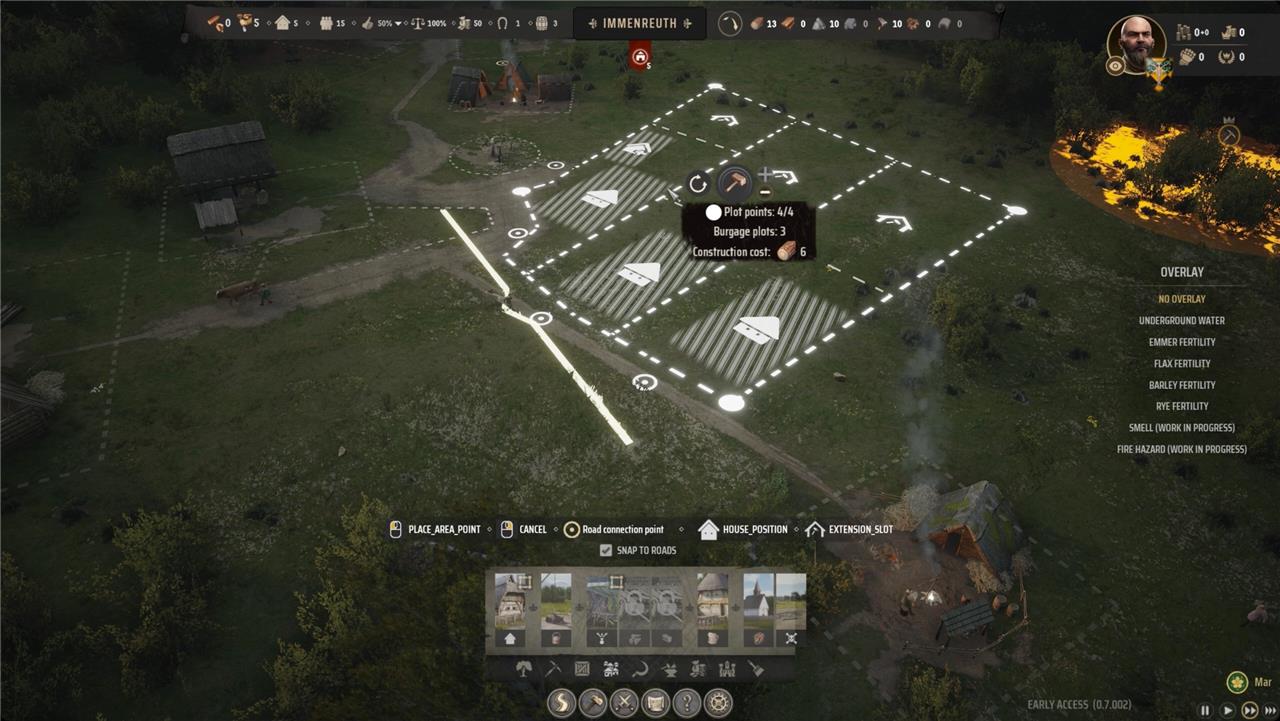
When you place a burgage plot, you’ll place four points for a flexible plot. The first two points will set the street-facing side by default (but you can change this after) and then automatically divide the plot into a maximum number of burgage plots. These are usually narrow, and will contain one house.
Once you’ve placed all four points of flexible plot, you’ll get a popup with a couple controls – an arrow to rotate the plot (to change the street-facing side), a hammer to (start to) build the plot, and then plus and minus buttons. Those last two set how many burgage plots your flexible plot gets divided into. Fewer plots means the burgage plots are wider (they take up more road), but it might also add enough room to expand living space – basically add a second, smaller house for a second family – indicated by a house icon with a plus sign on it.
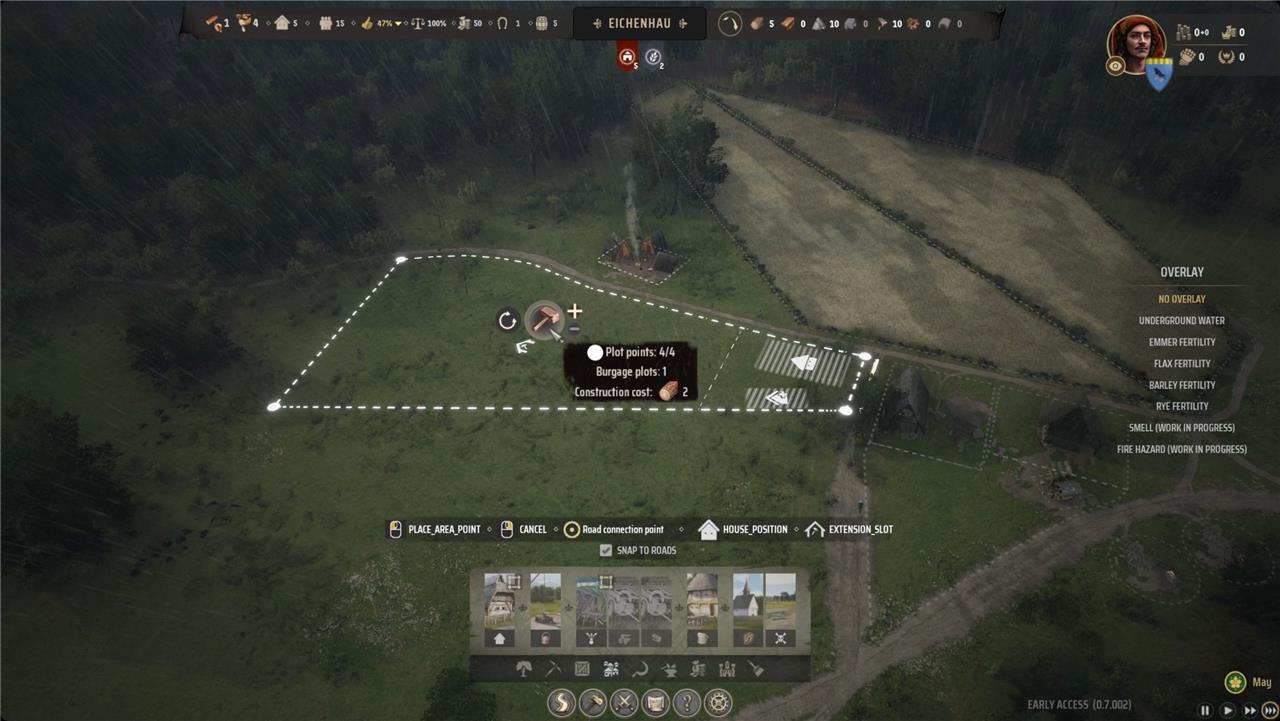
If you make the plot deeper (longer along the side leading back from the road), you’ll add an extension slot – effectively a backyard. This is space for something like a crop, livestock, or a workshop. Only vegetable gardens and (after you spend a development point on it) orchards are affected by the size of the extension – bigger yards equals more space for a garden. The various workshops and even livestock like chickens and goats don’t seem to be affected by the size.
Burgage Plots Level 2 requirements
To upgrade a Burgage Plot from Level 1 to Level 2 in Manor Lords, several key requirements must be met within your settlement. You need to have a Small Village settlement level, build a well to provide water access, and construct a wooden church for religious needs. Additionally, your marketplace must supply at least one fuel stall, two different types of food stalls, and one clothing stall. These resources ensure your Burgage Plot residents have essential access to water, food, fuel, and clothing. Once these conditions are fulfilled, upgrading the plot costs 4 timber and allows for expanded living space and artisan backyard extensions, such as blacksmith or joinery workshops, which are only available at Level 2 and above.
To upgrade from a burgage plot (Level 1) to a burgage plot (Level 2), you’ll need:
- A well (1 timber) built above underground water
- A wooden church (5 timber, 20 planks, 10 stone) or better
- A suppliedfuel stall in a marketplace
- Afood stallin a marketplace supplying (at least) two kinds of food
- A supplied clothing stall in a marketplace selling linen, leather, or yarn
- 4 timber for the upgrade itself
Once a burgage plot is constructed, you’ll have a burgage plot (Level 1), and a family will start moving in – depending on your approval. If you’ve got the Regional Wealth, you can add a vegetable garden, chicken coop, or goat shed. The rest of the extensions have to wait for burgage plot (level 2).
How to upgrade to Level 2, step-by-step
To upgrade a Burgage Plot from Level 1 to Level 2 in Manor Lords, start by selecting the Level 1 house and clicking the house icon with a plus sign. Before you can upgrade, ensure your village meets several requirements: you must have water access by building a well on groundwater, a Level 1 wooden church, sufficient firewood or charcoal supply (usually via a Woodcutter’s Lodge), and a marketplace stocked with at least two different types of food and one type of basic clothing resource like leather. Once these conditions are met, upgrading will cost 4 timber. This upgrade unlocks artisan backyard extensions such as blacksmiths and joineries, allowing your burgage plots to produce weapons and armor and generate more regional wealth.
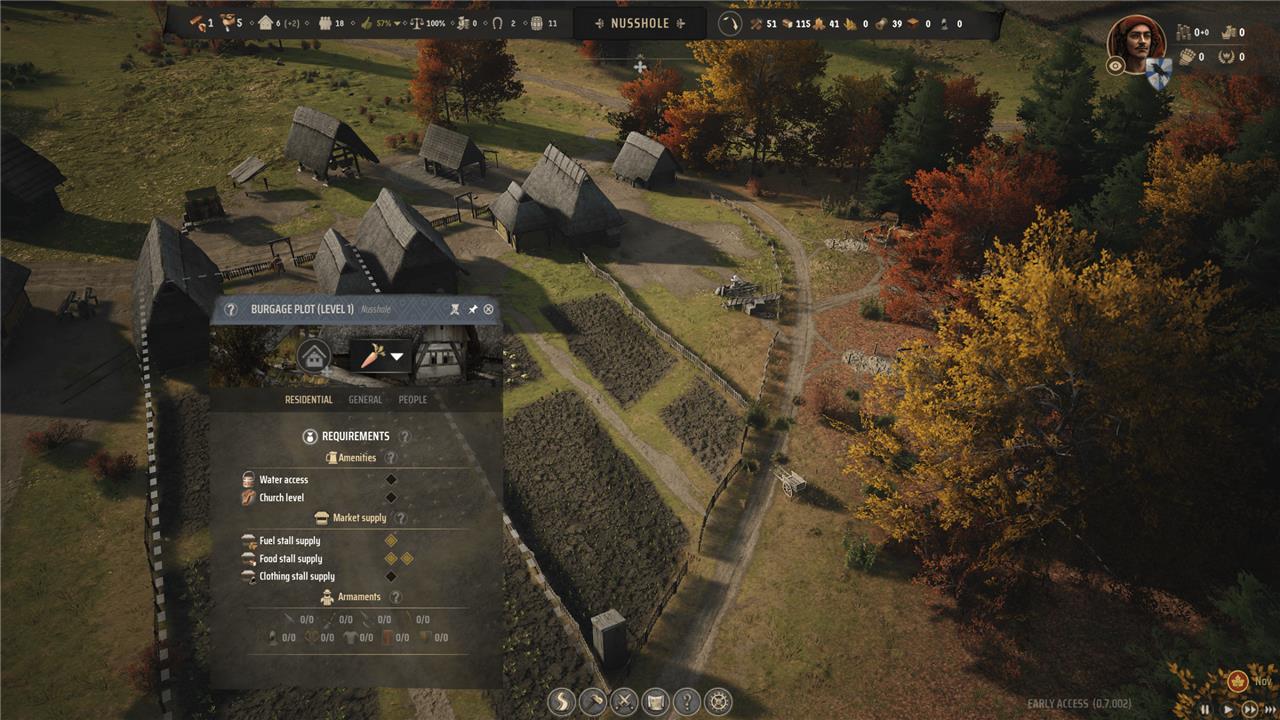
There’s a lot of infrastructure that goes into reaching Level 2. For timber, you’ll need a logging camp (2 timber). To turn that timber into planks, you’ll need a sawpit (2 timber) that will turn 1 timber into 5 planks. For fuel, you’ll need a woodcutter’s lodge (1 timber). The marketplace where families will set up stalls is, thankfully, free to build.
Meanwhile, you’ll have to feed your families. With a vegetable garden (see above), you’ll get some food, but you’ll need to supplement it with a hunting camp (no construction cost) and a forager hut (1 timber).
For clothing, you don’t actually need to be making full-on clothes. Really, all you need to supply is the ingredients, and the quickest (and cheapest) way to do that is with leather. A hunting camp already generates hides while also producing meat for food, so that’s your best option. Backyard goat sheds also generate some hides, but the setup costs 25 Regional Wealth, so it’s better to wait. Once you have a supply of hides, you’ll need a tannery (4 timber) to turn hides into leather that will then sell in the marketplace.
And, to make sure nothing rots or gets ruined by the weather, you’ll need a granary (2 timber, 10 stone) and a storehouse (2 timber).
On top of it all, you’ll need to assign families to each of those tasks (you don’t need to assign a family to the church).
Burgage plot (Level 2) extensions
Upgrading Burgage Plots to Level 2 in Manor Lords is a crucial step that unlocks new backyard extensions and enhances your settlement’s productivity. To initiate the Level 2 upgrade, your plot must have access to essential resources such as water (via a well), a wooden church, sufficient fuel supply, two types of food stalls, and at least one clothing stall. Once these requirements are met and you invest the necessary timber, the plot can be upgraded, allowing you to build artisan backyard extensions like the Blacksmith’s Workshop and Tailor’s Workshop. This upgrade not only enables crafting of weapons and armor but also activates a monthly income of one regional wealth per family, significantly contributing to your settlement’s growth and prosperity.
With a burage plot (Level 2), you’ll unlock some new backyard workshops for things like a blacksmith, brewery, or cobbler. The important thing to note here is that building these extensions converts the family (or families) on that burgage plot into artisans. That means the only thing families living on that Burgage Plot will do is that activity. And that means, for example, even if you pause the work at a Tailor’s Shop, the family won’t become unassigned and available for other jobs. Those families are only every going to be artisans.
Burgage plots Level 3 requirements
To upgrade Burgage Plots to Level 3 in Manor Lords, your village must already have Level 2 Burgage Plots and meet several key requirements. These include having a well for water access, a small stone church (upgraded from a wooden church), and a tavern that supplies ale. Additionally, your settlement must provide a diverse food supply with three types of food stalls (such as meat, berries, and vegetables or eggs), as well as two clothing stalls-one of which must sell finished clothing items like clothes, cloaks, or shoes. The upgrade also requires construction materials: 4 timber, 8 planks, and 4 clay tiles, along with a medium village settlement level. Upgrading to Level 3 doubles the number of families the plot can house and significantly increases regional wealth generation, making it a crucial step for town development.
To upgrade from a burgage plot (Level 2) to a burgage plot (Level 3), you’ll need the following on top of what was already required for Level 2:
- A well
- A tavern (5 timber) supplied with ale
- A small stone church (5 timber, 20 stone, 10 planks, 10 rooftiles), which is an upgrade to the wooden church
- A suppliedfuel stall in a marketplace
- A food stall in a marketplace supplying (at least) three kinds of food
- A suppliedclothing stall in a marketplace selling leather, linen, or yarn as well as shoes, clothes, or cloaks
- 25 Regional Wealth, 4 timber, 8 planks, and 4 rooftiles for the upgrade itself.
How to upgrade to Level 3, step-by-step
To upgrade a Burgage Plot to Level 3 in Manor Lords, first ensure the plot is already upgraded to Level 2. Then, meet the following requirements: have a nearby tavern supplying ale, upgrade your wooden church to a small stone church, provide a third type of food in the marketplace (such as vegetables or eggs), and secure a second clothing stall that offers finished garments like shoes or cloaks. Once these conditions are met, upgrading to Level 3 will cost 25 Regional Wealth, 4 timber, 8 planks, and 4 clay tiles. Click the house icon on the Burgage Plot summary to initiate the upgrade.
Upgrading your burgage plots again gets you some real benefits. Burgage plots (Level 3) get you 2 Regional Wealth per family per month. It also doubles the number of families that plot can support – meaning you’ll get two families for a regular plot or four for a plot with a living space expansion built.
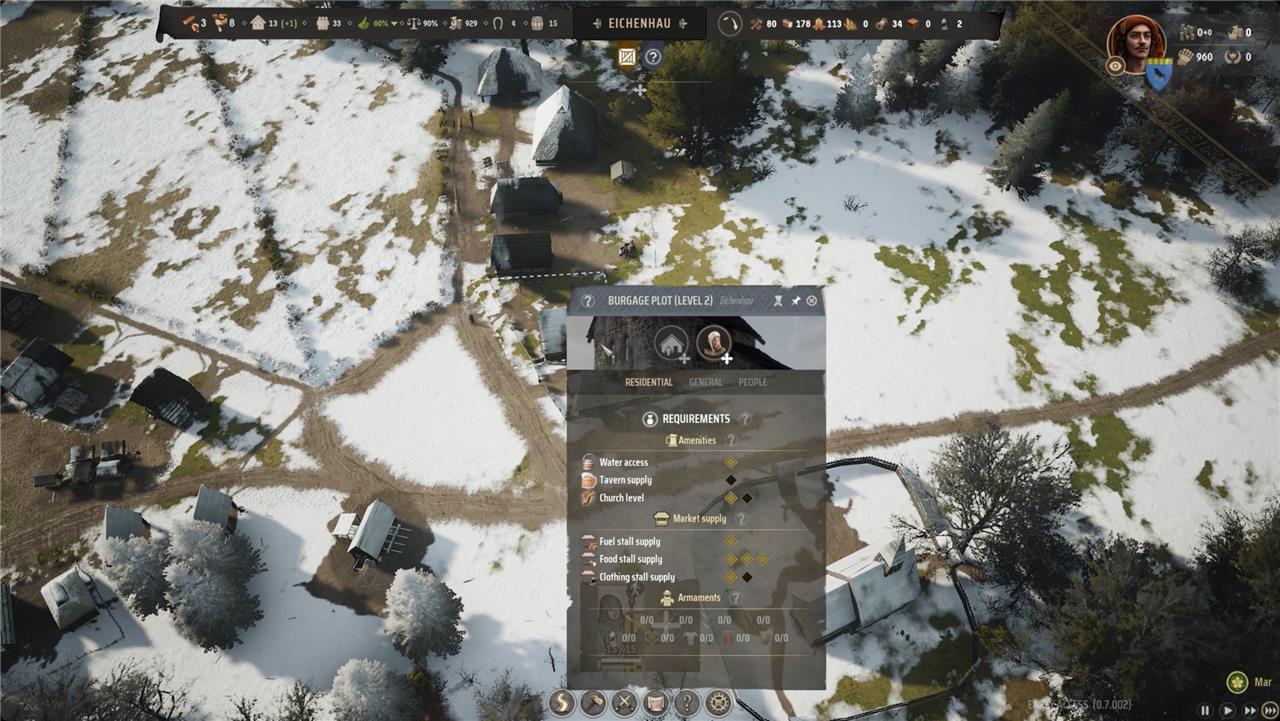
On top of everything you built for the first round of upgrades, you’ll have to have a bit more industry running for this upgrade. You’ll probably need a stonecutter camp (2 timber) near a fieldstone deposit by this point. For the rooftiles, you’ll need a mining pit (1 timber) over a clay deposit and a clay furnace (2 timber, 5 stone).
For the tavern, you’ll need ale. And for that, you’ll need at least one burgage plot (Level 2) with a brewery extension (5 Regional Wealth, 5 planks). That will need to be supplied with malt from a malthouse (4 timber). That, in turn, will need a supply of barley either from a field and farmhouse (3 timber) or from importing it through a trading post. Technically, you can import anything in that supply chain including ale, but that’s really expensive.
To supply shoes, clothes, or cloaks to the marketplace, you’ll need a burgage plot (Level 2) with a tailor’s workshop (5 Regional Wealth, 5 planks) or a cobbler’s workshop (5 Regional Wealth, 5 planks) built in its extension slot.
A tailor’s workshop needs some combination of linen from a weaver workshop (4 timber) supplied with flax from a farm, dyes from a dyer’s workshop (2 timber) supplied with berries from a forager hut, and yarn from a weaver workshop supplied with wool from a sheep farm (1 timber).
What secret steps unlock the fastest Burgage Plot upgrades in Manor Lords
The fastest way to upgrade Burgage Plots in Manor Lords involves carefully meeting specific prerequisites and managing resources efficiently:
-
Upgrade to Level 2:
-
Build a well on groundwater for water access.
-
Construct a wooden church (Church level 1).
-
Ensure a steady supply of firewood or charcoal, typically by having a Woodcutter’s Lodge.
-
Provide two different types of food at the marketplace, such as meat from a Hunting Camp and berries from a Forager Hut.
-
Supply clothing materials like leather, linen, or yarn, often via a Hunting Camp and Tannery.
-
The upgrade costs 4 timber once these are met.
-
-
Upgrade to Level 3:
-
Have the plot already at level 2.
-
Upgrade the wooden church to a small stone church (costing timber, stones, planks, and clay tiles).
-
Maintain a nearby tavern supplying enough ale.
-
Add a third food type to the marketplace, such as vegetables or eggs from backyard extensions, or bread from farming and baking.
-
Provide a second clothing stall with finished products like shoes, which require leather and a cobbler’s workshop extension.
-
The upgrade costs 25 Regional Wealth, 4 timber, 8 planks, and 4 clay tiles.
-
Secret tips for speed:
-
Prioritize hunting early and build a tannery quickly to meet leather supply needs.
-
Use backyard extensions like coops and gardens to diversify food types efficiently.
-
Temporarily place a tavern keeper just long enough to spread ale and meet level 3 requirements before pausing the tavern to save resources.
By strategically fulfilling these requirements and managing your market stalls and infrastructure, you unlock Burgage Plot upgrades rapidly, accelerating your settlement’s growth and prosperity.
What are the overlooked strategies to speed up Burgage Plot upgrades in Manor Lords
Overlooked Strategies to Speed Up Burgage Plot Upgrades in Manor Lords
-
Delay Early Upgrades to Focus on Population Growth
Upgrading Burgage Plots past level 1 too early (within the first 3-4 years) can slow down your overall progress. Prioritize growing your population first, as a larger population provides more workers to staff required buildings and stalls for upgrades. -
Build Burgage Plots Close to the Marketplace
Proximity to the Marketplace ensures that the Burgage Plots have easy access to required goods like food, fuel, and clothing stalls. This connectivity is crucial because upgrade requirements depend on resource availability through road connections, not just on-site buildings. -
Use Backyard Extensions to Diversify Food and Clothing Supplies
Backyard extensions such as chicken coops, vegetable gardens, and cobbler workshops help provide the multiple types of food and finished clothing products needed for higher-level upgrades without requiring large-scale farming or production buildings. This diversification speeds up meeting upgrade prerequisites. -
Temporarily Operate Taverns and Workshops
Since level 3 upgrades require ale supply and finished clothing goods, you can build and briefly operate a tavern and cobbler workshop just long enough to meet the upgrade conditions, then pause or repurpose them to save resources and workforce. -
Manage Regional Wealth Efficiently
Level 3 upgrades require a significant amount of Regional Wealth. Focus on generating wealth early by upgrading some Burgage Plots and building economic structures, but balance this with population and resource needs to avoid bottlenecks. -
Ensure Well Placement on Groundwater
Water access is mandatory for upgrades. Placing wells on groundwater spots (indicated by a blue hue) early ensures all Burgage Plots can upgrade without delay.
By combining these strategies-prioritizing population growth, ensuring resource access through strategic placement, leveraging backyard extensions, and temporarily running required buildings-you can accelerate Burgage Plot upgrades effectively and sustainably.
