
“Everything Everywhere All At Once” didn’t just win Best Picture-it proved that chaos, absurdity, and heartfelt storytelling can collide to create something unforgettable, redefining what Hollywood rewards as greatness.
Everything Everywhere All At Once is the 2023 Oscars Best Picture winner, and it also netted six other awards, for Best Director, Original Screenplay, Film Editing, Actress, and Supporting Actor and Actress. For anyone who watched this year’s ceremony, where the audience went wild every time the film was mentioned, the Best Picture win stopped being a surprise about halfway through the show. But a year ago, no one could have watched Daniel Kwan and Daniel Scheinert’s multiverse masterpiece and anticipated this kind of response or recognition – not from the notoriously stodgy Academy.
Everything Everywhere initially felt like a film designed to earn a small, passionate audience. At best, it seemed like it might become a well-kept cult-movie secret. It played like a bigger and brighter version of the Daniels’ first movie, Swiss Army Man – a movie beloved in certain circles, but too dark, eccentric, and subversive to command a mainstream or widespread audience. Certainly neither of their projects felt like Academy contenders.
But as word of mouth about the film grew, and it stayed in theaters week after week, the narrative began to change. There were so many reasons to see the film as a collective feel-good experience for cinema fans: Ke Huy Quan’s triumphant return to film; Michelle Yeoh landing a leading role worthy of her acting skills, as well as her martial-arts skills. Jamie Lee Curtis returning to comedy in a unique role. A majority Asian cast telling the kind of nuanced, emotional story they so rarely get to tell in American film. A story full of Easter eggs and in-jokes aimed directly at cinephiles. As the conversation around the movie got bigger and bigger, it started to take on scrappy-underdog overtones, especially by the time it became the first $100 million box-office hit for small arthouse distributor A24.
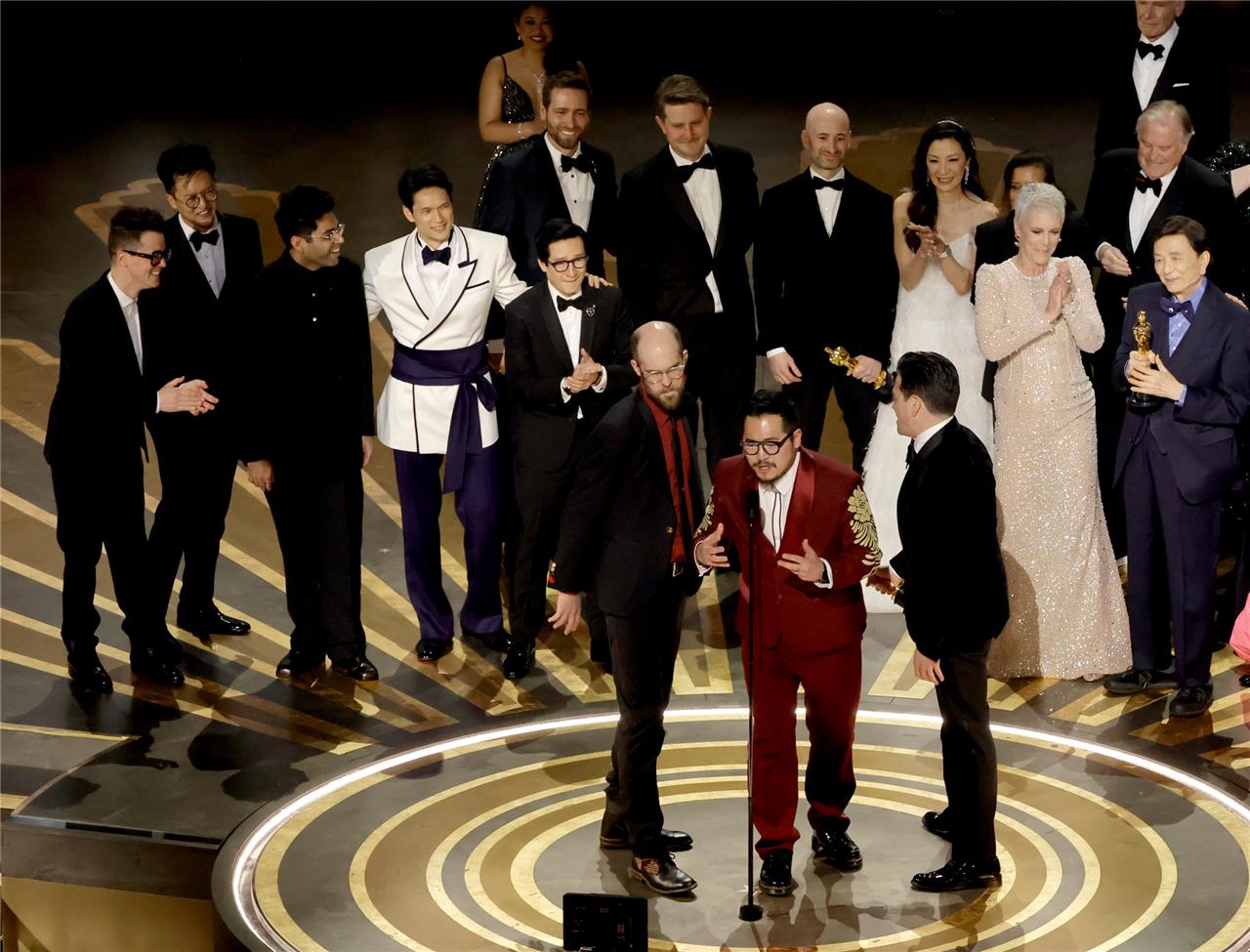
And by the time Oscar nominations rolled around, and the movie showed up in 11 categories, Everything Everywhere was looking like a real rarity in Oscars history: a serious Academy Awards contender that was also a comedy and an action-thriller – and above all, a weird, weird movie.
In one sense, at least, Everything Everywhere is a traditional Oscar movie: It takes its characters through a gauntlet of suffering, then gives them a humanistic, uplifting ending. But nothing else about it fits the usual Oscar model. Gags about dildos and buttplugs, S&M and condiment-squirting hot-dog fingers, all puncture the kind of self-important gravity that usually scores big at the annual ceremony. The Academy almost never recognizes genre films outside of the technical categories. But Everything Everywhere is a science fiction fantasy that fully embraces the possibilities of alternate universes, leaping between worlds and challenges viewers to keep up with the pace.
Just getting Academy attention in the first place makes the Daniels’ film a triumph. It’s the kind of project that should win Oscars far more often – a technically stunning, ambitious movie that deliberately pushes the envelope of what cinema can do. It’s consciously designed to go further and faster than most movies, to challenge the audience as well as the medium. And it’s designed above all to make the world a better place, to push viewers to come away wanting to be better, kinder people.
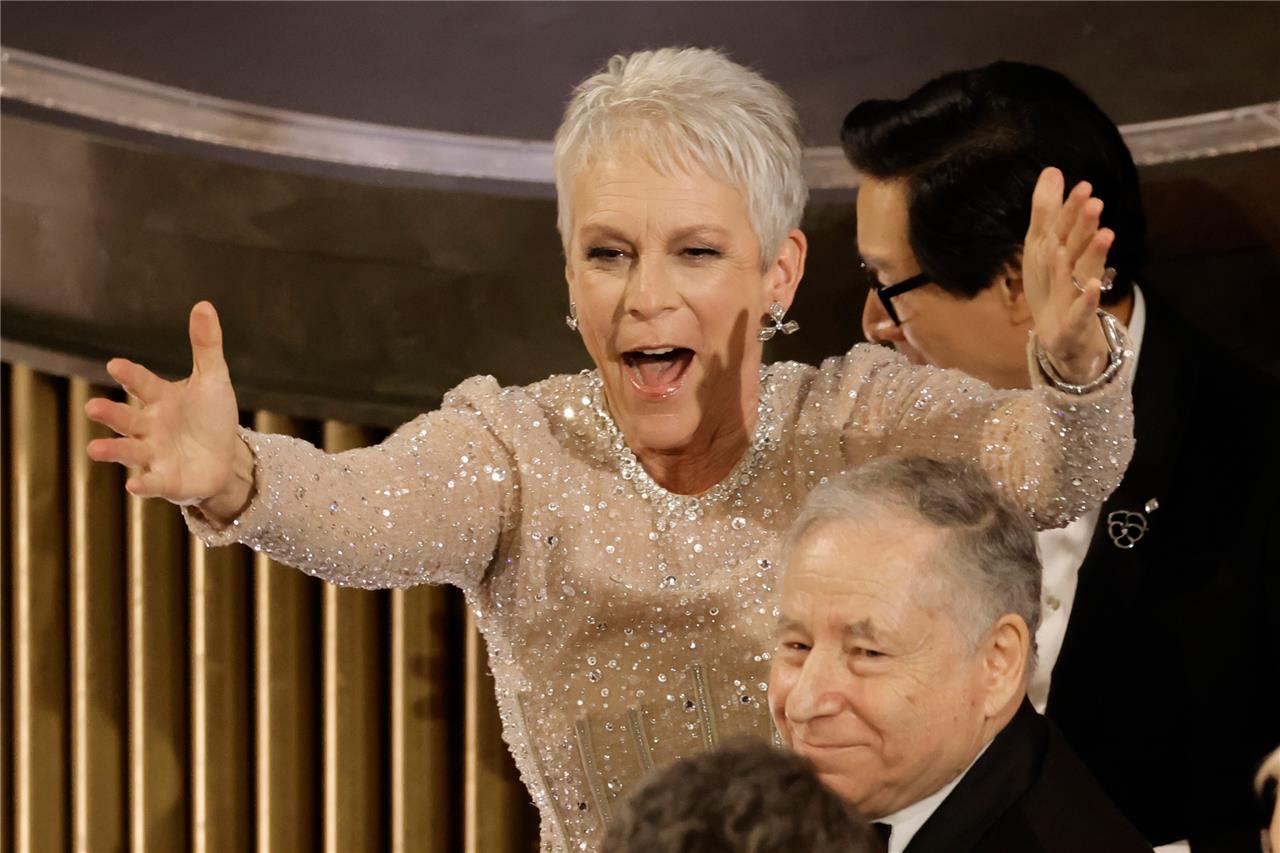
But that isn’t what the Academy usually honors. Even in the era of the expanded Best Picture category, designed to lure in viewers by recognizing a few populist blockbusters per year, the Academy still focuses the actual awards on historical dramas and prestige films. Even when the very occasional authentic oddity pulls off a Best Picture win – Guillermo del Toro’s The Shape of Water in 2017, for instance – it’s still always a grave and serious film, one that feels like a prestige drama with fantastical elements tacked on.
No one would accuse Everything Everywhere of being that. It’s a movie that genuinely challenges the medium, instead of imitating familiar styles and stories. It represents the kind of innovation and excellence that the Academy should be looking for every year. Recognizing it and rewarding it is a good look for the notoriously stodgy awards body.
But it’s also a triumph for downright weird cinema. If success continues to breed imitation in Hollywood, maybe at this time in a few years, we’ll see more movies picking up on the Daniels’ energy and hilarity the way, for instance, animators across a variety of studios have picked up on Spider-Man: Into the Spider-Verse‘s visual experiments and boundary-pushing animation. Maybe the energy that infected the Oscars this year, from the speeches to the audience response, will be a lesson for the Academy that joy and excitement are just as worthwhile and respectable as cinematic values as solemnity and historical weight. Bring on the cosmic bagels and the hot-dog fingers: Finally, weird cinema is fully mainstream.
What makes Everything Everywhere All at Once weird cinema
Everything Everywhere All at Once (EEAAO) stands out as “weird cinema” through its bold fusion of multiverse sci-fi, absurdist humor, and raw emotional depth, defying conventional storytelling.
Absurd Visuals and Scenarios
The film revels in bizarre alternate universes, like one where humans have hot dog fingers, another with everyone as rocks on a cliff, or a 2D cartoon realm-each used for both comedy and poignant metaphors on regret and identity. Everyday objects turn weapons in kinetic fight scenes, such as fanny packs wielded like nunchucks or inter-dimensional jumps triggered by chewing discarded gum or eating chapstick. A giant “everything bagel” symbolizes nihilism as both cosmic threat and a character’s suicidal despair, blending Jackson Pollock-like chaos with VFX innovation.
Genre Mashup and Tone Shifts
Directors Daniels (Kwan and Scheinert) mix martial arts action, slapstick (butt plugs as props), family drama, and philosophy without missing a beat, echoing their prior “farting corpse” film Swiss Army Man. It fractures from mundane laundromat life into hyperactive multiverse-hopping, where Evelyn controls infinite selves via “verse-jumping” through weird acts, creating a “metaphysical pep-talk” amid cynicism.
Thematic Weirdness
Beneath the frenzy, it probes immigrant struggles, generational clashes, queer identity, and existential voids-turning nihilism’s “nothing matters” into a heartfelt call for kindness and connection. This “hypermodern” style captures internet-age fragmentation, making the weird not just spectacle but a vehicle for authentic human stories.
How do Daniels create multiverse effects
Daniels (Daniel Kwan and Daniel Scheinert) crafted the multiverse effects in Everything Everywhere All at Once through resourceful low-budget ingenuity, blending practical on-set tricks with minimal digital enhancements.
Practical Effects First
They prioritized hands-on techniques like wires, puppets, leaf blowers, and camera rigs to sell interdimensional chaos without heavy CGI reliance. For the first “verse-jump,” they placed Michelle Yeoh in an office chair on a wheelbarrow, pushed it slowly with an open shutter speed and hair blown by a fan, then sped up the footage in post for frenetic energy. Everyday props became weapons-fanny packs as nunchucks-filmed kinetically to feel grounded amid absurdity.
Hybrid On-Set Tech
Locations like Chinatown doubled for multiple universes, with pre-built sets enabling quick swaps; LED screens played custom B-roll (e.g., blurry New York footage for “flying” transitions) while green screens wrapped for compositing. Slow-motion performances against sped-up backgrounds created seamless jumps, mimicking verse-hopping without full CG builds.
Post-Production Polish
A small VFX team (about five artists over 18 months) used Cinema 4D, Blender, After Effects, and Red Giant tools for 500 shots, treating elements like the “everything bagel” as 2D composites with one CG render masked and lit manually for instant tweaks-avoiding long renders. Practical paper was enhanced with warping effects near the bagel, blending real physics with subtle digital warps to evoke Ghostbusters-style handmade wonder over Marvel polish.
