
After the chaos of Genshin Impact’s grinding systems, Final Fantasy 14 feels almost relaxing-its daily tasks and progression loops ask less, reward more, and remind players that not every MMO needs to feel like a second job.
Final Fantasy 14 and Genshin Impact are both behemoths. Although developer Hoyoverse released Genshin just two years ago, the game has grown to include several giant regions and features a regular cycle of new content and events every six weeks. Similarly, Square Enix released Final Fantasy 14 in 2010 (and then again in 2013) and it still gets regular updates; it has since grown to receive four major expansions after the A Realm Reborn re-release. Two online multiplayer games that command massive audiences, both games demand commitment. The only difference is that Final Fantasy 14 respects my time in a way Genshin doesn’t.
For those unfamiliar, Genshin Impact sends players on a free-to-play open-world adventure set in an anime-esque fantasy world. You can play the game a bunch of different ways, focusing on building strong teams, exploring its many regions, or powering through n the story, but Genshin can feel pretty stressful to keep up with. Story quests with important lore and entire regions can be locked behind time-limited events; even building a team of four characters can take a long time since you have to level up the characters, their weapons, their individual skills, and items called artifacts that influence stats.
Genshin unravels a seemingly endless to-do list that’s highly rewarding if you make it through it all, but also entraps the player in a cyclical game loop that’s more focused on repetitive tasks than on advancing a single story. Each completed task seems to reveal more necessary tasks. Furthermore, the game rewards you with an in-game currency called Primogems; you can spend this currency on gacha and gamble for new characters. The mechanics incentivize daily players who stick to the battle pass and check off all the right tasks in order to win Primogems, which can make it feel like you are financially incentivized to play a certain way. In my case, this has led to increasing feelings of burnout, even a lack of motivation.
Unlike Genshin, Final Fantasy 14 derives from a more linear formula, which leads to feel like time spent in the game isn’t tossed into an endless black hole. Yes, I have the option to do repetitive daily and weekly tasks, but whether or not I do them feels like it’s truly up to me as a player. I can level up a single job relatively quickly by doing the mainline quest, and unlock later game content. It doesn’t feel like a constant grind where I juggle various tasks. After playing Genshin, looking down the barrel of this 300 hour-long or more game strangely doesn’t feel all that daunting.
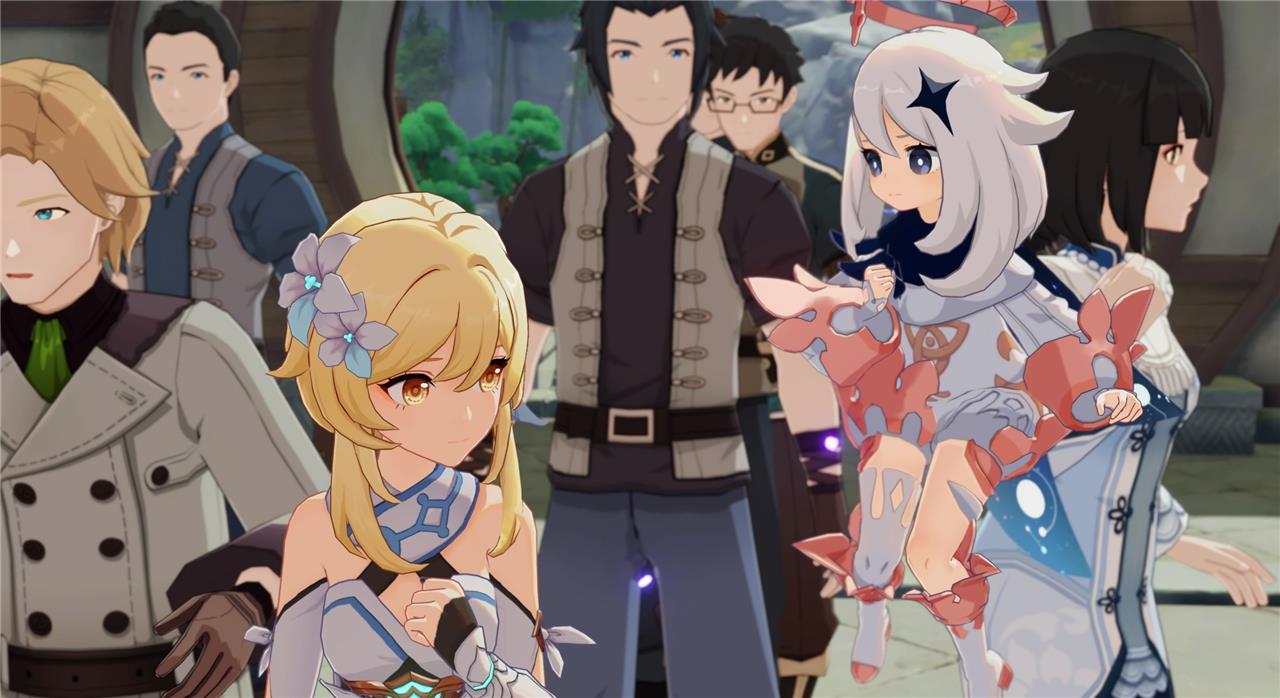
Before I started Final Fantasy 14 in earnest this winter, I played roughly ten hours of the game six months prior. With Final Fantasy 14, I was able to take a six-month break and return without so much as batting an eye, because I knew I just needed to click the buttons and just follow the map icon prompts for the main quest. Additionally, Final Fantasy 14 contains other basic but key quality-of-life features, like the ability to skip certain cutscenes or speed through dialogue in duller parts of the journey.
Another huge way to carry a player through a long journey is to seek help from comrades. The best part of playing Final Fantasy 14 has been adventuring with friends and learning under their tutelage. (Genshin has multiplayer features but limits how and what you do.) I had a friend and longtime player of the game offer to chauffeur me around in her giant Moogle mount, meaning I essentially had someone drive me around from quest point to quest point. As we slogged through the rather tedious early game quests of A Realm Reborn, she taught me about the world of the game. I learned about its history, and about what has changed in the world since she played. She talked to me about a wedding she attended, and what the ceremonies entail in Eorzea. She gossiped to me about characters and told me about drama in her guild. The conversations while playing didn’t just allow me to connect with my friend – it led Eorzea to feel more like a living, breathing world.
This isn’t to minimize the very real time sink that is playing an MMO. I don’t think Final Fantasy 14 is for everyone. But I don’t think the long time commitment in and of itself needs to be what scares a player away. That’s because Final Fantasy 14 shows the merits in having a game where the developers don’t need you to play every day, fully recognizing that players like to take time off. During a Q&A session at Gamescom, Final Fantasy 14 producer Naoki Yoshida (known to fans as Yoshi-P) offered advice to a player who asked about dealing with low motivation to play the game. Yoshi-P surprised fans with his answer by telling the player that they should actually just not play the game as much. According to a Reddit post translating the answer, he said:
It’s alright not to play it every day. Since it’s just a game, you can stop forcing yourself if it’s hard on you to keep that up. Rather, it’ll just pile up unnecessary stress if you limit yourself [to] playing just that one game since there are so many other games out there. So, do come back and play it to your heart’s content when the major patch kicks in, then stop it to play other games before you [get] get burnt out, and then come back for another major patch. This will actually make me happier, and in the end, I think this is the best solution I can answer for keeping your motivation up for the game.
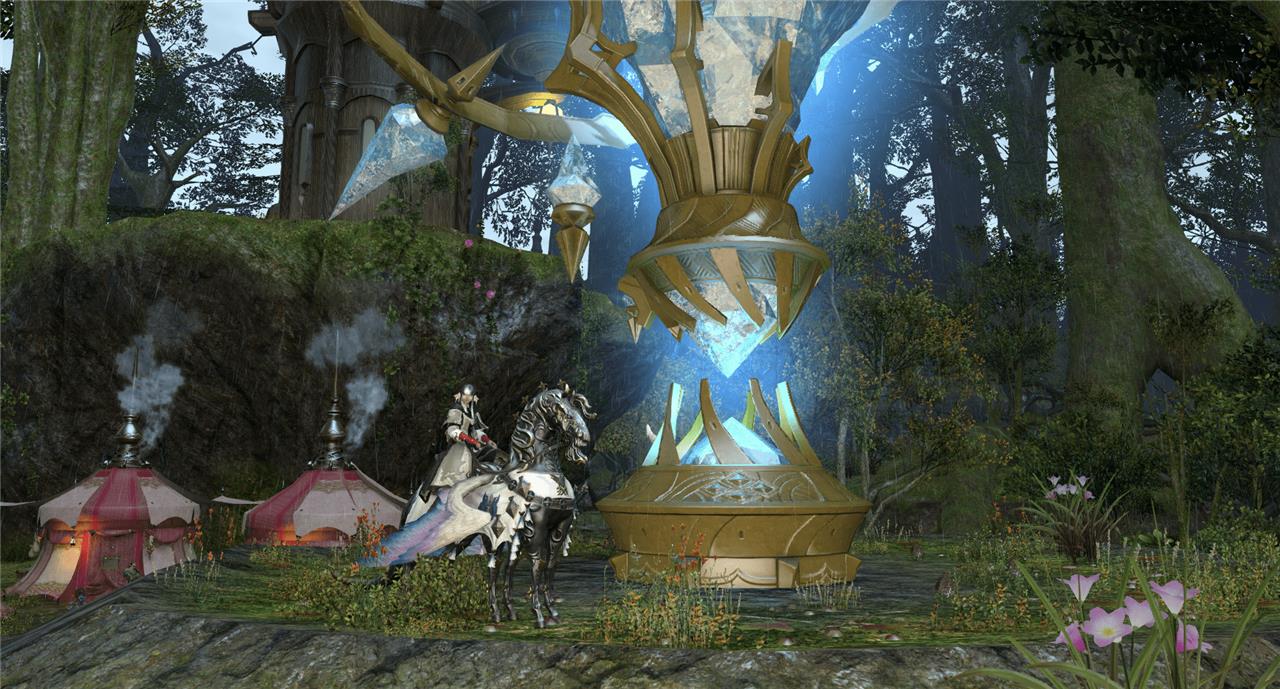
To me, this gets to the heart of why Final Fantasy 14 feels arguably easier to broach than, say, even returning to the regular grind of Genshin. For a game to be fun, you sometimes just need to take regular and frequent breaks. In Genshin, I need to enforce boundaries in a way I don’t with Final Fantasy 14, where taking a break feels natural. This is an element of playing a large game that feels difficult even with single-player games. I’ve played RPGs that feel a bit too difficult to get back into after a week-long break, because once you leave, you return to find you’ve forgotten some of the combat systems or feel too lost in a dungeon.
Sure, jumping into Final Fantasy 14 can be a doozy. From the moment you arrive, you’re hit with the daunting prospect of exploring a massive city. You see a map peppered with unfamiliar icons and observe dozens of other players going about their business around you. You have to learn about jobs, mounts, outfits, and so much more. It certainly can be overwhelming, but I’ve found a game that’ll allow me to unravel the secrets of its world at my own pace, one step at a time.
FF14 beginner guide after playing Genshin
FF14 offers a more structured, story-driven start than Genshin’s open-world grind, making it welcoming for transitions.
Starting Out
Create your character in one of three starting cities (Limsa Lominsa, Gridania, or Ul’dah) and pick an initial class like Gladiator or Lancer-easy to switch later via job quests. Focus solely on Main Scenario Quests (MSQ, blue icons with a meteor) to unlock zones, dungeons, and expansions; skip most side quests early to avoid bloat. Use the Hall of the Novice in your starting city for free tutorials on combat basics, earning an XP-boosting ring up to level 30.
Key Differences from Genshin
Unlike Genshin’s daily commissions and resin limits, FF14 has no mandatory dailies-progress at your pace with rested XP for offline gains. Combat emphasizes positionals (flank/rear attacks) and mechanics over raw DPS spam; queue for dungeons via Duty Finder for quick groups. Gear comes from MSQ rewards, vendors, or dungeons-no gacha or artifact RNG.
Leveling Tips
Prioritize MSQ and class/job quests (yellow icons) for abilities and story; run daily roulettes for bonus XP and first-time clears. Join a Free Company (guild) early for buffs, advice, and carry help-use Party Finder for group content. Unlock mounts via early quests/dungeons for faster travel across Eorzea’s zones.
Best beginner jobs for Genshin players
FF14 jobs suit Genshin players by emphasizing rotation-based combat over open-world chaos, with familiar elemental flair but structured roles.
Top Picks
Lancer/Dragoon mirrors Genshin polearm users like Xiao or Hu Tao-simple poke combos build to jumps, with low cooldowns and high jumps for aerial flair; great for solo story.
Archer/Bard feels like bow DPS (e.g., Fischl off-field or Ganyu), focusing procs and DoTs over direct aim; songs buff groups like supports.
Thaumaturge/Black Mage evokes Pyro mages (Xiangling, Yanfei) with fire spells and risky MP bursts-bind casts for mobile play like swap-heavy Genshin teams.
Why These Work
Genshin vets handle positionals (flank/rear hits) intuitively from elemental triggers, easing into FF14’s mechanic-heavy fights. Start melee for faster queues; swap to healers (Conjurer/White Mage, like Barbara) later for self-sustain without resin gates. All unlock early, level via MSQ.
