
Why settle for one path when you can walk many? In Baldur’s Gate 3, multiclassing lets you break the mold, blending abilities from different classes to forge a hero that’s uniquely yours-whether you want a spell-slinging rogue or a sword-wielding sorcerer, the possibilities are as limitless as your imagination. Ready to unlock powerful synergies and craft a character that defies convention? Here’s how to master multiclassing across PC, PlayStation, and Xbox.
In this Baldur’s Gate 3 guide, we’ll teach you how to multiclass; explain the multiclass requirements for, and pros and cons of, multiclassing; and suggest some of the best multiclass builds.
How to multiclass in BG3
To multiclass in Baldur’s Gate 3, you first need to reach level 2 on your character. When you level up, open the Level Up screen and click the “Add Class” button-usually found in the upper right corner. This lets you choose an additional class to combine with your current one, allowing you to mix and match abilities from any of the game’s twelve classes. Each time you level up, you decide which class to advance, but remember: your total levels across all classes cannot exceed the game’s cap of 12. Multiclassing is only available on Balanced or Tactician difficulties, and while it offers powerful synergies, it also means you might miss out on the highest-level abilities of any single class.

You can multiclass in Baldur’s Gate 3 as early as level 2, and there are no restrictions on which classes you can combine together – although some obviously play much better together than others.
When you level up, look for a button in the top right of the level up panel (on the left side of your screen). You’re looking for a button that has an ax and a staff crossed on it, with a plus symbol sitting above it. If you click that button, the game will open a panel that shows how many levels you have in each class. From there, you can select a new class and level up in that instead of in your main class.
The next time you level up, you’ll see a new display that shows your two classes and their respective levels. You’ll then be able to select between the two of them or add a third subclass. Now I don’t recommend getting into more than two classes for a single character (unless you’re going for the Jack-of-all-Trades achievement) but there’s nothing actually stopping you from putting a single level into all 12 classes.
Should you multiclass in BG3?
Multiclassing in Baldur’s Gate 3 offers the freedom to blend abilities from different classes, creating unique and versatile characters. However, with a level cap of 12, multiclassing comes with trade-offs: while you can access a broader range of skills and spells, you may miss out on the most powerful high-level features available to single-class characters. This makes multiclassing best suited for players who want to experiment with creative builds or fill specific gaps in their party, but it requires careful planning to avoid weakening your character overall. If you’re looking to maximize endgame power or unlock the strongest class features, sticking to a single class is often more effective. Ultimately, multiclassing is ideal for those who value flexibility and synergy over raw, specialized power.

Multiclassing is a very complex decision in Baldur’s Gate 3, and you’ll need to weigh the pros and cons as you’re putting your build together.
The positives are fairly obvious. By deciding to multiclass you can:
- Combine class features together to make truly busted combinations
- Shore up some of the weaknesses of your main class
- Gain more resources that benefit your main class, like additional spell slots
- Fulfill a really cool roleplay fantasy of a heavy armored mage or a raging barbarian monk
- Get even more attacks per turn
The drawbacks, however, are a bit more nuanced.
Making the decision to multiclass at all means your main class will never reach level 12, which is the max level in the game. Because of this, you might miss out on some truly amazing features, depending on your class and subclass. You’ll need to weigh that against the amazing feature combos you can get from combining with a second class.
Another con – or at least something to be aware of – is that you only gain the proficiencies of your first class. So you can’t start as a Sorcerer, decide you want to wear heavy armor, and then take a dip into Paladin. What you’d need to do there is start as a Paladin and then take the rest of your 11 levels in Sorcerer. You can’t just take a dip into a few classes and walk away with all the proficiencies.
Finally, and this is a pro or a con depending on how much of a strategy fan you are: Multiclassing can make the game very easy when playing on the standard difficulty. Building a multiclass character is typically a big investment, and you’ll probably feel a little behind once you forgo a level in your primary class and start dipping into another. But once you’re at max level and you’ve got a ton of magic items to combine together – not to mention and so much gold that you can easily tweak your class to perfection via Withers – you can become an unstoppable monster fairly simply.
Best multiclass builds in BG3
Baldur’s Gate 3 offers a wealth of powerful multiclass builds that combine the strengths of different classes for unique playstyles and devastating combos. Some of the most popular and effective options include the Sorcadin (Paladin/Sorcerer), which blends frontline durability with potent spellcasting and smite synergy, and the Lockadin (Paladin/Warlock), renowned for its explosive burst damage and action economy. Other top-tier builds are the Rogue/Monk for unmatched mobility and damage output, the Rogue/Ranger for high ranged and sneak attack damage, and the Barbarian/Paladin for a blend of tankiness and raw melee power. Players also find success with creative mixes like Bard/Rogue for versatile support and control, Wizard/Cleric for spellcasting flexibility, and even more specialized setups such as the Death Knight (Bladesinging Wizard/Fighter) or the Hexbuckler (Warlock/Rogue). With so many viable combinations, nearly every multiclass build can shine if you focus on synergy and avoid mixing classes with conflicting playstyles.
Multiclassing is a very promising and lucrative endeavor, if you make the right choices. The most powerful builds in Baldur’s Gate 3 typically involve multiclassing, and there is some real fun to be had if you put some thought into your character or follow a build guide.
If you want to try to put together your own combos, keep in mind that classes usually work best together when they share the same main stat, like Paladin, Bard, Warlock, and Sorcerer all using Charisma.
If you’d rather get some recommendations, here are three of our favorite combos:
Paladin and Pact of the Blade Warlock
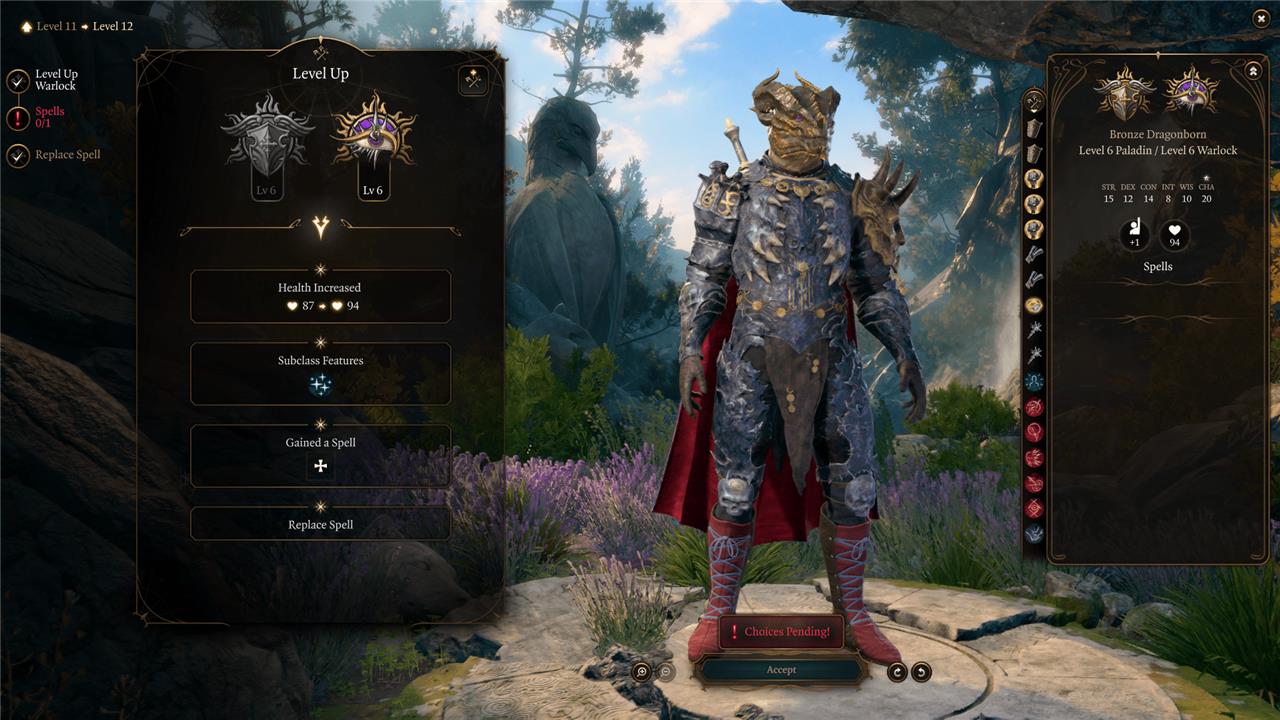
This combination is extremely powerful. Start with a Paladin of whatever Oath fancies you, and level it up to level 5 so you get your extra attack. Then, start taking levels in Warlock. At Warlock level 3, take Pact of the Blade and make your Paladin’s main weapon your Pact Weapon (this is extremely powerful when combined with a shield and the Blood of Lathander mace).
Once you hit Warlock level 5, you’ll gain another attack when using your Pact Weapon, and this stacks with your extra Paladin attack, giving your three weapon hits per turn. Take at least one more level in Paladin to get your Aura and the last level in whichever class you prefer. When you combine all of those attacks that use your Charisma score, an aura to buff your allies, heavy armor, Eldritch Blast, and Warlock spell slots that you can use to Divine Smite (which reset on a short rest, no less), the Palock is truly one of the most impressive builds in the game.
Thief Rogue and Gloomstalker Ranger

Where some multiclass combos are like mixing chocolate and peanut butter together – two great flavors that somehow make the other even better – others are more like adding chocolate to more chocolate. That’s pretty much what you’re dealing with when it comes to the Rogue and the Ranger.
The level up process for this one is pretty simple. Start with a Rogue and level up your character three times so you can select your subclass: Thief. Thief is just a totally busted subclass on Rogue because it gives you a second Bonus Action that you can use to dash, disengage, and do several other things that leave.
Then you take the next eight levels in Ranger and pick up the Gloomstalker subclass, which is the sneaky, stealthy ranger. From this you’ll deal some massive bonus damage on your first turn of each combat (paired with Sneak Attack from Rogue, you’ll be able to take out some enemies in a single hit to start the fight), and will gain an extra attack eventually. Once you hit Ranger level 8 and get a Feat, take one more dip into Rogue to finish your leveling experience with another Feat.
This build basically just turns you into a burst damage, stealth, and mobility machine. It’s a very popular build, and a ton of fun to play.
Barbarian and Fighter
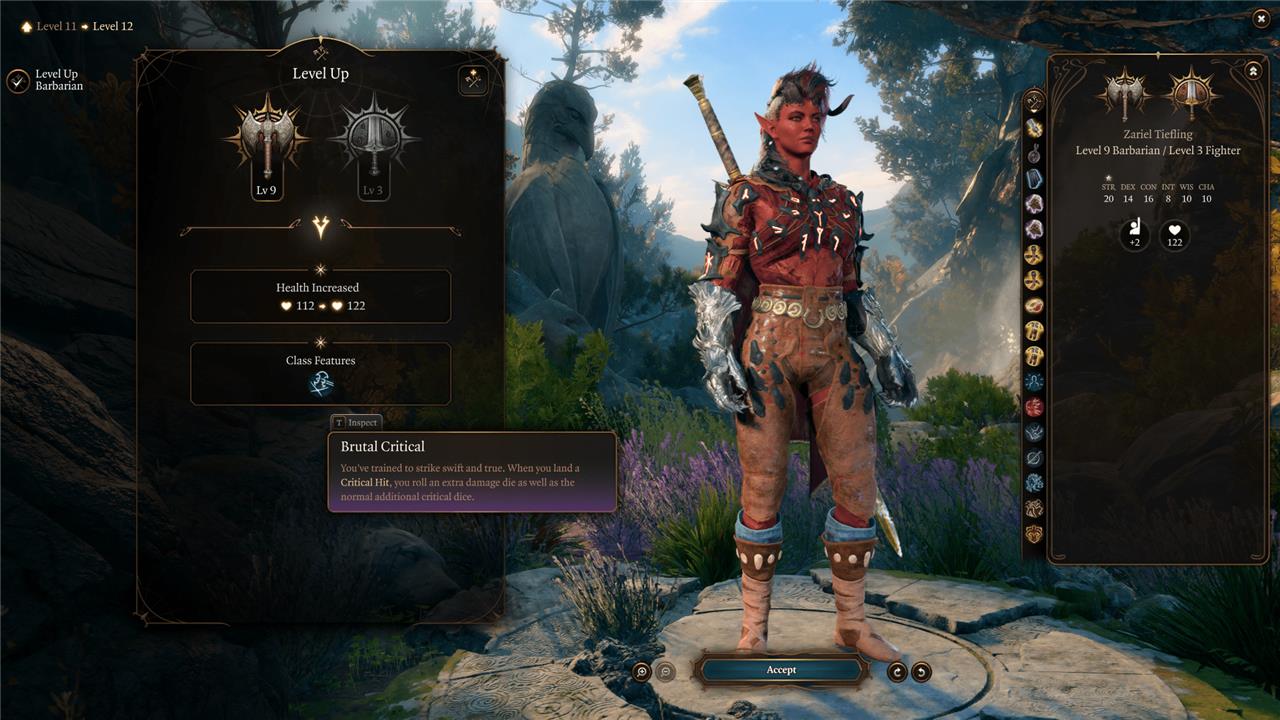
Sometimes in Baldur’s Gate 3, you just want to make a character that’s really, really good at hitting stuff really, really hard. Let Gale and Wyll sling some spells. You have a date with a big hammer, your own rage, and Action Surge.
The BarbarianFighter is a classic, powerful combo that allows you to tank your way around the battlefield beating enemies to a pulp.
For this, start as a Barbarian and level up until level 5, when you get your extra attack. That should help carry you through the first two levels of Fighter. Take Fighter to level 3 and choose the Champion subclass, which will allow you to critically attack when you roll 19 or 20 on the die. You’ll also pick up Action Surge, which allows you to gain your action back once per short rest. That means at level 8 (five in Barbarian and three in Fighter), you can strike a boss four times in a single turn. And you’ll roll a crit 1 in 10 rolls instead of 1 in 20.
Finish out the leveling process with Barbarian all the way to level 9, which will net you the Brutal Critical effect, which causes you to deal increased damage on a critical hit. As for your Barbarian subclass, I like to pair Champion with Berserker, as you’ll get yet another attack that you can use your bonus action on if you kill something.
What are the most effective multiclass builds for different playstyles in BG3
Most Effective Multiclass Builds for Different Playstyles in Baldur’s Gate 3
Powerful multiclass combinations in Baldur’s Gate 3 let you tailor your character to a wide range of playstyles, from stealthy assassins to devastating spellblades. Here are some of the most effective builds for popular archetypes:
Melee Damage & Survivability
-
Hexblade/Paladin (“Lockadin”): Combining Paladin (often Oath of Ancients) with Hexblade Warlock delivers high burst damage, access to heavy armor, spellcasting, and strong survivability. This is a top-tier pick for those who want to smite enemies with both martial and magical might.
-
Barbarian/Fighter: This classic martial combo maximizes attacks per turn and tankiness, making it ideal for frontline bruisers who want to dish out and absorb damage.
Martial Versatility & Mobility
-
Monk/Rogue/Fighter (“Meatgrinder Monk”): A mix of Monk (Way of the Open Hand), Rogue (Thief), and Fighter (for Action Surge) results in a character with exceptional mobility, multiple attacks, and high burst potential. This build excels at darting around the battlefield and delivering punishing flurries.
-
Swashbuckler/Hexblade (“Eldritch Pirate”): Combining Swashbuckler Rogue with Hexblade Warlock offers a stylish, mobile duelist with strong melee and spell options.
Ranged Damage
-
Rogue/Ranger: The most popular multiclass in BG3, this build leverages sneak attack and ranged weapon synergies for high single-target damage at a distance-perfect for sharpshooters and ambushers.
-
Arcane Archer/Fighter: Focuses on maximizing ranged attacks with magical enhancements, ideal for those who want to rain down enchanted arrows.
Spellcasting Power
-
Sorcerer/Paladin (“Sorcadin”): Blending Sorcerer’s spell flexibility with Paladin’s smite potential, this build offers potent burst damage and utility, making it a favorite for magical gish enthusiasts.
-
Storm Sorcerer/Tempest Cleric (“God of Thunder”): This combo creates a thematic and mechanically strong caster who can manipulate weather and deal massive lightning damage.
Support & Control
-
Circle of Stars Druid/Death Cleric: Offers powerful healing, crowd control, and summoning, making it a top choice for those who want to support allies while still contributing offensively.
-
Bladesinging Wizard/Death Knight: A hybrid that can control the battlefield with spells while holding their own in melee, ideal for tactical players who like versatility.
Unique & Fun Builds
-
Giant Barbarian Rainbow Thrower: Focuses on throwing enemies and objects for massive damage-a quirky but effective option for creative players.
-
Hand Crossbow Gunslinger Bard: Delivers rapid ranged attacks with Bardic support and utility, great for those who want to mix damage with party buffs.
Summary Table
| Playstyle | Example Build(s) | Key Features |
|---|---|---|
| Melee Damage/Tank | Lockadin, Barbarian/Fighter | High burst, tankiness, smites |
| Martial Versatility | Monk/Rogue/Fighter, Swashbuckler/Hexblade | Mobility, multiple attacks, style |
| Ranged Damage | Rogue/Ranger, Arcane Archer/Fighter | Sneak attack, magical arrows |
| Spellcasting Power | Sorcadin, Storm Sorcerer/Tempest Cleric | Burst, spell versatility |
| Support/Control | Stars Druid/Death Cleric, Bladesinger/Death Knight | Healing, control, melee-spell hybrid |
| Unique/Fun | Giant Barbarian Thrower, Gunslinger Bard | Creative, unconventional combat |
These multiclass builds are highly effective and cater to a variety of playstyles, allowing you to personalize your Baldur’s Gate 3 experience whether you prefer brute force, subtlety, spellcasting, or support.
Which multiclass builds best suit aggressive combat playstyles in BG3
Best Multiclass Builds for Aggressive Combat Playstyles in BG3
For players seeking aggressive, front-line dominance and high burst damage in Baldur’s Gate 3, several multiclass builds stand out for their raw offensive power and relentless combat presence:
Barbarian/Fighter (“Whirlwind Bruiser”)
-
Build Example: Barbarian (Path of the Berserker) 5 / Fighter (Champion) 7
-
Why It Works: This build combines the Barbarian’s devastating rage and extra attacks with the Fighter’s Action Surge and improved critical hit chance. The synergy allows for multiple attacks per round, high durability, and the ability to deal massive area-of-effect (AoE) and single-target damage. Key feats like Great Weapon Master and Polearm Master further amplify offensive output, making this build a top-tier choice for aggressive melee playstyles.
Fighter/Paladin
-
Build Example: 8 levels Fighter (Battle Master or Champion) / 4 levels Paladin (Oath of Vengeance recommended)
-
Why It Works: This multiclass leverages the Fighter’s Action Surge and Extra Attack with Paladin’s Divine Smite for explosive burst damage. Heavy armor proficiency and access to powerful melee abilities make this a premier pick for players who want to be at the center of the action, dishing out and absorbing hits in equal measure.
Paladin/Warlock (“Oathbreaker/Fiend Pact”)
-
Build Example: Oathbreaker Paladin 7 / Pact of the Fiend Warlock 5
-
Why It Works: This dark knight build uses Warlock’s Pact of the Blade for extra attacks and spell slots, fueling Paladin’s Divine Smites for huge burst damage. The combination of martial prowess and spellcasting makes this a formidable, aggressive damage dealer, especially effective at initiating combat and finishing off enemies quickly.
Monk/Rogue (“OH Monk/Thief Rogue”)
-
Build Example: 8 levels Monk / 4 levels Thief Rogue
-
Why It Works: This build focuses on overwhelming foes with multiple attacks, high mobility, and bonus actions. The Monk’s martial arts and the Rogue’s additional bonus action from the Thief subclass enable rapid, relentless offense-ideal for players who want to stay on the move and keep the pressure on enemies.
Summary Table
| Build | Key Features | Ideal For |
|---|---|---|
| Barbarian/Fighter | High burst, AoE, durability, extra attacks | Frontline melee aggression |
| Fighter/Paladin | Burst damage, tankiness, smites | Melee damage and survivability |
| Paladin/Warlock | Burst, spell slots for smite, versatility | Aggressive hybrid attackers |
| Monk/Thief Rogue | Multiple attacks, mobility, bonus actions | Fast, relentless melee offense |
These builds excel at aggressive combat, letting you dominate the battlefield with overwhelming force and relentless attacks.
