
When Pablo Berger fell in love with the graphic novel “Robot Dreams,” he didn’t just imagine it on the big screen-he built an entire animation studio from scratch to bring its bittersweet story to life. Discover how one director’s passion project became a cinematic sensation, reshaping the world of animated film.
“This time, when I got to the end of the book, that last act, I was so moved by the story, it brought me truly to tears,” Berger told AELGAMES in an interview ahead of the film’s limited theatrical release. “I was so shaken by the story. Right there at that moment, I thought there was something very special about the book. That’s when I decided to adapt it and make an animated film – even if it was something new for me.”
Varon’s book is a surprisingly poignant look at the ephemeral nature of friendships, and Berger was determined to capture that in his movie. He’d written and directed three celebrated, successful live-action feature films – Torremolinos 73, Abracadabra, and Spain’s 2012 Academy Award submission, Blancanieves. But making an animated movie would be different. Very different.
“I was truly very frightened about starting the production,” he says. “But I like challenges. It didn’t block me. It really excited me, the fact that it was something new.”
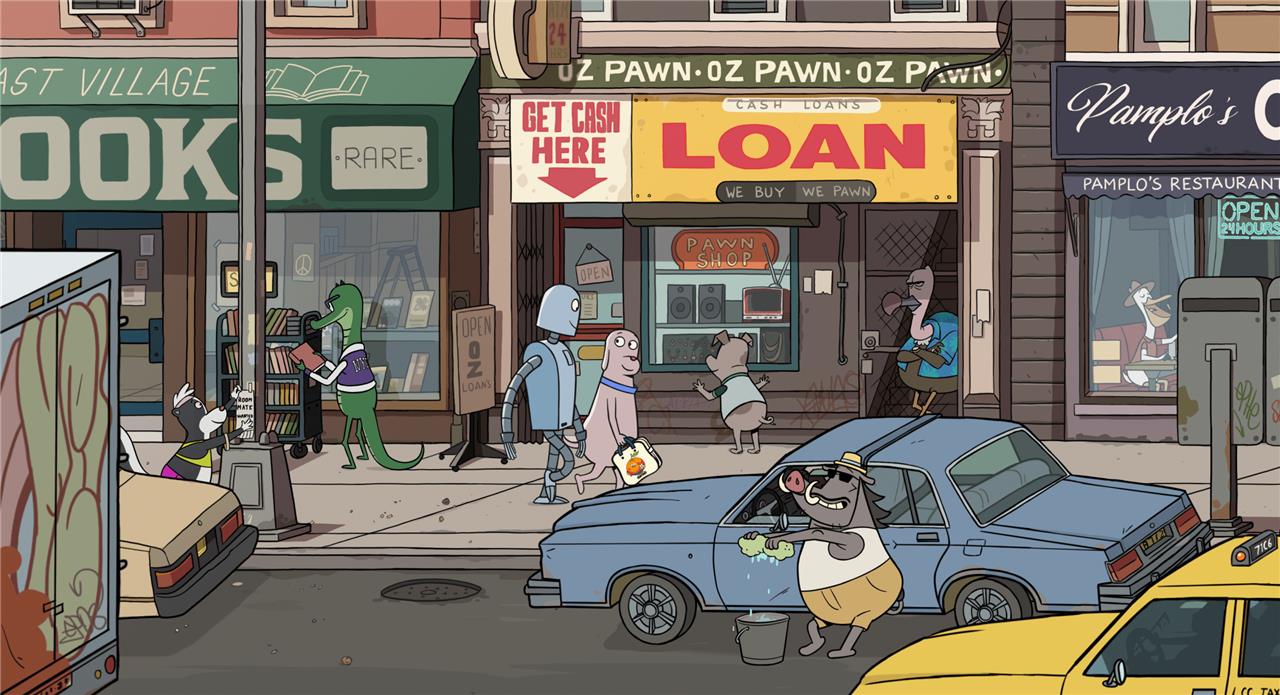
But despite his lack of experience, Berger’s Robot Dreams captures the book’s surprising poignancy, while using the extra space of a feature-length film to expand on its central relationships. It’s set in 1980s New York City, in a world populated by anthropomorphic animals. When one of them, Dog, feels lonely and isolated, he orders a robot companion. And after a whirlwind summer together, bonding over Earth, Wind & Fire’s “September,” they become best friends.
But an outing to Coney Island leaves Robot powered down and stranded on the beach, and when Dog returns to rescue him, he finds the beach closed for the rest of the year. The remainder of the movie follows what happens to the two of them in their time apart, and how they forge new connections while never forgetting each other. It’s a lovely reverie on friendship, and the space we hold in our hearts for those we left behind (in this case, pretty physically and literally).
Following a limited release, Robot Dreams was nominated for the Best Animated Feature Oscar, alongside Spider-Man: Across the Spider-Verse, Nimona, and The Boy and the Heron. The movie finally debuts in American theaters this summer, starting with a small release in New York City on May 31. Berger is excited to see his movie gain more traction after its surprise Oscar appearance, especially since it’s a story he is so passionate about. That passion was what fueled the production, despite the challenges for a first-time animation director. And there were some big challenges. Originally, Berger was set to work with Irish animation studio Cartoon Saloon (Wolfwalkers, The Secret of Kells) for Robot Dreams. But production hit a snag during the COVID-19 pandemic, and Berger had to pivot.
“Suddenly, we had to create our own studios in Spain,” he says. “So we called them pop-up studios, because we had to create them from scratch. We had to find the offices, buy the computers, hire animators and artists from all over Europe, and create a pipeline. So that was really hard.”
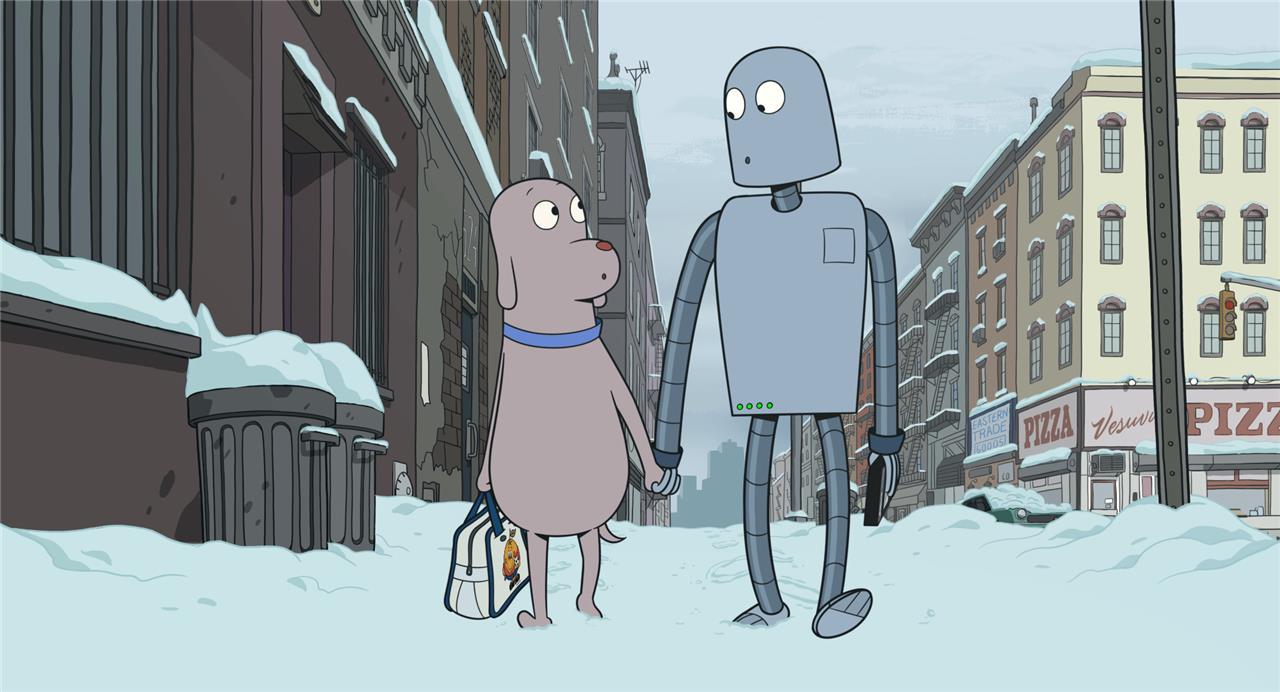
Berger quickly learned some key differences between production on a live-action movie and an animated one. For one, there are no individual department heads for hair and makeup or camera on an animated movie; it all falls under the art department. And there are no actors in a movie without dialogue; the animators handle all the “acting.”
“At the same time, I had to achieve the same goal,” says Berger. “Three-dimensional, emotional, believable performances.”
Berger tells us that in his live-action work, he talks with actors and looks deep in their eyes in order to draw out the most emotionally truthful performance he can. And with Robot Dreams, he wanted to take the same approach – just a little bit adjusted, of course, since there were no actors to make that connection with.
“When I was looking at the animation of the drawings, I looked at the pupils of the characters,” he explains. “So basically, to bring a truthful, believable performance that could move the audience, that the audience could have empathy for Dog and Robot.”
Berger says he enjoyed every minute working on Robot Dreams, and he would happily do another animated film in the future. There’s a lingering prejudice, especially in the United States, against animation, seen primarily as a medium for children’s movies. But Berger, like Guillermo del Toro and Phil Lord and Christopher Miller before him, is a firm believer that animation isn’t a genre.
“Animation is just a way to tell the story. And animation is not only for kids. There are so many great animated films that could be for kids, but could be for adults,” he says, citing the likes of Persepolis, The Triplets of Belleville, and Studio Ghibli’s filmography. While Robot Dreams is family-friendly, Berger says his studio never made any compromises in the filmmaking process in order to appeal to children. In fact, aiming at a specific audience was the last thing on his mind.
“I like to make an analogy with film. Films, for me, they are like a lasagna. And there are different layers. Every audience gets a different layer,” he says. “In a way, it looks back to when I was a kid and I saw the same film as my parents. Some of the films that are released in the last decades seem that they’re catered for [just] cinephiles, or for commercial [audiences], or for children. I think [Robot Dreams] really is for a very wide audience.”
Why should I watch “Until Dawn” in theatres?
The “Until Dawn” movie adaptation offers several potentially compelling reasons to watch it in theaters:
-
A fresh narrative within the “Until Dawn” universe: The movie introduces a new group of characters and story, focusing on Clover (Ella Rubin) and her friends as they navigate a time loop in the remote valley where her sister disappeared.
-
Reimagining of game mechanics: Director David F. Sandberg is bringing the game’s main mechanics to the big screen, where characters face different outcomes for their decisions and die multiple times. Each time they come back to life, they find themselves in a new horror genre, which should make for a dynamic experience.
-
Connections to the original game: Peter Stormare reprises his role as Dr. Hill from the game. Also, you may see a familiar mask from the game and fleeting glimpses of wendigos.
-
Potential for surprises: There’s a chance the movie could surprise viewers or introduce new audiences to the source material. Sony might be playing with expectations, and the movie could have more cameos and easter eggs that made the game fun.
-
A different experience for fans: The filmmakers aim to provide game fans with a different experience than they had when playing the game.
-
Homage to choose-your-own-adventure: The film aims to replicate the structure of a video game, in which you can just start over if things aren’t going your way.
How does the movie adaptation compare to the original game
The movie adaptation of “Until Dawn” differs significantly from the original game primarily because of the inherent differences between interactive gameplay and passive film viewing. While the game immerses players in an active, choice-driven horror experience where their decisions directly affect outcomes, the film translates this into a linear narrative that reimagines the story with new characters and a time loop mechanic, rather than replicating the game’s branching paths and player agency.
Video game adaptations often struggle because films are a passive medium, lacking the interactivity that defines gaming. This can make it challenging to capture the tension and engagement players feel when controlling characters and making choices, which is central to “Until Dawn” the game. The film version attempts to evoke the game’s essence by having characters face different horror genres as they relive events, but it inevitably presents a fixed storyline rather than a player-driven one.
Moreover, adaptations frequently take artistic liberties with story and character to fit cinematic storytelling, which can alienate fans expecting a faithful recreation. Unlike the game’s specific narrative and gameplay mechanics, the movie introduces new elements and characters, aiming to offer a fresh experience rather than a direct retelling.
In summary, the “Until Dawn” movie adaptation contrasts with the original game by shifting from an interactive, choice-based horror experience to a scripted, genre-blending film narrative that reinterprets the source material for a passive audience, reflecting common challenges faced by video game-to-film adaptations.
