
Rupees don’t come easy in Zelda: Tears of the Kingdom, but the right items can turn your pockets from empty to overflowing. From monster parts to rare gems and clever material flips, here’s what truly sells – and how to make every trade count.
It won’t take long until Link receives rupees in exchange for helping somebody, but in the meantime, you’ll need a plan B to keep you afloat. If you’re wondering what to sell to make money in Zelda: Tears of the Kingdom, this guide covers the best recommendations, as well as some other forms of making bank in Hyrule. At least eggs aren’t as expensive over there.
What to sell to make money in Zelda: Tears of the Kingdom
Gems like amber, opal, topaz, ruby, sapphire, and especially diamonds sell for high prices, so offloading extras from ore deposits is a fast way to build up rupees. Common materials that pile up in your inventory, such as monster parts, Zonai Charges, and duplicate armor pieces, are also safe to trade for cash, since they can usually be farmed again later. Cooked meals and elixirs made from low-value ingredients are another smart choice to sell, as their resale value is often better than the raw items, letting you clear space while boosting your wallet.
Deciding what to sell in Zelda: Tears of the Kingdom leads to some hard choices, considering how pretty much everything can become a Fuse combination. That being said, we have a few commendations of items that are fairly easy to restock, thus making them a great pick when you’re low on rupees and need to make money.
Before we begin, remember that you can sell your items to traveling merchants that you come across on roads, NPCs in charge of stores, and also Beedle, the traveling merchant who’s always around stables.
Mining ores for opal, topaz, sapphire, and ruby
People might get mad at me for this suggestion, but let’s be honest: How many mining ores are you hoarding in your inventory as you read this?
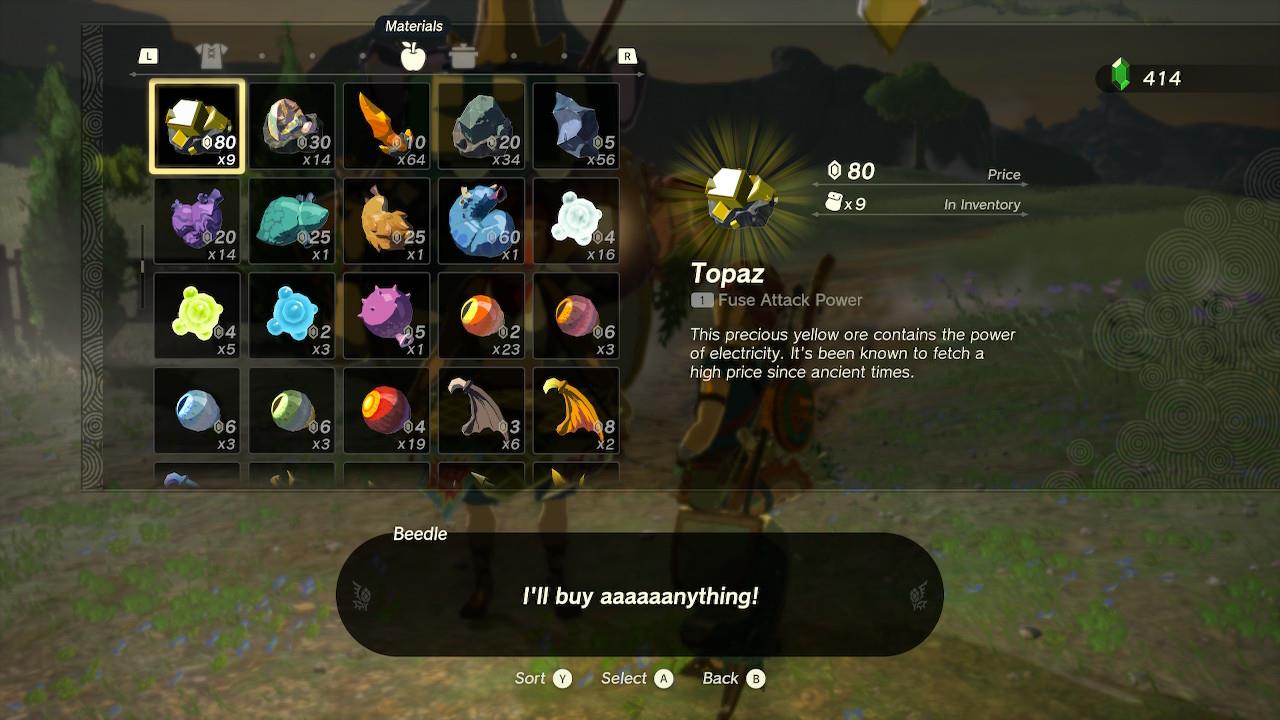
The truth is, as long as you’re exploring caves and wells somewhat frequently, you’ll have no shortage of opal and topaz to sell for 30 and 80 rupees each, respectively.
Rubies will net you 110 rupees a pop, while sapphires are 150. That being said, these are far more rare to find, so I recommend selling them more sparingly.
The same applies to diamonds, which you should hold onto, even if the 500 rupees return might be tempting. They add 25 Fuse attack power, and are also helpful for upgrading certain armor sets.
If you’re wondering about flint or amber, their prices range from 5 to 10 rupees. As such, you’re best keeping them for when you need to make a fire, for example, or as additions to your arrows.
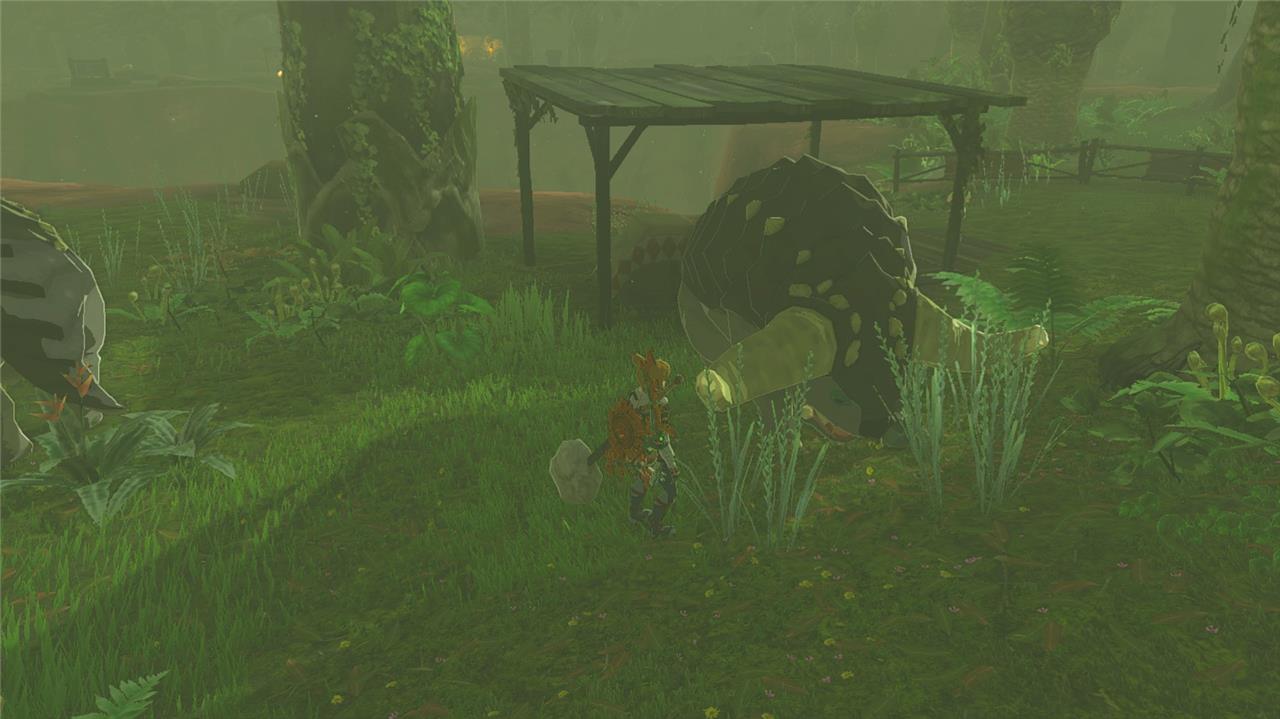
Also, in case you’re searching for a decent farming spot alongside mining ores, there’s a good method involving dondons. In southern Akkala, close to Lakeside Stable, you’ll find a dondon sanctuary. If you have access to the Joju-u-u Shrine, you just need to glide down to a campfire nearby.
Here are the steps to get mining materials from dondons in Tears of the Kingdom:
- Drop a luminous stone in front of each of the five dondons.
- Watch the dondons eat the stone.
- Leave the area, and return around 10 minutes later.
- Collect your loot.
Keep in mind you can get anything from flint to less-rare materials from dondons. Yet, this is a great method to build a cycle around if you’re interested. Fast travel to the shrine, feed them luminous stones, and then continue with other activities. You’ll always come back to a pool of materials. And if you have the travel medallion, you can make a more direct fast-travel shortcut for yourself.
Brightbloom seeds
Both brightbloom and giant brightbloom seeds are key to light up the Depths, sure. That being said, both resources are everywhere inside caves, wells, and the Depths themselves.
Now, regular brightblooms seeds go for 2 rupees each, while giant ones are 4 rupees a pop. It’s not a lot, but since it’s so easy to get them – the first more than the latter, but still – you should be selling them in chunks of 50 or 100 whenever you have the chance. Just make sure to grab as many of them when you’re exploring Hyrule’s underground areas to keep the ball running.
Splash fruit and ice fruit
I’m grouping splash fruits and ice fruits together as the reasoning is the same for both. Mainly, as you’re exploring the Zora’s Domain and the Gerudo Highlands areas, respectively, you’ll stumble upon dozens and dozens of each of the fruits.
Mechanically, they’re there to help you endure the regional phenomena tormenting the villages and their surroundings. It’s a good help, but since they’re such a common resource, you should go ahead and sell the ones you don’t use. Splash fruits are sold by 2 rupees each, while ice fruits are 3 rupees each, which can really add up when you’re selling in bulk.
Dragon materials
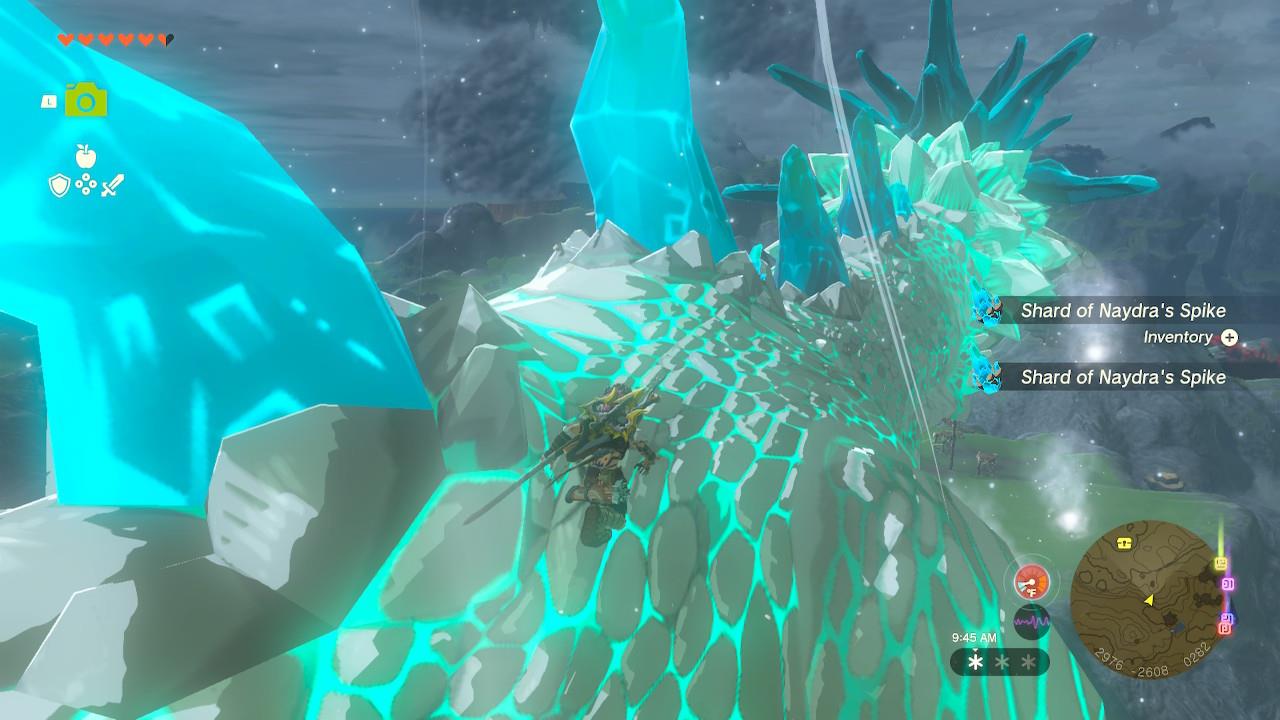
As mythical as these creatures are, you can find dragon locations quite frequently if you know where to look. When you do, I recommend taking the time to jump on their backs and grab both shards of spikes and dragon scales.
The action is fairly low effort, as you can pick shards of spikes as you’re walking over the dragon, and there’s usually at least 10 of them if not more. Then, dragon scales only require for you to hit the dragon (the spikes work!) and you’ll get one up for grabs on the spot.
A shard of spike sells for 30 rupees each, while dragon scales are 150 a pop. Yes, they’re useful items for upgrading armor sets, so you should always have a few spares with you. But you can match the price with just five shards of spikes, which are far more abundant.
Bokoblin horns
Bokoblins drop multiple resources that can make for great Fuse combinations. That being said, when you look at the Fuse Attack Power that they add, there are other similar options that can either match or surpass the benefit. As such, you won’t need to defeat rare Bokoblins all the time.
When you do, though, the horns tend to go for decent prices. Black Bokoblin horns are 9 rupees each, while Blue Bokoblin horns are 5 each, and far more common to find.
In addition, guts can also be a good alternative, going for around 20 to 60 rupees depending on the Bokoblin’s rarity. If you’re not too pressed about crafting elixirs, feel free to sell them. There are plenty of Bokoblins around.

Luminous stone
The elusive cousin of the mine ores family. Luminous stones are a tad harder to find, but you can sell them for 20 rupees each, so the hunt is worth the time.
If you’re exploring the Depths, it’s quite common to receive luminous stones from mining ores as opposed to the more common materials. Also, the Crenel Hills Cave at the coordinates (0484, 0729, 0041) is a nice spot that you can get to fairly early on. It has ores of the stone both outside and inside, so you can pay a visit regularly to check if the resource has respawned, and repeat the process.
You’ll have to go through the cave to get your hands on the Barbarian Armor set anyway, so best to get there as soon as possible.
Meals over ingredients
This one is more laborious, but it’s worth the trade-off. If you have a few meals obtained by cooking or as rewards and you don’t plan on using them right away, sell them! Regular recipes can go for around 30 rupees, while others can get you 75 rupees or more. If you have a ton of ingredients and need to make a quick buck, head over to a cooking pot and prepare a few recipes. It’ll take longer, but you’ll also get a better deal for them.
Below are some meal recipe suggestions to sell for rupees in Tears of the Kingdom:
- Sunny steamed tomatoes (70 rupees): 1 raw prime meat, 2 Hylian tomatoes, 2 sundelions
- Hearty tomato mushroom stew (64 rupees): 1 hearty truffle, 4 Hylian tomatoes
- Hearty tomato mushroom stew (92 rupees): 2 big hearty truffles, 2 Hylian tomatoes
- Warding meat skewer (81 rupees): 2 raw prime meat, 3 dark clumps
- Hearty fruit and mushroom mix (133 rupees): 3 golden apples, 2 big hearty truffles
- Glazed meat (79 rupees): 2 courser bee honey, 3 raw meat
Elixirs
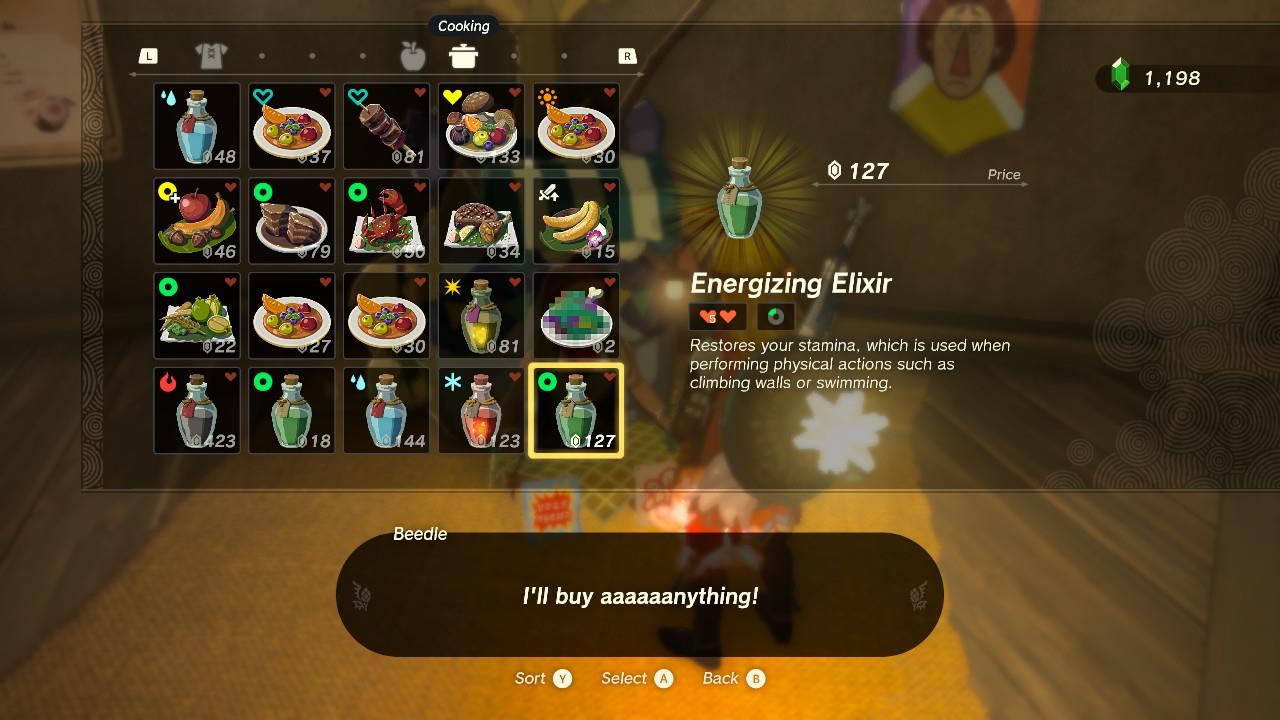
In a similar fashion to cooked meals, elixirs fetch a decent price.
As you make your way through Hyrule, you’ll amass no shortage of monster parts. Combining them with specific lizards and bugs will grant Link all sorts of advantages, such as heat resistance and cold resistance. If you’re not too dependent on these, however, selling elixirs is a great option to earn rupees.
Below are some elixir suggestions you can sell for rupees in Tears of the Kingdom:
- Bright elixir (81 rupees): 2 deep fireflies, 2 Bokoblin guts, 1 Light Dragon horn
- Fireproof elixir (423 rupees): 3 fireproof lizards, 2 Molduga guts
- Sticky elixir (144 rupees): 3 sticky frogs, 2 Horriblin guts
- Spicy elixir (123 rupees): 3 Horriblin guts, 1 warm darner
- Energizing elixir (127 rupees): 1 Boss Bokoblin gut, 1 restless cricket, 3 Hyrule herbs
Other ways to make rupees in Zelda: Tears of the Kingdom
Shoot Blupees with arrows for gem drops that merchants buy at good rates. Solve Hudson sign puzzles around Hyrule for 100 rupees each from grateful NPCs. Complete quick side quests like photographing sky monoliths or aiding travelers under attack to pocket handfuls of rupees fast.
Alongside the act of selling items, there are a few ways to get rupees in Zelda: Tears of Kingdom:
- Attacking the Blupees that lead you to cave entrances
- Completing Addison’s Hudson Construction puzzles
- Completing side adventures, such as “Messages from an Ancient Era”
- Helping NPCs under attack
The general rule is to always help those in need. Of course, Link isn’t doing it for sheer interest – he’s just a good guy lending a hand. Yet, NPCs will often give you a few dozen rupees for your trouble, which is always welcomed.

Rates tend to vary depending on the activity. Addison’s Hudson Construction puzzles tend to be 20 rupees a pop, for example. The one you can possibly do the most each time is attacking Blupees, which are the light blue rabbits that lead you to caves.
Best farming spots for diamonds in Tears of the Kingdom
The most reliable diamond “farms” in Tears of the Kingdom are: the Royal Hidden Passage ore loop, Rare Stone Talus routes, and feeding luminous stones to the Dondons near Lakeside Stable.
Royal Hidden Passage ore loop
-
The tunnels under Lookout Landing and Hyrule Castle (Royal Hidden Passage) are packed with rare ore deposits that can drop diamonds, and they respawn after each Blood Moon.
-
There is also a chamber in this passage full of luminous stone deposits (including a hidden Stalnox) that lets you stock up on luminous stones for Dondons while still getting chances at diamonds from rare ore.
Rare Stone Talus routes
-
Rare Stone Talus and other Talus variants have a good chance to drop diamonds when you break their ore node, making a marked “Talus route” that you clear after each Blood Moon one of the best repeatable farms.
-
Mark every Talus you find on the map; once you have a loop of several Rare Stone Talus spawns, you can rotate through them for consistent diamond and gem drops.
Dondons in Bronas Forest
-
In Bronas Forest, just north of Lakeside Stable in Faron, Zelda’s Dondon sanctuary lets you feed Dondons luminous stones; after some in-game time, they “produce” random ores on the ground, including diamonds.
-
Feed each Dondon one luminous stone at a time and return after a while to collect the ores; this is slower than straight ore mining but is a passive diamond source you can check between other activities.
If you say whether you are early, mid, or late game, a more tailored route (with easier or harder Talus and shrine chest picks) can be suggested.
Best rare ore routes for quick diamond runs
Fast “diamond runs” focus on tight loops of rare ore deposits in caves and around Eldin’s volcanic cliffs, plus a few dense caves near central Hyrule and Zora’s Domain.
Central Hyrule quick loop
-
Passeri Greenbelt Cave (just west of Lookout Landing) has several rare ore deposits close together and is very quick to clear, making it ideal for early-game diamond attempts.
-
Combine this with ore around nearby cliffs and other small caves in Hyrule Field and you get a short loop you can repeat every Blood Moon for extra diamond chances.
Zora’s Domain summit route
-
Upland Zorana Summit Cave south of Upland Zorana has multiple rare ore deposits in a compact space, with good chances for diamonds and other high-value gems.
-
Run this cave together with surrounding cliff-side ores in the Upland Zorana area; use the Sensor+ set to “rare ore deposit” to quickly ping all the nodes along the ridge.
Eldin volcano cliff circuits
-
The Eldin region (around Eldin Canyon, lava flows, and jutting cliff faces) is packed with ore, and many nodes are rare ore deposits that can drop diamonds.
-
Travel up lava flows and circle the cliff edges and monster camps; mark dense clusters of ore on your map to form a personal “Eldin loop” you clear after each Blood Moon.
How to maximize each run
-
Take a picture of a rare ore deposit and use Sensor+ so you can sprint from node to node without wandering, which massively speeds up each route.
-
Always bring at least one strong rock-hammer fused weapon so you break each node in a single combo, then fast-travel out, sleep or progress time, and repeat after a Blood Moon for steady diamond income.
