
In Civilization 7, confusion isn’t just expected-it’s part of the experience. As you navigate the complex layers of empire-building, from managing production and science to balancing happiness and warfare, the game’s intricate systems can feel overwhelming at first. But don’t let that stop you: each turn is a lesson, and every mistake brings you closer to mastery. Embrace the chaos, learn on the fly, and soon you’ll uncover the strategies that turn bewilderment into victory across Nintendo, PC, PlayStation, and Xbox platforms. Welcome to the most challenging-and rewarding-Civilization yet.
All of that behind-the-scenes complex machinery is what makes Civilization Civilization, and it’s what veterans come to the series for – a way to build out what actually feels like an empire from scratch. But all of those moving pieces can make for a very stressful first-time experience. Worse, it can make you feel like you don’t understand the game. It could even make you feel like you shouldn’t play it.
That feeling of a lack of understanding propelled me away from past Civilization games, even though I enjoyed the few matches I spent with them. But I’ve learned something after bouncing off more than one Civilization game before Civilization 7: You’re supposed to be confused.
As I mentioned before, the Civilization series is complex, and there are a lot of moving pieces happening every single turn. Confusion is a completely natural feeling when faced with a thousand potentially important pieces of information in front of you. “What does Production do? How much Science do I need to research something? What does Happiness even do? Why can my unit move two spaces sometimes and one space other times? What do you mean they’re declaring war on me?!” I get it. But those questions are normal, and the way you feel is okay. You’re definitely doing a ton of stuff “wrong,” but I have excellent news for you: You can still win at Civ if you’re doing almost everything wrong, but doing one thing right.
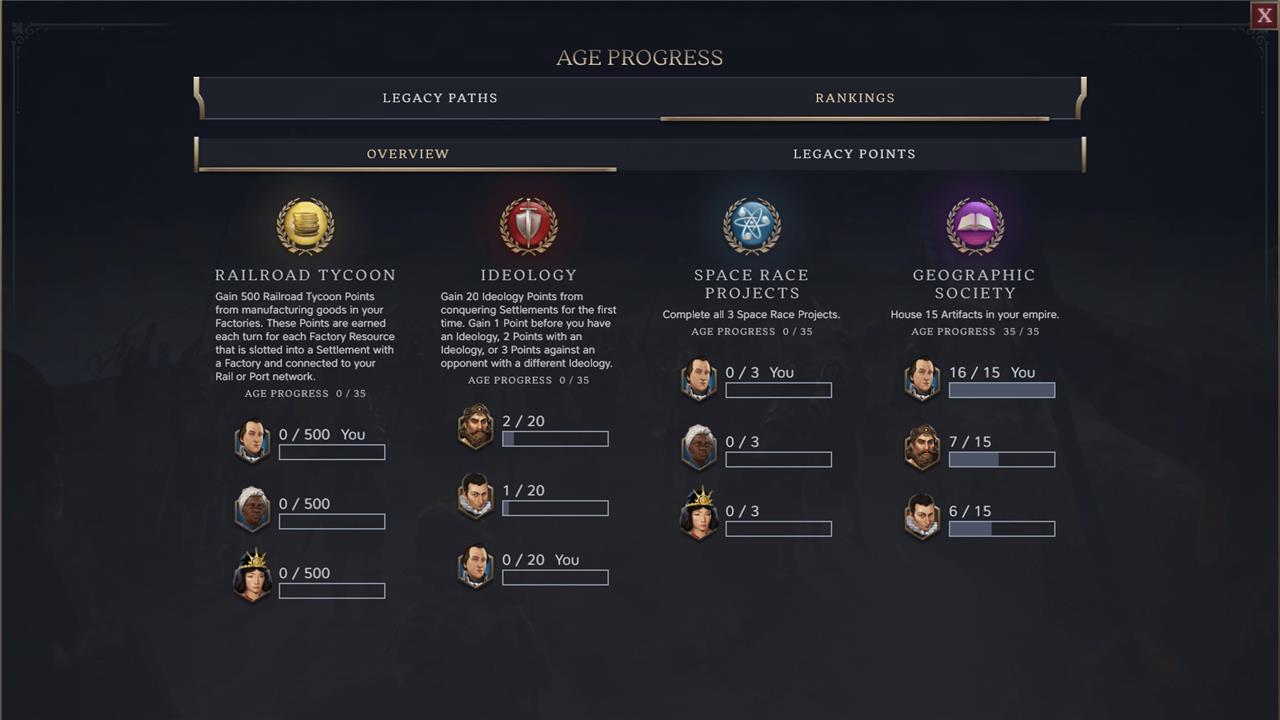
Civilization 7 is a video game in which you learn by doing. Guides are extremely helpful for answering your specific questions, especially when the Civilopedia in-game can be less than helpful. (And to that end, you don’t want to miss our Civilization 7 guides.) But nothing teaches Civilization better than actually playing Civilization.
When you’re first starting out, you want to pick a leader that means something to you, and a civilization that you have some affinity for. You’re going to be seeing a lot of your leader, and you’re going to be working on evolving your civ, so make sure if you pick Confucius, it’s because you’ve read one of his biographies or something like that. Connections and a desire to see Rome succeed (or wherever your extended family might be from) will pull you through when the deep confusion hits.
Once you’re in the game, pick an advisor and stick with them. This will basically determine what victory path you’re going to go on. Maybe you like the idea of ruling the world by conquering it and you want to go for a Military Victory. Or maybe you’re fascinated by some of the incredible wonders of our world, or are interested in religion. Then follow the culture advisor to reach a Culture Victory.
After you’ve selected a direction for your civilization, it really is as simple as boosting that one aspect as much as possible. If you’re looking to complete the Manhattan Project and win a Science Victory, get your Science up as high as it can go. Do whatever your Science advisor says. If you don’t understand why your units are moving weird or why you’re suddenly losing a battle you thought you would win, just know that you don’t need to understand that. You just need more Science.

On the default difficulty, following your advisor is potentially enough to win the entire game, and you’ll walk out the other side understanding how to win that kind of victory in the future. Then, pick another civilization, another leader, and another victory condition for your next match. As the turns go by, you’ll begin to understand the things that confused you the last time around, and you can then compound that knowledge with what you now know about Science civilizations or whatever you did the first time.
Like the cities in Civilization 7, knowledge about the game is built up, paved over, and rebuilt over time. You cannot read the Civilopedia or even our guides to fully grasp the game. You must read and play, or otherwise risk overloading yourself with information. The best and biggest advice I can give for coming into Civilization 7 is to resist that urge to restart your game because it isn’t going well. There are lessons to be learned every turn in Civilization, even ones where you lose entire armies or even cities. And even if you feel like you’re not learning as you play, I promise you are. Every turn, every age, and every match will get you that much closer to that “I think I finally get it,” moment. With enough practice, you might even fully understand it in time for Civilization 8.
Why does Civilization 7 encourage confusion in mastering Confucius’ strategies
Why Civilization 7 Encourages Confusion with Confucius’ Strategies
Complexity Is By Design
Civilization 7 is intentionally complex, with countless interlocking systems that can overwhelm even experienced players. The game’s depth means that mastering any leader-especially one as nuanced as Confucius-requires navigating a maze of mechanics, trade-offs, and evolving strategies. This confusion is not a flaw but a feature: it encourages experimentation, learning from mistakes, and gradual mastery as you discover how each decision shapes your empire’s fate.
Confucius: A Leader Built on Nuance
Confucius in Civilization 7 exemplifies this complexity. His playstyle revolves around rapid city growth and maximizing the output of specialists, which involves intricate planning of city layouts, adjacency bonuses, and happiness management. While his bonuses (+25% city growth, +2 science from specialists) seem straightforward, the real challenge comes from balancing these strengths with the game’s happiness and infrastructure systems. Specialists, for example, can drain happiness, forcing players to carefully weigh when and where to assign them.
Strategic Ambiguity Mirrors Confucian Philosophy
The confusion players feel when trying to master Confucius’ strategies mirrors the philosophical tradition he represents: success comes not from rigid formulas but from adapting to changing circumstances, understanding the interconnectedness of systems, and learning through reflection and adjustment. The game rewards those who embrace this uncertainty, experiment with different civilization pairings, and refine their approach through trial and error.
Learning Through Confusion
Ultimately, Civilization 7’s encouragement of confusion-especially with leaders like Confucius-serves to deepen engagement. It pushes players to:
-
Explore multiple paths to victory
-
Adapt to setbacks and new information
-
Develop a holistic understanding of the game’s systems
As the Polygon guide notes, feeling lost is part of the journey, and even flawed strategies can lead to victory if you persist and learn from each playthrough. This design philosophy ensures that every game, and every leader, remains a fresh and rewarding puzzle.
What aspects of Confucius’ strategy create confusion for new players in Civ 7
Aspects of Confucius’ Strategy That Create Confusion for New Players in Civ 7
Balancing Specialists and Happiness
-
Confucius’ core strategy revolves around rapidly growing cities and maximizing the output from specialists, who receive a significant science bonus under his leadership (+2 Science per specialist).
-
However, assigning specialists comes at the cost of happiness, especially in the early game. New players may not realize that overusing specialists too soon can lead to unhappiness, stalling city growth and productivity.
-
Managing this balance-knowing when to assign specialists and when to hold back-can be confusing, as the optimal timing depends on city infrastructure, available policies, and era progression.
Adjacency and City Planning Complexity
-
To fully leverage Confucius’ bonuses, players must carefully plan city layouts for optimal specialist adjacency. This requires understanding how different buildings and districts interact, which is not always intuitive for newcomers.
-
The need to prioritize production buildings over traditional growth buildings like Granaries, due to Confucius’ innate growth bonus, further complicates conventional strategies.
Era-Dependent Strategy Shifts
-
Confucius’ strengths evolve across the ages: his cities grow quickly in the Antiquity Age, but the full benefits of his specialist focus are only realized in later eras, especially the Modern Age.
-
New players may become confused or frustrated when early investments in specialists do not yield immediate results, not realizing that patience and long-term planning are essential for his strategy to pay off.
Synergy with Specific Civilizations and Policies
-
Confucius’ effectiveness is amplified by pairing him with certain civilizations (such as Han, Ming, and Qing) and specific civic or policy choices, which may not be obvious to those unfamiliar with the game’s deep systems.
-
The need to pursue particular wonders, pantheons, and civic trees for optimal results adds another layer of complexity that can overwhelm new players.
Defensive and Expansion Considerations
-
Rapid city growth and high yields can make Confucius a target for AI aggression, requiring players to adopt a defensive posture and carefully manage expansion, which may not align with the aggressive playstyles some new players prefer.
In summary, the confusion stems from Confucius’ strategy demanding a nuanced understanding of specialist management, city planning, era transitions, and synergy with other game systems-elements that can be daunting for those new to Civilization 7.
