
Ready to prove that brains trump brawn? In Civilization 7, a Science Victory means leading humanity’s ultimate space race-advancing through eras by mastering technologies, building scientific wonders, and launching the first manned space mission to claim your place among the stars. This guide will walk you through every step, from researching writing and collecting codices in the Antiquity Age to completing critical space projects in the Modern Era, ensuring your civilization outpaces rivals and conquers the cosmos.
In this Civilization 7 guide, we’re going to give you a broad idea of how to get a Science Victory and then give you an age-by-age walkthrough on how to make it happen.
How to get a Science Victory in Civilization 7
Achieving a Science Victory in Civilization 7 requires a focused strategy centered on advancing through the technology tree and completing key space-related projects in the Modern Age. Begin by prioritizing scientific research early on, starting with Writing to unlock Libraries, then progressing through Mathematics to build Academies, which boost your science output. Collect Codices by researching tech masteries and displaying them in your cities to gain Legacy Points that enhance productivity in later eras. In the Modern Age, research Flight to build Aerodromes and complete projects like Trans-Oceanic Flight and Break the Sound Barrier. Then, research Rocketry to construct a Launch Pad and complete the Launch Satellite and Staffed Space Flight projects. Successfully launching the first manned space mission secures your Science Victory. Throughout, focus on maximizing Science and Production yields in your cities, supporting Specialists, and managing resources efficiently to outpace rivals in the space race.
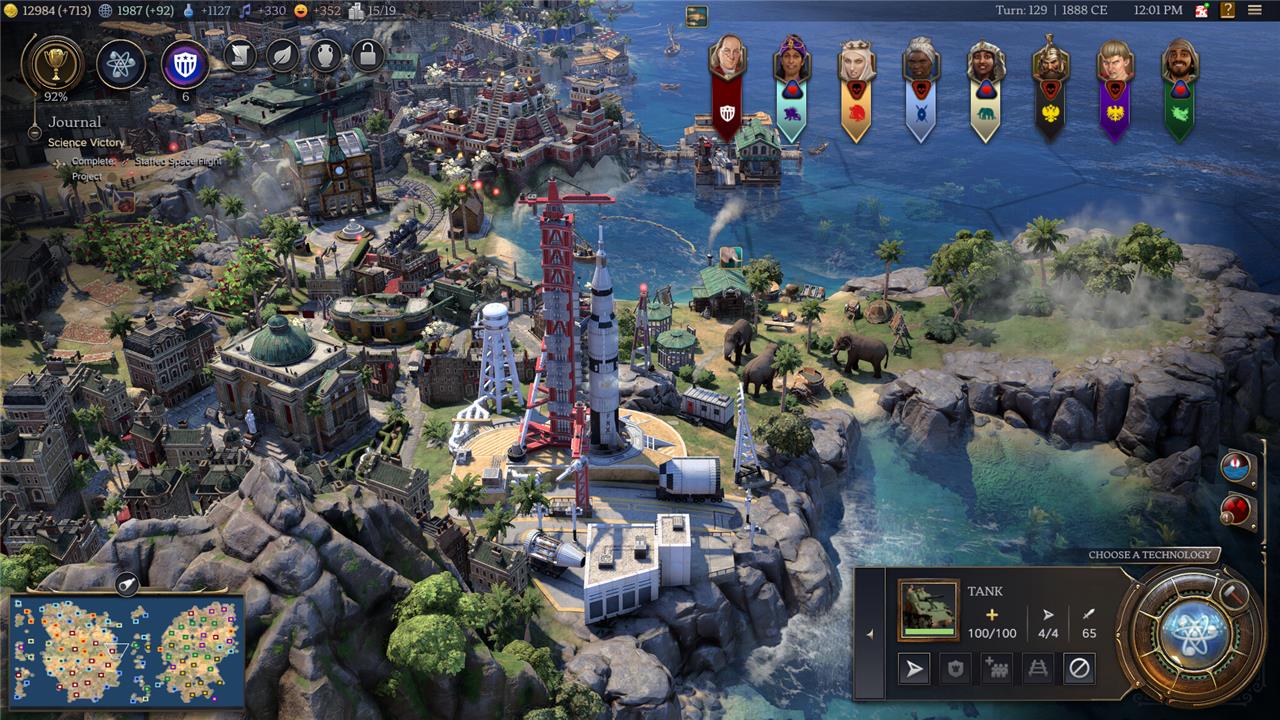
In a Science Victory, you’ll want to stack your tiles with Science buildings and specialists to get as much brain power as possible. This will help you rocket through the Tech tree, allowing you to reach new milestones much faster than your competition. This will also – eventually – make you very difficult to deal with militarily speaking, as your units will be far more powerful than your enemies (especially once you have the power of flight and they don’t).
In the beginning of the game, you’ll want to not only research new technologies, but also research their masteries, which will give you Codices that you can display in your palace, academies, and libraries. This will grant you critical Legacy Points, which will help you boost your yield in the following ages.
The Science Victory doesn’t have as many tangible objectives as the other win conditions. Instead, it’s more about boosting your yields as high as possible, so by the time you get to the end of the Modern Age, you’re pulling in hundreds or even thousands of Science a turn. This will help you push through the more advanced Tech Tree items in only a few turns, which is critical when trying to make your way to space – which is your ultimate goal.
However, something to keep an eye out for on the way to your Science Victory is stagnated city growth and, more importantly, unhappiness. You’ll learn in the Exploration Age that Specialists can help you drastically increase your yields in certain districts – especially in the Science department. However, Specialists also bring with them a penalty to happiness and food. You’ll need to supplement your cities’ food supply with towns, otherwise they’ll never grow. And you need to run cultural festivals and build happiness buildings to keep your citizens happy, otherwise they’ll tank your precious Science yield or, worse, burn your cities to the ground.
Balance your scientific advancement with the happiness of your cities and you’ll find your way to space before anyone else with the Staffed Space Flight project, which will instantly win you the game.
Science Victory walkthrough in Civilization 7
To achieve a Science Victory in Civilization 7, start by focusing on research from the Antiquity Age, prioritizing technologies like Writing to unlock Libraries and Mathematics for Academies, which boost your science output significantly. Collect and display Codices in these buildings to gain Legacy Points that enhance your progress in future ages. As you advance, build a strong food and production base to support city growth and specialist placement, maximizing science yields. In the Modern Age, research Flight to unlock Aerodromes and complete projects such as Trans-Oceanic Flight and Break the Sound Barrier. Finally, research Rocketry, build a Launch Pad, and complete the Launch Satellite and Staffed Space Flight projects to secure your victory by being the first civilization to send a manned mission to space.
As described above, a Scientific Victory is all about out-researching the other civilizations around the world, enabling you to rocket past them (metaphorically) into the stratosphere (literally).
Below, we’re going to give you a bit of more structured advice for each age to help you push through the game’s objectives and complete the Science Legacy Path, which will help guide you to completing the Staffed Space Flight project in the Modern Age.
Antiquity Age

Before we get started, here’s a snapshot of what the Antiquity Age looks like for a Science Victory:
- Research Writing in the Tech tree
- Build a library
- Research the Writing 2 Mastery in the Tech tree
- Research Mathematics in the Tech tree
- Build an academy
- Collect and display 10 Codices in your libraries
In the Antiquity Age, your goal is to gather as many codices as possible and place them in your academies, libraries and palace. But first you’ll need to do a bunch of research in the Tech tree in order to unlock the ability to create codices and advance along your Legacy Path. To do that, you want to start off by researching Writing in the Tech Tree.
As you’re researching, you want to build early buildings that focus on Production and Food in your cities. These are critical resources for the entirety of the Science Victory path, and you should prioritize them both just behind your Science yield.
For Science runs, high Production will help you build your Science buildings (academies, in the Antiquity Age) quickly netting you more Science earlier in the game. Food will eventually be the more useful of the two, but place it behind Production during the Antiquity Age. Either way, don’t miss our guides on increasing your Production and Food.
Once you’ve researched Writing in the Tech Tree, build your first library and research the Writing Mastery, which will net you your first Codex. Once you’ve done that, you’re more or less on your own for a bit when it comes to the Legacy Path. Keep researching new technologies, increasing your Science, and upping your Production and Food until you research Mathematics. This will unlock the ability to build an academy, and that’s when the hunt for Codices will really begin.
Continue building out your Science buildings as you research any Masteries in the Tech Tree that promise a Codex. There are a few Civics – like Literacy – that also grant a Codex. Keep gathering these up and displaying them in your cities until you reach 10 and grant yourself a Golden Age leading into the Exploration Age.
Exploration Age

Before we get started, here’s a snapshot of what the Exploration Age looks like for a Science Victory:
- Research Education on the Tech tree
- Place four specialists
- Increase your yields in non-city-center tiles over 20
- Place specialists in non-city center tiles
- Have four non-city-center tiles with a yield of 40 or over
In the Exploration Age, Food will become your primary resource outside of Science. Production – while still important – will take a bit more of a back seat. In this age, your goal is to beef up your cities with brilliant minds called specialists, who will help increase your workflow drastically, preparing you for the space race to come in the Modern Age.
To start, you’ll need to familiarize yourself with the specialist system, which is a little odd, but extremely powerful once you wrap your brain around it. The idea is that, when your city has enough Food to grow in population, you’ll have the option to further invest in an already established tile rather than expand your borders outward with an improvement like a farm or something similar. The catch is that you can only put a specialist on an urban tile, so you’ll need to pave over some of your old improvements if you want them.
Specialists offer 2 bonus Science and Culture by default, and can be enhanced by policies, adjacency bonuses, and other things. However, they also reduce the tile’s Happiness and Food by -2, so you’ll need to compensate for those things with Cultural Exchanges and other sources. But for the sake of Science and progress, these specialists are easily worth it, as you’re able to really increase how much your civilization can benefit from just a single tile. And that’s exactly what you’ll need to do to progress your Legacy Path.
Once you get to Education in the Tech Tree for the Exploration Age and you’ve placed four Specialists in your cities, you’ll get a new quest to achieve 20 or more yield on a single tile (that isn’t your city center, which is the main tile under the nameplate). You’ll also need to place two more specialists outside of a city center. These objectives work together, as having a specialist on the tile will naturally increase its yield. Try to place your specialists down on tiles that already have a few buildings that are increasing your production.
You’ll then need to repeat this objective, in a way, getting one tile up to 40 yield. Eventually, you’ll need five of these super tiles.
The best way to increase your yield to that degree is to place specialists and research items like Education Master, which causes all Science buildings to produce bonus Science going forward. You can also place attribute points into the Scientific tree to increase yields.
This is much less straightforward than other victory conditions, and can be a bit of a bear if you didn’t set your cities up for success in previous ages. Just keep investing into your cities and their specialists and you’ll eventually be ready for the Modern Age.
Modern Age

Before we get started, here’s a snapshot of what the Modern Age looks like for a Science Victory:
- Research Flight in the Tech tree
- Build an Aerodrome
- Complete the Trans-Oceanic Flight project
- Research Aerodynamics in the Tech tree
- Complete the Break the Sound Barrier project
- Research Rocketry in the Tech tree
- Build a launch pad in a city
- Complete the Launch Satellite project
- Complete the Staffed Space Flight project
The Modern Age is where all your hard work and preparation pays off, but first you’ll need a ton of Science. The good news is that achieving a Science Victory in the Modern Age is rather simple, ironically – especially when compared to the Exploration Age goals for Science.
All you really need to do here is push your way down the Tech tree, build a few buildings, and launch some projects in your cities, which take a predetermined number of turns. That’s all of course a bit more complex than we make it seem, but not by as much as you’d expect.
You want to start off with your sights set on Flight, which is on the third wing of the Tech tree. By this time, you should have fairly high Science, and you’ll want to further increase that as you play the waiting game for Flight. Some of the later game Tech tree nodes are very expensive, so your main priority is upping your Science as much as possible in this age. (We were earning more than 1,000 Science a turn by the end of the Modern Age, and some later Tech tree Mastery items were still taking four or more turns.)
Once you finally research Flight, build the Aerodrome building in the city of your choice and then select the Trans-Oceanic Flight project in that same city. This can be a little weird to find if this is the first time you’ve done a project, but it’s in your city’s production menu under the projects tab, which sits between units and Wonders. It’ll take you 10 turns to complete.
As you’re waiting, you’ll want to push even further forward in the Tech Tree to Aerodynamics. This will unlock the ability to start the Break the Sound Barrier project, which functions identically to the Trans-Oceanic Flight Project. After you have the appropriate Tech upgrade and your first Space Race Project is complete, get cracking on the second.
In that same vein, you’ll want to research Rocketry as soon as you’re done with Aerodynamics, and build a launch pad in a city – or cities, as it gives a great Science bonus – of your choice. Then, just like before, launch the Launch Satellite project from a city with a launch pad in it. When it eventually takes off, you’ll unlock the final space race project and be able to see the entire map.
With all pre-space race projects done, all you need to do now is launch the Staffed Space Flight project from one of your cities with a launch pad. This will take 20 turns (going to the moon is not easy, it’s hard, or so I’ve heard), and as long as your space shuttle project launches before anyone else hits a victory condition, you’ll win the game with the greatest scientific achievement in our species’ history!
How can I outpace rivals in the race to space in Civilization 7
To outpace rivals in the race to space in Civilization 7, focus on maximizing your science and production output throughout the game while maintaining a stable and happy population. Early on, prioritize researching Writing to build Libraries, then Mathematics to unlock Academies, which boost science generation. Transform your cities into scientific hubs by constructing key buildings like Libraries, Academies, and later Aerodromes and Launch Pads in the Modern Era. Progress through the Modern Age technologies-Flight, Aerodynamics, and Rocketry-completing associated projects such as Trans-Oceanic Flight, Break the Sound Barrier, and Launch Satellite to stay ahead. Choose cities with high production to speed up space projects, and keep an eye on rivals’ progress, using espionage or military means if necessary to disrupt their space race. Selecting leaders and civilizations with bonuses to Science and Production, like Benjamin Franklin or Meiji Japan, can further accelerate your path to victory. Ultimately, efficient city management, technological focus, and strategic disruption of opponents are key to winning the Science Victory by completing the Staffed Space Flight Project first.
What early game strategies can give me an edge in the space race in Civ 7
To gain an early edge in the space race in Civilization 7, start by founding multiple cities quickly to boost your science output, ideally near mountains for campus adjacency bonuses and on your own island if possible to reduce early conflict. Prioritize building Campuses and Industrial Zones adjacent to each other to maximize science and production, which are critical for space projects. Adopt government policies like Wissenbanken and Democracy to enhance science and trade route yields, and use international trade routes to funnel resources into your key cities. Recruit Great Scientists and Engineers early, as their bonuses significantly accelerate space project progress, and use spies to protect your industrial zones and spaceports from sabotage. Additionally, select leaders and civilizations with science and production bonuses to complement this strategy. Early exploration is vital to identify optimal settlement locations and establish diplomatic or trade relations that can support your scientific growth. Balancing production between military units and infrastructure ensures your empire remains secure while advancing technologically. Finally, aggressively managing or eliminating nearby rivals early can prevent disruptions and secure the land needed for expansion and resource control.
