
Unleash the sinister power within as you dive into Baldur’s Gate 3’s Dark Urge origin, where every choice teeters on the edge of darkness and redemption. Our definitive guide reveals the ultimate build-centered on the formidable Oathbreaker Paladin-that balances devastating combat prowess with a gripping narrative of broken oaths and forbidden powers. Whether you embrace the chaos or resist the urge, this guide equips you with the perfect class, skills, companions, and Illithid powers to dominate the battlefield and unravel your haunting past. Step into the shadows and master the Dark Urge like never before.
Creating your perfect Baldur’s Gate 3 character isn’t easy, what with all the classes you can choose from, but it’s worth spending the time to educate yourself as much as possible before making a big decision that will impact your game time for 100 hours or more.
In this Baldur’s Gate 3 guide, we’ll explain what the Dark Urge is, what the ramifications are for playing as the Dark Urge. And, while playing as the Dark Urge in Baldur’s Gate 3 is more of a narrative choice than a mechanical one, we’ll offer some suggestions for the best build and class that work for the character.
What is the Dark Urge origin character in BG3?
The Dark Urge origin character in Baldur’s Gate 3 is a unique, fully customizable protagonist plagued by violent and cruel impulses due to their nature as a Bhaalspawn, a being born from the God of Murder, Bhaal. Unlike other origin characters, players can choose any race, class, and gender for the Dark Urge. The character suffers from amnesia but is haunted by dark urges to kill, which they can either resist or indulge throughout the game. This origin offers a distinct personal quest called “The Urge,” revealing a sinister backstory involving leadership of the Cult of Bhaal, betrayal by another Bhaalspawn named Orin, and a pivotal role in the game’s central plot. Players face critical choices about embracing or rejecting their dark heritage, which significantly impacts the story’s outcome and the character’s abilities.
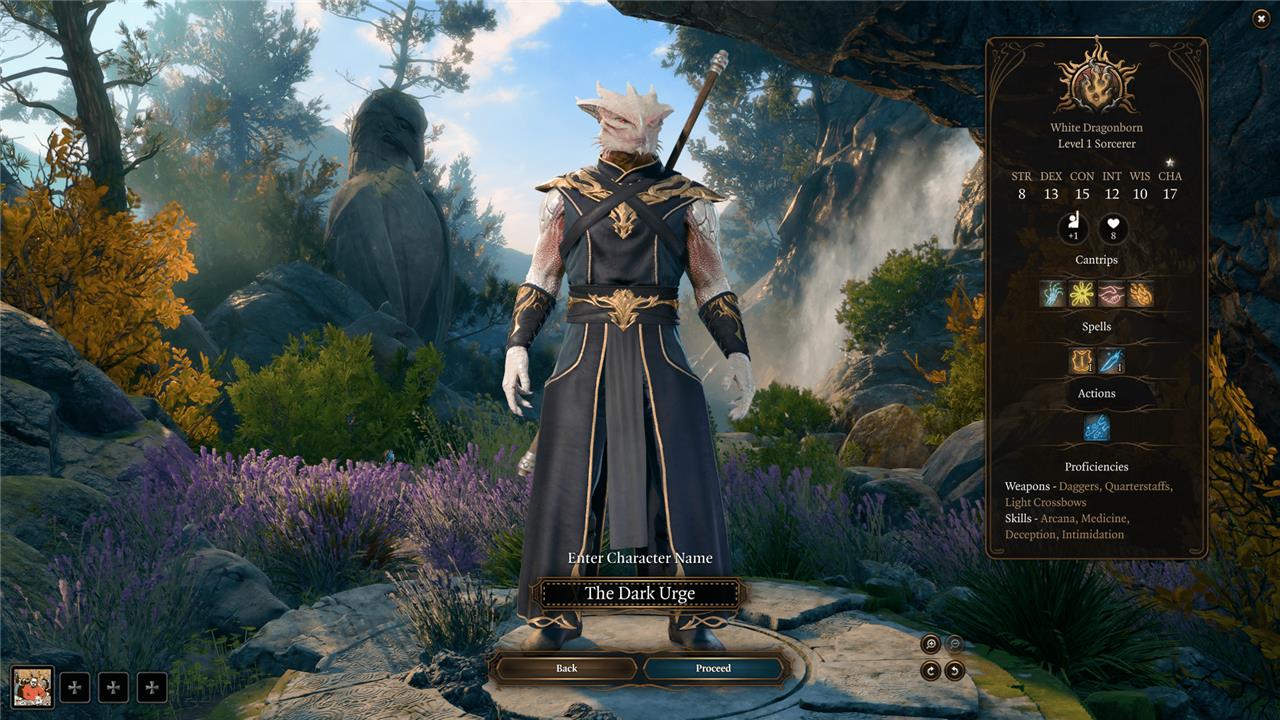
When you’re first starting your game in Baldur’s Gate 3, and creating your character, you’ll get to choose between a fully custom character or one of several origin characters – characters with a pre-determined backstory, which usually come with a locked race and class combo.
Most origin characters are based on party members you’ll meet in the world of Baldur’s Gate 3 – like Karlach, Astarion, or Wyll – allowing you to play the game as these characters instead of alongside them. The Dark Urge, however, doesn’t have an NPC equivalent in any other playthroughs. The Dark Urge will only appear in the world of Baldur’s Gate 3 if you’re actively playing as them.
This is because the Dark Urge comes with a unique, and uniquely dark, backstory that actively changes some events in the campaign.
The elevator pitch is that, for some reason, you have dark thoughts swirling in your mind constantly, backed up by the narration. For example: When you meet a party member for the first time, the narrator might say that you imagine their fresh, beautiful corpse on the ground. Or, if you examine a body, the narrator will pipe in to tell you how much you’re really digging all of this destruction, death, and sadness.
All of this Dark Urge stuff ties into some major parts of the act 3 narrative. We won’t spoil any of that here, as that’s a big reason why you’d want to try your hand at a Dark Urge playthrough. But, suffice it to say, if you don’t want your origin to be tied into evil itself, the Dark Urge probably isn’t the origin character for you.
Is the Dark Urge only for evil playthroughs in BG3?
The Dark Urge origin in Baldur’s Gate 3 is often associated with evil playthroughs due to its inherent murderous impulses and dark backstory, which unlock unique violent dialogue options and cutscenes that enhance a wicked narrative experience. However, it is not strictly limited to evil choices; players can choose to resist these urges and pursue a more redemptive or humane path, making the Dark Urge a flexible origin that supports both evil and non-evil roleplay. While the Dark Urge naturally lends itself to more brutal and ruthless decisions, it offers a complex storyline that can be explored from different moral perspectives, allowing for varied playthroughs beyond just evil alignments.

Despite the evil origin of the Dark Urge, you certainly don’t have to roleplay the character that way. In fact, you can play much of The Dark Urge as a kind of redemption tale, pushing against who you’re supposed to be and forging a new destiny. Baldur’s Gate 3 is very good at flexing to meet your internal roleplay, and that remains true for The Dark Urge.
However, if you want to play a purely good character, you want to stay away from The Dark Urge. Being good in a Dark Urge playthrough means fighting back against narrative temptations and actively trying to avoid doing the evil things that your internal monologue is tempting you to do.
If these kinds of interjections of chaos and bloodshed sound interesting to you, the Dark Urge’s story does go to some very interesting places. If those aren’t the kinds of curveballs you’re interested in, the Dark Urge won’t be a good fit.
Should the Dark Urge be your first character in BG3?
The Dark Urge can be an intriguing choice for your first character in Baldur’s Gate 3 if you are interested in a narrative rich with moral complexity and unique story elements. This origin offers additional dialogue options and a compelling overarching quest centered on resisting or succumbing to the Dark Urge, which significantly shapes the game’s narrative, especially in Act 3. However, it is recommended to experience the main campaign first with a more neutral character to fully appreciate the Dark Urge’s story twist. If you prefer a straightforward or humane playthrough, the Dark Urge might not be the ideal starting point. But for players seeking a darker, more roleplay-heavy experience from the outset, it can provide a fresh and engaging perspective.

If you’re just starting Baldur’s Gate 3 for the first time, I would advise not to play the Dark Urge as your first character.
There are a couple of reasons for this, but it’s primarily because the Dark Urge’s story is arguably more interesting if you’ve already seen the way Baldur’s Gate 3’s story plays out on a normal playthrough.
Another reason I’d recommend staying away from The Dark Urge is that it changes the narration to make it more of a psychological horror game than a traditional fantasy one. If that’s the kind of vibe you’re looking for, you could probably have a great time starting with the Dark Urge. But I see the Dark Urge as more of a way to remix the game just a little bit on a second playthrough than as a baseline experience.
Best class and build for the Dark Urge in BG3
The best class and build for the Dark Urge in Baldur’s Gate 3 is the Oathbreaker Paladin, which offers a powerful combination of raw combat strength and rich narrative ties that complement the Dark Urge’s dark and complex storyline. This build emphasizes Strength and Charisma for weapon damage and spellcasting, respectively, and leverages abilities like Divine Smite, Aura of Hate, and Control Undead to dominate in battle. The Oathbreaker subclass is unlocked by breaking your Paladin oath early in the game, adding unique roleplay elements and access to potent crowd control and damage options. Skills like Persuasion and Athletics further enhance dialogue influence and combat resilience. For companions, Minthara, Astarion, and Lae’zel are ideal to support this build’s playstyle and story progression. Alternative builds include Sorcerer/Wizard multiclass or rogue-based stealth builds, but the Oathbreaker Paladin remains the top recommendation for combining gameplay effectiveness with the Dark Urge’s narrative depth.
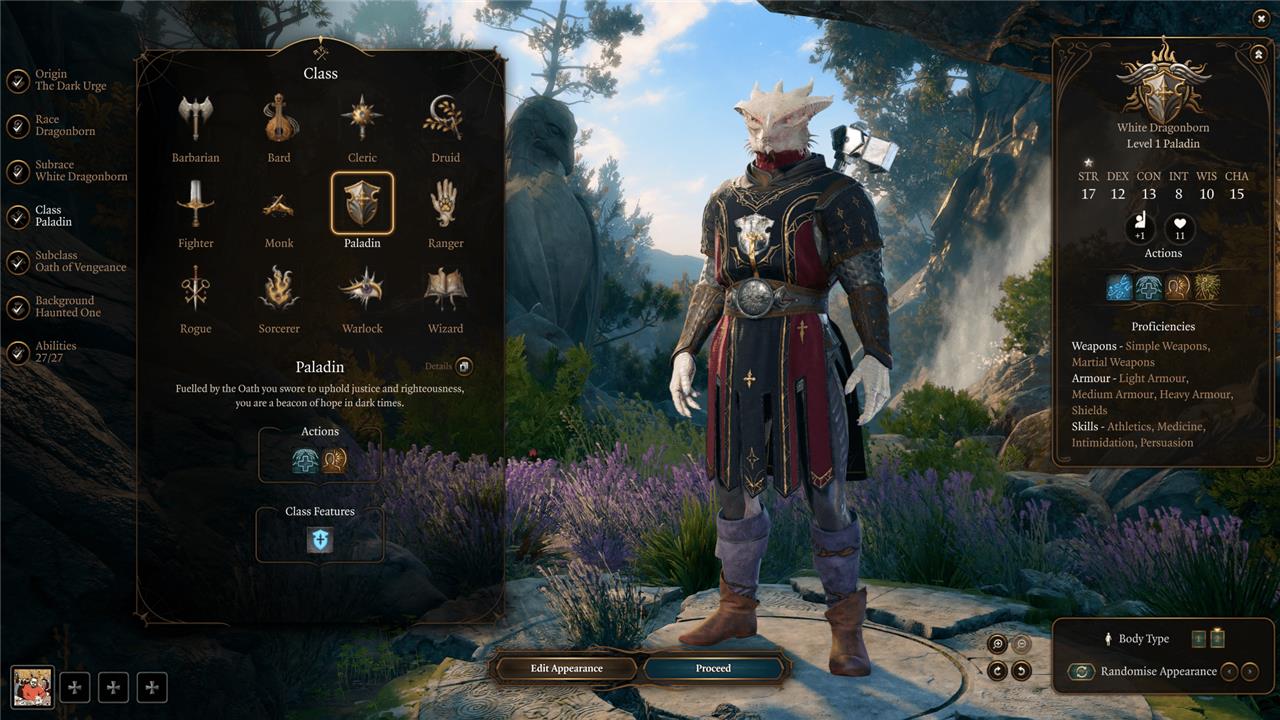
Unlike the other origin characters in Baldur’s Gate 3, you’re free to select the Dark Urge’s race and class. Neither are locked to their default. That said, the Dark Urge defaults to Sorcerer and a White Dragonborn with red accents, and I suggest sticking with something similar in your playthrough.
You don’t need to play a Sorcerer as the Dark Urge, but at the very least, I’d recommend sticking with a Charisma-based class like Sorcerer, Paladin, Bard, or Warlock. Because these classes are all Charisma casters, your damage abilities are directly tied to the stat that also makes you good at talking to other characters.
Usually, Charisma casters are referred to as the “face” of a party, meaning they handle all the persuasion and intimidation checks. When playing the Dark Urge, you’ll want to be the face of your party, as you want to be the person either intimidating others or persuading them that you’re not actually that bad of a person and that you’re trying to be better.
There’s nothing about the Dark Urge character type that demands you play as a certain class – there’s no difference between a normal Warlock and a Dark Urge Warlock – and you can definitely find success as a Dark Urge that’s a Rogue, Cleric, or any other class. However, with it being such a roleplay heavy origin character, you’ll have an easier time if your Charisma checks have some added bonuses.
If you’re looking for the best character builds that thematically pair well with Dark Urge, here are some that exhibit trickery, violence, and chaos – or justice and redemption:
- Wild Magic Sorcerer
- The Great Old One Warlock
- Oath of Devotion or Oathbreaker Paladin (break your oath to get the latter)
- College of Lore Bard
- Trickery or Light Domain Cleric
- Assassin Rogue
As for why you should stick with the White Dragonborn with red accents: It looks really cool and creepy. If that look doesn’t speak to you, you’re more than welcome to swap to a creepy Elf or a mean-looking Dwarf. Or, hey, maybe you want to make your Dark Urge a bubbly, friendly-looking Tiefling. Your race is The Dark Urge decision that matters least, so do whatever you feel inspired to do. (And, if I’m being totally honest, while Dragonborn do look really cool, their racial bonuses are pretty subpar compared to other races, so you won’t be missing much if you swap.)
How does choosing the Oathbreaker Paladin enhance the Dark Urge’s power and story
Choosing the Oathbreaker Paladin subclass enhances the Dark Urge’s power and story by deeply aligning with the character’s narrative of broken oaths and dark ambitions. In Baldur’s Gate 3, Oathbreaker Paladins are those who have intentionally forsaken their sacred vows to pursue evil or personal ambition, which perfectly mirrors the Dark Urge’s internal struggle and violent impulses.
Mechanically, the Oathbreaker grants the Dark Urge access to powerful and thematically fitting abilities such as Spiteful Suffering, Control Undead, and Dreadful Aspect, which emphasize necrotic damage, crowd control, and commanding undead minions-abilities that shift the playstyle toward aggressive frontline combat and dark magic rather than traditional Paladin support roles. The subclass also provides unique spells like Crown of Madness and Darkness, enhancing both offensive and tactical options.
Narratively, playing as an Oathbreaker Paladin reflects the Dark Urge’s inevitable fall from grace. The game forces players to break their original Paladin oath through morally dark choices-such as killing innocents or betraying allies-triggering a dramatic story moment where the character fully embraces their corrupted path by meeting the Oathbreaker Knight at camp. This transformation not only changes gameplay but also deepens the roleplaying experience by confronting the tension between the character’s former ideals and their monstrous nature.
Thus, the Oathbreaker Paladin subclass uniquely enhances the Dark Urge by combining raw combat power with a compelling story of inner darkness and shattered vows, making it the best fit for players who want to explore the full depth of the Dark Urge’s twisted origin.
How does the Oathbreaker subclass boost the Dark Urge’s combat abilities
The Oathbreaker subclass significantly boosts the Dark Urge’s combat abilities by granting access to powerful necrotic and control spells, enhanced melee attacks, and unique crowd control options that fit the character’s dark theme. Key features include:
-
Spiteful Suffering: Inflicts ongoing necrotic damage on a target and grants advantage on attack rolls against it, increasing damage output over time.
-
Control Undead: Allows the Dark Urge to command undead creatures as allies, effectively summoning minions to aid in battle without concentration.
-
Dreadful Aspect: Emits a fear-inducing pulse that frightens nearby enemies, providing crowd control to disrupt foes.
-
Hellish Rebuke (Reaction): Deals fire damage to attackers when the Dark Urge takes damage, adding a reactive damage layer.
-
Inflict Wounds: A potent melee-range necrotic damage spell that complements the Dark Urge’s aggressive combat style.
-
Extra Attack (Level 5): Enables two weapon attacks per turn, which synergizes with Divine Smite for massive burst damage.
-
Oath Spells like Crown of Madness and Darkness: Provide control and battlefield manipulation, forcing enemies to attack each other or obscuring vision to gain tactical advantage.
-
Aura of Hate (Level 7): Boosts melee weapon damage for the Dark Urge and nearby fiends or undead by adding the Charisma modifier, increasing overall damage output.
Additionally, the subclass benefits from spells like Shield of Faith for defense and Branding Smite for preventing enemy invisibility, rounding out a versatile and powerful combat toolkit. This combination of offensive spells, summons, fear effects, and enhanced attacks makes the Oathbreaker subclass a formidable choice that amplifies the Dark Urge’s raw power and thematic darkness in combat.
