
Ready to build a championship-winning roster in EA Sports College Football 25? Mastering the art of recruiting is your key to dominating Dynasty Mode, from scouting top prospects and managing scholarships to leveraging pipeline strengths and official visits. Whether you’re aiming for five-star recruits or strategic sleepers, these 10 essential tips will transform your recruiting game on PlayStation and Xbox, turning your team into a powerhouse that no opponent can ignore.
Dynasty mode is one of the crown jewels of EA Sports College Football 25, thanks in no small part to its incredibly detailed, complicated, and intricate recruiting system. Nothing is more important to building a college football powerhouse than the talent you’re able to bring in year in and year out, but recruiting the best players in the country isn’t easy, especially if you’re trying to bring a smaller school within striking distance of the playoff picture.
To help you build the CFB champions of your dreams, we’ve put together a list of tips for how to level-up your recruiting game and land the best prospects in the country in College Football 25.
Study your Team Needs spreadsheet
To effectively recruit in EA Sports College Football 25, start by thoroughly studying your Team Needs spreadsheet. This tool provides a clear overview of your roster, showing each position’s current player count and overall rating, which helps identify where your team requires reinforcements. Focusing your recruiting efforts on these specific needs ensures you allocate your limited recruiting hours efficiently, targeting positions that will strengthen your squad the most. Additionally, prioritize recruits from strong pipelines related to your program, as these players are easier to secure and can give you a competitive edge. This strategic approach allows you to build a balanced and formidable team by addressing gaps and maximizing your recruitment potential.
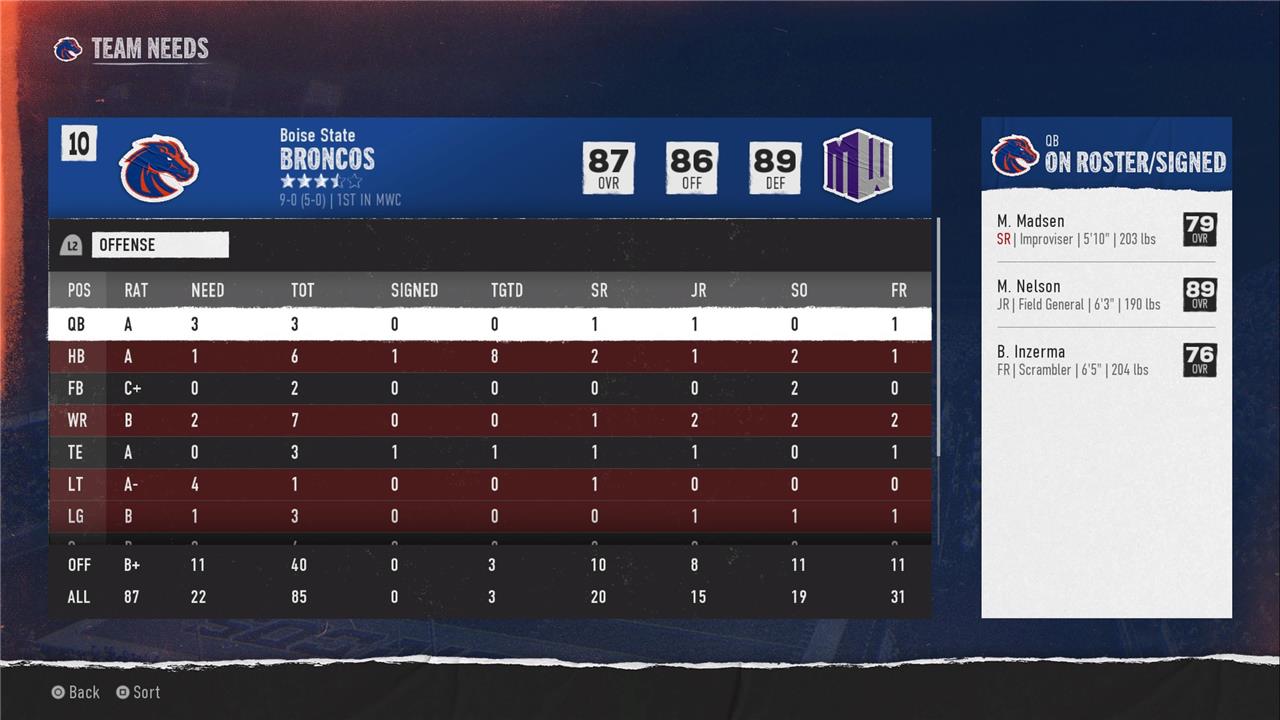
It’s entirely possible to track your roster’s shortcomings by hand, but thankfully College Football 25 doesn’t make you do that kind of work. Instead, you should spend a significant amount of your recruiting time in the Team Needs spreadsheet – which you can find by pressing the right stick while in the recruiting menu.
This screen will let you know which positions you’re currently light at, and which ones you’ll need more of because you’ve got exiting seniors or players expected to declare for the draft. It will also let you know how many players at each position you’re targeting on your prospect list, and how many you’ve already got committed this season. You shouldn’t feel limited to only recruiting positions of need, but they should be the first bases you cover each recruiting season, and they’re particularly important in the offseason when the Transfer Portal rears around (more on that later). –AG
Focus on the big fish early, but don’t get your heart set on them
In EA Sports College Football 25 recruiting, it’s wise to focus on the big fish early by targeting 5-star and 4-star recruits with strong pipeline ratings during the preseason when you have the most recruiting hours. This approach allows you to make your pitch early and gauge your chances of landing top talent. However, don’t get your heart set on these stars alone-be flexible and ready to shift focus to more realistic targets as you learn which recruits you can actually sign. Balancing ambition with pragmatism helps build a strong and balanced roster over time.
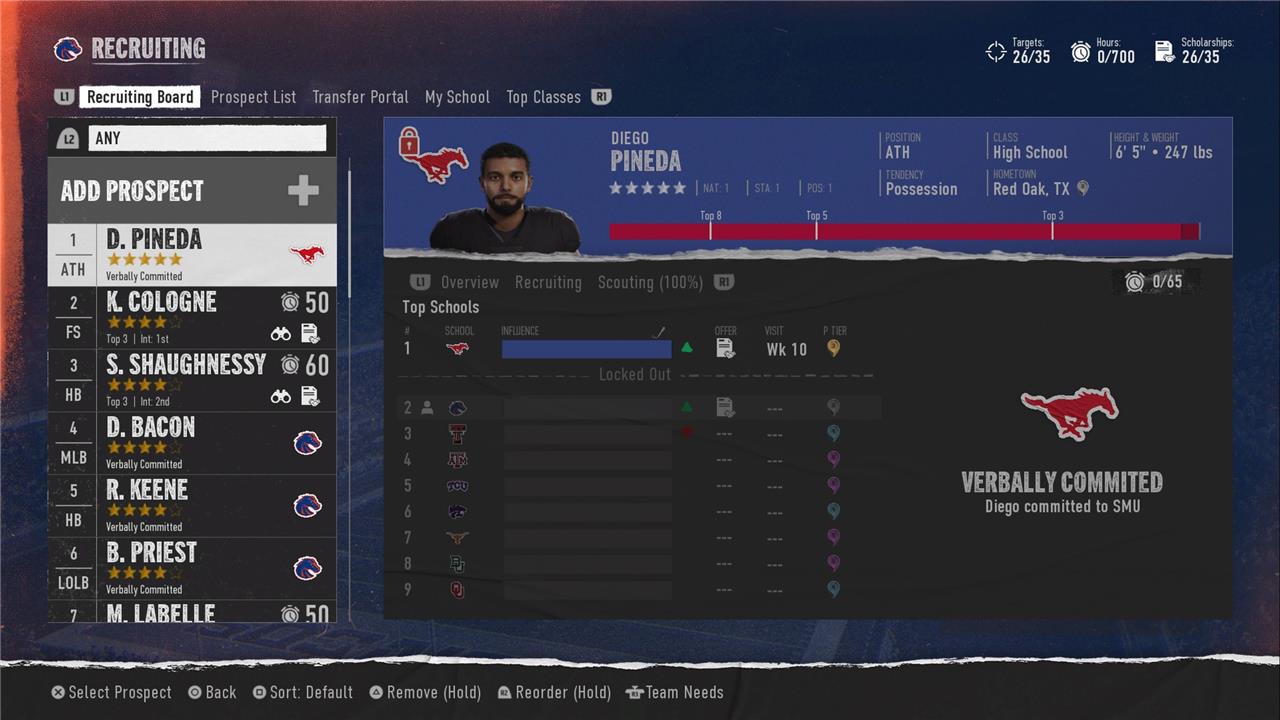
The early fall is time for hope in football programs all across the country, both for a better season than the one before, and for all those five-star recruits that barely paid your program a passing glance. You get more hours in the pre-season than you will the rest of the year, so take big shots. Send the House for the five-star who has you listed 8th, and gamble on any high-quality recruits you can. While the chances are probably slim, you might get lucky with a couple of players who happen to match your program just right.
But hope isn’t a guarantee, so it’s best to have a backup plan. While you may land the player of your dreams, especially if you’re at a bigger school, the chances are good that most of the 5-stars are going somewhere with a little more prestige than your burgeoning dynasty can muster just yet. But that doesn’t mean you shouldn’t chase them for a while. –AG
Find the prospects other teams missed
To find the prospects other teams missed in EA Sports College Football 25, focus on identifying talented players who may be overlooked by bigger programs chasing the top five-star recruits. Look beyond the obvious stars and target those with strong potential but less attention, such as four-star players or recruits in less competitive pipelines. Use the Team Needs spreadsheet and Recommended Tab to spot these hidden gems efficiently. Prioritize players who fit your team’s needs and have signable traits like proximity to home or interest in your program’s style. This strategic approach not only saves recruiting resources but can significantly strengthen your roster by adding quality talent others have missed.

My current Dynasty file is with New Mexico, which starts as a one-star program. That means there are very few four-star prospects who will even give me the time of day (and even fewer five-star prospects).
In the preseason stage of recruiting, I follow the advice above: Find every four- and five-star prospect that will even listen to me, and offer scholarships to the ones I would want on my team. By the time the season starts, most of them end up off my board, because they’ve been offered by bigger schools that I simply can’t compete with. But this also leads to the crucial part: Identifying the best prospects that bigger schools overlooked
It’s actually pretty easy: In Week 0, I filter prospects by “five-star recruits” and “four-star recruits,” respectively, and then sort it by offers received. (The format for this column is Y for if you’ve offered the prospect, N for if you haven’t, and then their number of total offers in parentheses – you’re looking for a 0 there). Every single elite recruit without any offers is getting an offer from me.
Using this strategy, I’ve been able to land at least four four-star recruits in each of my three recruiting classes at New Mexico. Later in the recruiting cycle, I fill out the rest of my class with solid three- and two-star prospects, but being able to land these overlooked elite recruits has made a huge difference. –PV
The recommended tab is your friend, but don’t rely on it alone
The recommended tab in EA Sports College Football 25’s recruiting system is a valuable tool that helps you focus on players who fit your team’s needs and priorities, such as those with strong pipeline ratings and high star rankings. It provides a quick overview of your roster and highlights key positions to target, making it easier to allocate your recruiting hours effectively. However, relying solely on this tab can limit your success, as it doesn’t capture every nuance of recruiting strategy. You should also scout beyond the recommended players, consider positional flexibility, and manage your recruiting hours wisely to build a well-rounded team. Balancing the recommended tab insights with broader scouting and strategic planning is essential for recruiting the best talent and building a championship-caliber roster.

EA Sports College Football 25’s recruiting system features a recommended tab, which surfaces players the game thinks you should target. This largely shows you players that already have you in their top 10, or realistic targets in pipeline states. I find this to be an easy way to find solid recruits to fill out the rest of my class later in the recruiting cycle, but I tend to ignore it at the very beginning unless there are big time prospects that are considering my school (but I’ll likely find those anyway). –PV
Use your pipelines
Using your pipelines effectively in EA Sports College Football 25 is a key strategy to boost your recruiting success. When creating your coach, selecting a pipeline gives you influence over a specific geographic area, making it easier to recruit players from that region due to proximity preferences. Pipelines act as multipliers in recruiting actions, enhancing your chances of securing top talent from those areas. Prioritize pipelines near your school for the strongest boost, but choosing pipelines from other regions can also open opportunities for diverse talent. Each pipeline may feature different player styles and strengths, so align your choice with your team’s needs. Once set, your pipeline cannot be changed, so choose wisely to maximize recruiting advantages throughout your coaching career.

Pipelines are a crucial mechanic in EA Sports College Football 25, as both your school and your coaches have them. Basically, pipelines give you bonuses to recruits from certain regions of the country. Use this! If all else is equal, it is better to spend your hours on a recruit from a pipeline region than one who isn’t – you’re simply going to get more bang for your buck. That doesn’t mean you should totally box out recruits from non-pipeline regions (sometimes, you can land them!), but it’s worth prioritizing regions that you already have a footprint in, just like real life.
At New Mexico, that means every season my first targets are the top players in the state of New Mexico, followed by the best players in Texas and California that the big schools in those states aren’t offering. Occasionally, I’ll pick up players from other states, but that’s where the bulk of my recruiting classes are coming from. –PV
Use your hours wisely
To use your recruiting hours wisely in EA Sports College Football 25, focus on prioritizing your efforts where they matter most. Spend all available hours each week since they do not roll over, and target high-impact recruits early in the season, especially 5-star and 4-star prospects with strong pipeline ratings to your school. Use your hours strategically by offering scholarships early to increase interest and scheduling visits during optimal times such as home games or bye weeks. Concentrate on players who fit your team’s needs and motivations, and avoid spreading your recruiting efforts too thin by focusing on key positions and prospects you have the best chance to land. Managing your recruiting hours efficiently will maximize your influence and help build a strong, competitive team.
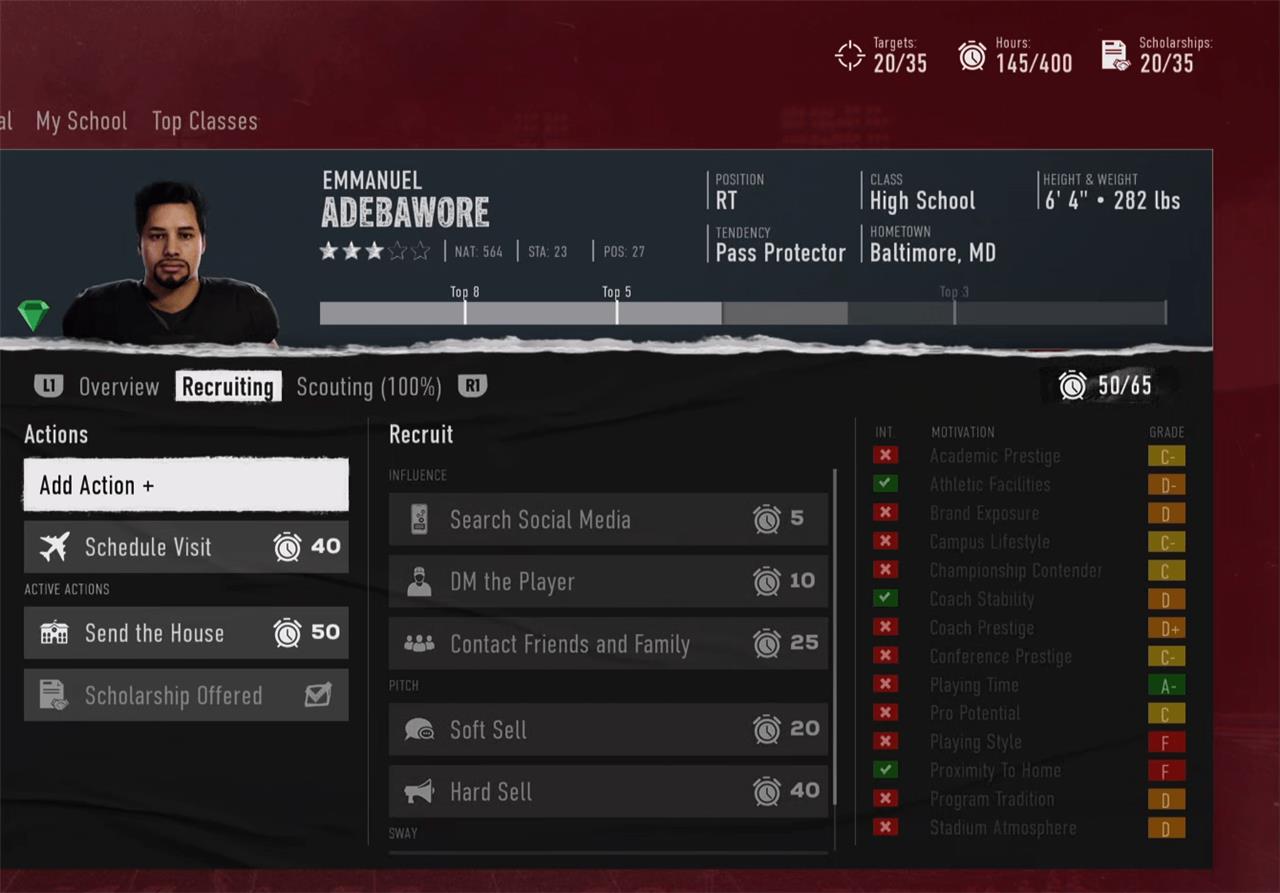
You have a limited number of hours each week to spend on recruiting actions, and those hours are even more limited if you’re a small school. So how do you spend them? I tend to max available hours on my biggest targets – the four- or five-star recruits – and spend as much as I can there until they have committed to my school or locked me out. At that point, I move on to the three- and two-star recruits, scouting them (more on that in a second) and spending my hours on them.
After you get to know a recruit well enough, you unlock the option to “Hard Sell” or “Soft Sell.” This allows you to make a more targeted pitch to the recruit, highlighting three specific areas you want to focus on. This is best used when your program’s strengths line up with the recruits priorities (which will be shown with a check mark on the recruiting tab). If you’re able to sell them well on all three of their priorities at once, it’s going to help you out massively on the recruiting trail. If they don’t align, your hours might be better spent elsewhere. –PV
When to scout and when not to scout
Scouting in EA Sports College Football 25 should be done strategically to maximize your recruiting success. Scout early in the pre-season when you have the most recruiting hours available, focusing on high-priority targets like 5-star and 4-star recruits with strong pipeline ratings, as this increases your chances of landing top talent. Use scouting to unlock player ratings and motivations, which helps tailor your recruiting pitch effectively. However, avoid scouting too many players at once to prevent spreading your limited recruiting hours too thin. Later in the season, concentrate your scouting efforts on key prospects and the transfer portal, while turning off auto-recruiting to maintain control over your recruitment board. Balancing manual scouting with selective auto-scouting ensures efficient use of resources and better overall results.

You have the option to scout recruits, learning more about their attributes, and if you fully scout them, the game will tell you whether they are a gem (with a green gem icon), a bust (with a red X over a gem icon), or neither. Think of a gem as a player whose actual ratings are equivalent to a star rating above them, and a bust as the opposite. So a three-star gem is more like a four-star recruit, and a three-star bust is more like a two-star recruit.
When to scout depends largely on the program you’re running and what kind of recruits you want in the door, but in my save file with New Mexico, I don’t scout any four- or five-star recruits ever. Even if they are busts, they will still benefit my program. I do scout almost all three- and two-star recruits I am considering, to try and prioritize gems. If possible, I try to do some scouting in the preseason, but lately that’s been waiting until midseason so that I can maximize my limited available hours on just the four- and five-star recruits I’m targeting.
One other note, which we’ll follow up on in a second: Don’t scout players in the Transfer Portal. Because they are known entities in college, there isn’t the degree of mystery that there is with high school players, and their listed star rating is their real one. There are no gems or busts in the Transfer Portal. –PV
The Transfer Portal is here to help, but don’t bank on it
The Transfer Portal in EA Sports College Football 25 offers a valuable opportunity to bolster your roster by targeting players looking to switch schools during the offseason. However, it’s important not to rely solely on it. The portal operates within a condensed four-week recruiting window, requiring quick decisions and strategic prioritization of players who show genuine interest and fit your team’s needs. While high-rated transfers are tempting, focusing on underrated three-star players with fewer offers can yield better results. Ultimately, the Transfer Portal can enhance your recruiting efforts but should be just one part of a broader, balanced recruiting strategy to build a competitive team.

The Transfer Portal is one of the most helpful tools in the recruiting process. At the end of every season, players unhappy with their current team situation can throw themselves into the whirlpool of the Portal, opening themselves up to offers from teams all around the country – including yours. This is the perfect way to fill out some depth for your roster, or to chase one or two more stars before you get ready to start your next season, but you shouldn’t count on it to fill all the gaps on your team. There’s no telling exactly who will be in the Transfer Portal each year or how good they’ll be.
For this reason, it’s best to approach the Portal by looking for any stars within your grasp, as well as maybe a third or fourth string player at a couple positions, rather than counting on getting a surefire starter who was unhappy at their previous school. –AG
What you need to know about Visits
Visits are a crucial part of the recruiting process in EA Sports College Football 25. Once a recruit has finalized their top five schools and received a scholarship offer from your program, you can schedule an official visit, which costs 40 recruiting hours. Visits allow you to bring up to four prospects to your campus during home games or bye weeks, where you can engage them in activities tailored to their interests and your team’s strengths. Scheduling visits early and strategically is important-aim to get recruits on campus within a week or two to maximize your chances of securing their commitment. Complementary visits with players from different positions can enhance the experience, but avoid scheduling multiple recruits from the same position simultaneously to prevent negative competition effects. Overall, well-timed and well-executed visits are key to closing strong with top prospects.
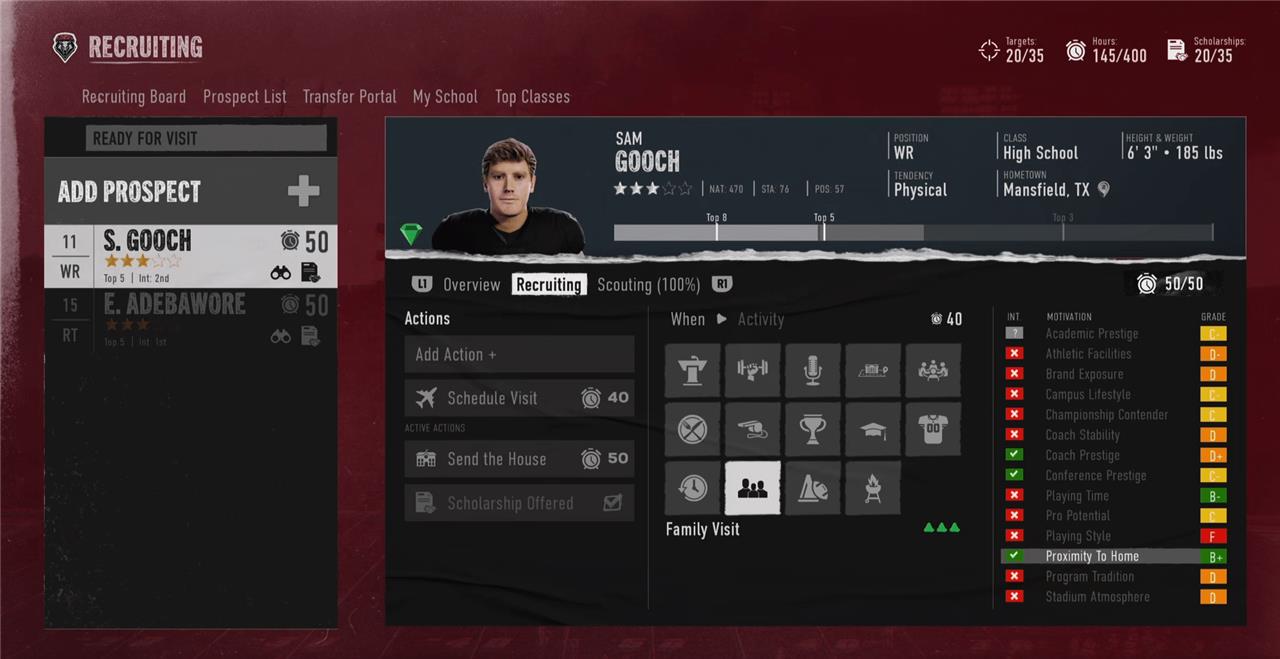
Visits are a particularly effective and important recruiting tool that becomes available after a player has listed your school in their top 5 choice. From there you can invite them to your campus for a home gameday. During their stay, you can have them focus on one element of your program. Ideally for this you’ll want to choose a category that’s important to them (has a checkmark next to it on their scouting sheet) as well as something you’re rated highly on, ideally with a B grade or higher.
While these visits are a great way to seal the deal with recruits, there are a lot of nuances to doing them right. For instance, you’ll lose influence with the player you’re recruiting if you lose the game the week of their visit. Even more importantly, you can schedule multiple players to visit on the same week, which can give you either complementary bonuses or conflicting penalties. If you have a quarterback and a wide receiver both visit on week 8, they’ll compliment each other and each boost the other’s interest. On the other hand, if you have something like three cornerbacks all visiting at the same time, their interest will all drop because they don’t feel you’re as interested in them specifically.
All of this leads to visits being a bit of an imprecise science, but still a very important tool to get used to in your recruiting adventures. –AG
The end is not necessarily the end
In EA Sports College Football 25, the end of a recruiting cycle or a season is not necessarily the end of your journey to build a winning team. Each ending is a new beginning, offering opportunities to reassess your strategy, develop existing players, and prepare for the next wave of recruits. Just as in real college football, success in recruiting is about persistence and adaptation-closing one chapter only sets the stage for the next phase of growth and triumph in your dynasty.

Sometimes, a recruit can seemingly lock you out – but that’s not always the end of things. Each recruit has a Dealbreaker – one element of a school that they prioritize above all else. Some of those Dealbreakers are fluid – Playing Style, Playing Time, Championship Contender can all change over the course of the season. If a recruit commits to a school, and then their Dealbreaker is no longer valid with that school, they could still de-commit and sign with you on National Signing Day.
Similarly, with New Mexico, I offered scholarships in the preseason to a group of prospects with Championship Contender as their Dealbreakers. At the time, my Championship Contender rating was sufficient, but over the course of the season, it dipped below what was acceptable for them, and I was seemingly locked out. However, no other school offered any of the recruits a scholarship, so I kept them on my recruiting board just in case. When Signing Day came around, sure enough, those recruits signed for me, even though their Dealbreaker didn’t fit with my school. Now, they’ll be at a higher threat of transferring than other recruits, because players retain their Dealbreakers once they get to college, but I got them in the door. –PV
How can I maximize pipeline strength to land top recruits in EA Sports College Football 25
To maximize pipeline strength and land top recruits in EA Sports College Football 25, focus your recruiting efforts on players from pipelines where your school has a high-tier rating, ideally pipeline ratings of 4 or 5. Pipeline strength acts as a multiplier on recruiting actions, making it easier to secure players from those regions.
Here are key strategies:
-
Prioritize recruiting prospects with strong pipelines to your school, especially 5-star and 4-star recruits from pipelines rated 5, as these yield the greatest recruiting efficiency.
-
Target your recruiting board to include mostly players from your top pipelines. This increases your chances of success since schools with higher pipeline tiers have a significant advantage in recruiting players from those areas.
-
Invest in upgrading your best pipelines through in-game upgrades or focusing on recruiting in those regions, which improves your pipeline tiers and boosts your recruiting multiplier for those areas.
-
Focus on pipelines in talent-rich states such as Florida, Texas, California, and Georgia, as these have multiple strong pipelines and a high concentration of top recruits.
-
Use your recruiting hours strategically on high-pipeline prospects early in the season, offering scholarships and scheduling visits to build strong relationships before other schools can intervene.
-
Monitor your pipelines regularly via the “My Pipelines” tab to identify and prioritize prospects where your pipeline strength gives you an edge.
By concentrating your recruiting resources on players within your strongest pipelines and upgrading those pipelines when possible, you maximize your ability to attract top talent and build a competitive roster in College Football 25.
How do pipeline levels influence my chances of landing top recruits in EA Sports College Football 25
Pipeline levels in EA Sports College Football 25 significantly influence your chances of landing top recruits by determining your recruiting strength and impact in specific geographic regions. Each pipeline has a tier or level ranging from 1 to 5, with 5 being the strongest. The higher your pipeline level in a region, the more influence you have there, which boosts a recruit’s initial interest in your school and increases the effectiveness of your recruiting pitches.
Schools with high-tier pipelines (levels 4 and 5) have a substantial advantage in recruiting players from those areas, making it much easier to secure top prospects. Conversely, lower-tier pipelines (levels 1 to 3) put you at a disadvantage, requiring more recruiting effort to compete against schools with stronger pipelines. This system encourages focusing recruiting efforts on players within your strongest pipelines, as these connections provide recruiting bonuses and improve your odds of success.
Additionally, stacking coaching staff with the same pipelines can amplify your influence in those regions, while diversifying pipelines offers broader recruiting reach but less concentrated power. Strong pipelines are often found in talent-rich states like Texas, Florida, and California, which produce many elite prospects, making pipeline selection a critical strategic decision in Dynasty Mode.
In summary, pipeline levels act as a recruiting multiplier: the higher the pipeline tier, the greater your influence and chances of landing top recruits from that region, making pipeline management essential for building a competitive roster in College Football 25.
