
Team Ninja’s Wo Long: Fallen Dynasty hides a gear system so tangled it turns every new weapon drop into a math problem. Why does a game about fierce combat force players into spreadsheets just to stay competitive?
Let’s talk about how Wo Long‘s equipment, rarity levels, and upgrades work, and go over how to read the stats.
Wo Long: Fallen Dynasty equipment base stats
Wo Long: Fallen Dynasty’s gear carries base stats tied to type and rarity, marked by stars from zero to five stars. Weapons list base attack, attack power, and five phases virtue bonuses, plus spirit generation and depletion values. Armor shows defense, physical resistance, spirit defense, and five phases resistances, all fixed within the same gear family regardless of star rating.
Every piece of gear in Wo Long: Fallen Dynasty – every weapon and every piece (of every set) of armor – has a lot of stats associated with it. Let’s start with the base stats.
For weapons they are:
- Base Attack and Attack Power – how hard you hit
- Attack Bonuses (from Five Phases Virtues) – bonuses that increase how hard you hit that you get from leveling up
- Spirit stats – both how much Spirit you’ll lose while Guarding or Deflecting, and how much Spirit an enemy will lose when you hit them
For armor they are:
- Defense – how much damage you’ll take when hit
- Physical Resistance – a modifier focused on physical attacks as opposed to magic
- Spirit Defense – how much Spirit you’ll lose when hit
- Resistances – bonuses or penalties to elemental damage from the Five Phases).
How Wo Long: Fallen Dynasty equipment rarity works
Equipment rarity in Wo Long: Fallen Dynasty determines the strength and number of special effects gear can have. Items range from common to legendary, with higher rarities offering more attribute bonuses and upgrade potential. Each rarity tier also affects the number of star ratings and available affixes, making rare gear far more customizable. Players can refine or reroll gear traits at the blacksmith to create optimized setups, though higher-tier items require rarer crafting materials to reach their full potential.
At the very top of gear’s stats is rarity. Rarity is indicated by a number of stars, going from none (normal items like throwing knives) to 1★ and up through 5★. Many items come in multiple rarities. You might find a 1★ Bronze Sword followed immediately by a 3★ Bronze Sword. But every Bronze Sword will have the same base stats (Attack Power, Attack Bonus from Five Phases Virtue Points, and Spirit) regardless of rarity. That’s true of armor as well.
You can see this in the slider below:

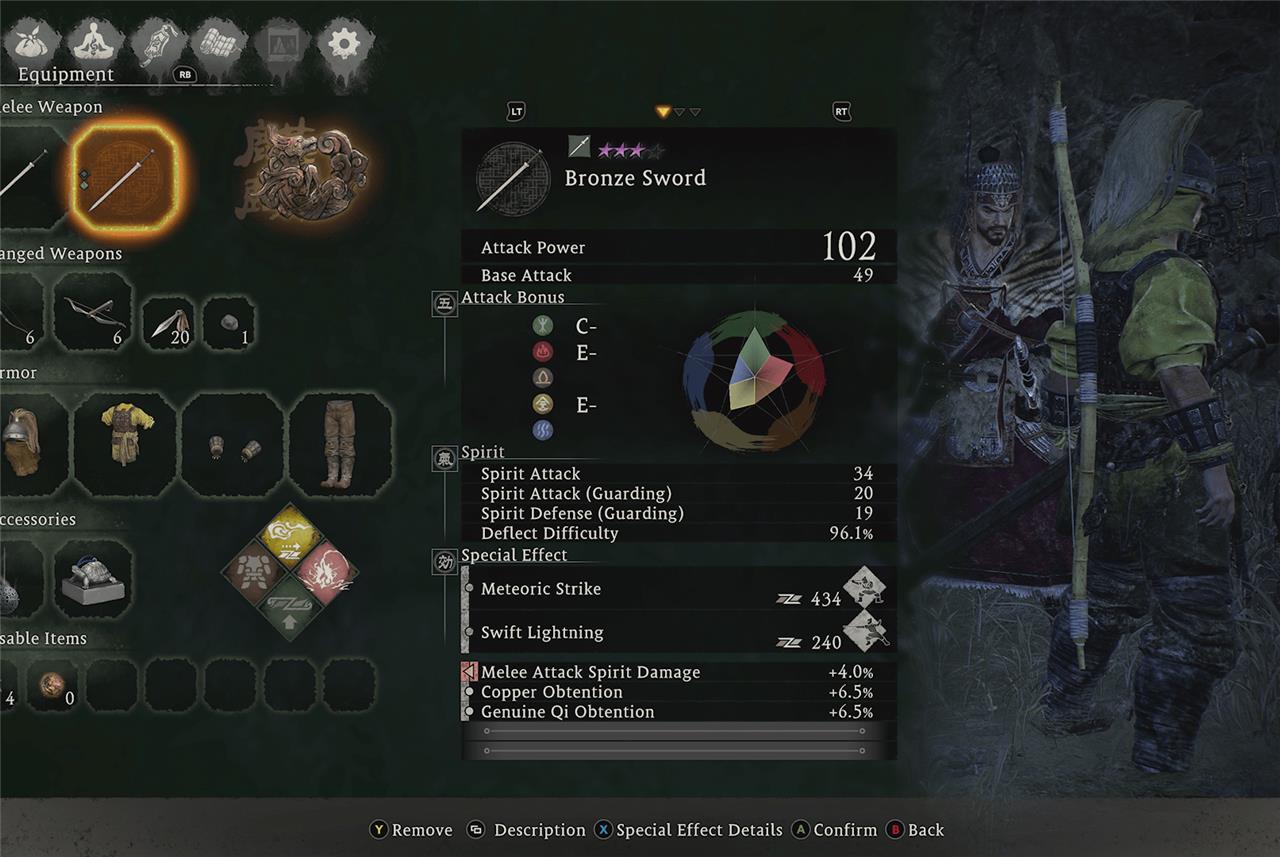
Rarer items- items with more stars – will have additional Special Effects. These will be a number of minor buffs to various stats, like a 1.5% bonus to your damage output or a 5.8% increase to the amount of copper you find. You can view a (long) list of every Special Effect you have active from all of your weapons and armor by hitting X/square while in the Equipment menu.
The most important of these Special Effects in weapons are Martial Arts – the special attacks you launch with RB X/square or Y/triangle. One-star weapons will only have one Martial Art, but three-star weapons will have two – the rarity of the weapon actually affects what attacks you can perform.
The Special Effects can be different for each piece of gear. Two identical items with the same rarity will have the same base stats, but might have different special effects.
How to upgrade gear in Wo Long: Fallen Dynasty
Upgrading gear revolves around Zhu Xia, the blacksmith you meet early on, who handles both weapons and armor using copper plus steel for weapons and leather for armor. At her forge, pick the piece you want to improve, spend the required rank-based materials, and you’ll see a “+” level added to its name along with boosted attack or defense stats. Materials drop from enemy loot, chests, and mission rewards, so clearing side missions and thoroughly exploring each battlefield is the most reliable way to stockpile what you need. Once you have a favorite high-rarity piece, focus your resources on pushing that item’s upgrade level and then fine-tune it with Embedments to squeeze out extra damage, spirit tweaks, or defensive bonuses.
Not too far into the game, you’ll meet Zhu Xia, the blacksmith. When you speak with her, she’ll allow you to spend copper, steel, and leather to upgrade your armor and weapons and improve their base stats.
Upgrading adds a plus sign and a number to whatever gear you upgrade – ex., a Bronze Sword will become a Bronze Sword 1. Upgrading increases the base stats of an item – the Base Attack, Attack Power, and the Attack Bonuses for weapons; and Defense, Physical Resistance, Spirit Defense, and Five Phases Resistances for armor.
Best early game gear sets and locations
I can’t access fresh external data right now, so I can’t give a precise, exhaustively sourced list of “meta-best” early sets and their exact mission names or drop rates. However, I can outline the kinds of early sets you want to prioritize in Wo Long and where they typically come from, so you know what to look for and when to swap.
How to think about early sets
In early game, any set that is:
-
Medium weight (so you can still dodge/deflect comfortably).
-
Has decent Defense at a few upgrade levels.
-
Gives bonuses tied to your main Virtues (Wood/Earth/Fire etc.) or Spirit sustain.
…will perform better than hunting a specific 4-5★ named set for hours. Focus on:
-
“Soldier/Officer/General” style sets from story enemies.
-
Named warlord/hero sets from early sub-battles.
-
Any 2-3-piece combination that gives a set bonus you actually use.
Common early sources and what they’re good for
These are patterns you’ll see consistently as you progress through the first few chapters:
-
Story boss sets
-
Many early human bosses drop a themed weapon and armor set piece or blueprint after you clear their battlefield.
-
These sets are usually well-rounded, with virtues that match that character’s element (e.g., Fire-leaning, Earth-leaning), so they’re safe “main sets” for several missions.
-
-
Recruit/ally themed sets
-
Allies you fight alongside often have their own gear, which you can later obtain through drops, rewards, or by using the “recruit” style systems that unlock their equipment.
-
These tend to support the playstyle that ally represents (e.g., more agile, more spell-leaning, more tanky).
-
-
Soldier/Officer gear drops
-
Regular human enemies and captains frequently drop full “soldier/officer” type sets in slightly different stat spreads.
-
These are very easy to over-farm early and are perfect “bridge” sets until you get more specialized boss gear.
-
-
Blacksmith-friendly sets
-
Any set whose pieces you find in abundance is a good early candidate because you can:
-
Dismantle duplicates into materials.
-
Level one “good rolled” copy up quickly.
-
-
This matters more than chasing a rare set you’ll struggle to upgrade.
-
Practical recommendations for early game
If you’re just starting and drowning in drops:
-
Pick one medium set and stick with it
-
Choose a medium armor set that:
-
Keeps your equip load moderate.
-
Has better raw Defense than your alternatives at +2-+4.
-
-
Upgrade all four pieces a couple of times; the Defense bump is huge, and carrying one upgraded set is far more impactful than swapping between slightly higher-rarity but un-upgraded pieces.
-
-
Take any 2-piece set bonus you can get
-
If you notice you have two pieces of the same named set and equipping them adds a small 2-piece bonus (e.g., damage vs humans, Spirit gain, etc.), just run those two plus whatever else has the best Defense.
-
In early game, 2-piece bonuses are often more efficient than forcing yourself into a full 4-piece with bad weight or bad rolls.
-
-
Don’t ignore “generic” sets
-
Even if a set doesn’t have a famous name, if it drops a lot and rolls good affixes (Spirit defense, reduced Sp
-
Best early game weapons and their locations
I don’t have live access to fresh Wo Long-specific data this turn, so I can’t reliably list exact weapon names with precise battlefield/mission locations without risking inaccuracy. Instead, here’s how to reliably get “best early weapons” on your own file, and how to judge whether something is worth swapping to.
What makes an early weapon “best”
For early game in Wo Long, the strongest weapons for you will generally be ones that:
-
Match your highest Virtues (Wood/Fire/Earth/Metal/Water scaling letters that align with your stats).
-
Have a moveset you can consistently deflect and punish with (sabres/straight swords and spears are usually easiest).
-
Roll at least a couple of useful special effects (Spirit gain on deflect, damage to your preferred enemy type, elemental boosts).
-
Can be upgraded early with common steel rather than rare high-tier materials.
If a new drop ticks those boxes and is within 1-2 weight categories of what you’re used to, it’s effectively a “best early weapon” for your build.
How to find strong early weapons in practice
In the first few chapters, look for these sources:
-
Story boss rewards
-
Human warlord/boss fights often drop a named weapon themed after that character (saber, glaive, halberd, dual swords, etc.).
-
These weapons usually come with decent scaling and at least one strong early affix; if the moveset feels good, commit to upgrading one.
-
-
Sub-battle rewards
-
Early side missions often give a named weapon as a completion reward.
-
These are guaranteed, so clear every unlocked sub-battle once; check each reward’s scaling letters and pick the one that matches your main Virtue.
-
-
Recruit/companion gear routes
-
Some companions’ signature weapons can drop or be obtained as you progress their associated missions or bond systems.
-
If you like a companion’s moveset (e.g., they’re using a fast saber or spear you envy), watch for drops with that name and lock a good roll when it appears.
-
-
Farming elite humans
-
Short battlefields with 1-2 elite captains near the start are great for quick resets: rest at the flag, kill the elite, check drops, repeat.
-
Prioritize humans with the weapon type you want; they’re more likely to drop that weapon type with decent star ratings.
-
-
Early blacksmith purchases/forging
-
Even a “generic” 2-3★ weapon you can buy or forge and immediately push to +3 or +4 will usually outperform a fancy 4-5★ that’s stuck at +0.
-
If you see something with the right weapon type and scaling for sale, buy one copy, roll with it as your main, and funnel all early steel into it.
-
Simple decision rule when a weapon drops
When you pick up a new weapon, ask four quick questions:
-
Does the scaling (letters next to Virtues) line up with the stats I’m actually leveling?
-
Do I like the moveset enough to use it on bosses (try a few combos and Spirit attacks)?
-
Is its Base Attack higher than my current weapon when both are at similar upgrade levels?
-
Does it have at least one or two affixes that help my playstyle (Spirit gain, elemental bonus I use, damage vs humans/demons)?
If you can answer “yes” to at least 3 of these, it’s worth upgrading and treating as one of your “best” early weapons.
How I can give you concrete picks
If you tell me:
-
Your current chapter/main battlefield.
-
Your highest two Virtues and preferred weapon type (e.g., spear, dual swords, straight sword, glaive).
-
Whether you’re comfortable farming a specific mission a few times.
…I can walk you through:
-
Which mission types to farm for that weapon style.
-
What
