
From dream-sculpting strategy in Unconscious Mind to thrilling co-ops and clever quick-plays, 2023 delivered board games that reshaped how strategy, storytelling, and imagination collide around the table.
Unconscious Mind
Set in 1900s Vienna and inspired by Freud’s theories, Unconscious Mind blends worker placement, engine-building, and area control into a rich psychological theme. Players lead a group of psychoanalysts who interpret dreams and treat patients while publishing research to advance understanding of the human mind. The game’s layered mechanics reward planning and creativity, offering a deep strategic challenge with stunning art and thoughtful design.
This evocative design has players occupying the role of psychoanalysts participating in Sigmund Freud’s society of followers. The game has already established its own following, raising over a million euros on Kickstarter in 2022.
It blends popular board game categories of worker placement and engine building to facilitate a rich experience of interconnected mechanisms that produce powerful cascading turns. It should be the type of medium-weight strategy game that rewards repeated exploration and stands up to long-term play.
Unconscious Mind is set to be released in December.
Frosthaven
Frosthaven expands on the legacy of Gloomhaven with deeper mechanics, new characters, and a harsh frozen setting that pushes players to adapt their strategies. Its mix of tactical combat, resource management, and evolving campaigns creates a challenging experience that rewards teamwork and careful planning. The game’s narrative richness and detailed world-building make each scenario feel meaningful, offering months of cooperative play for those who enjoy complex strategy and story-driven progression.
Gloomhaven is the smash-hit DM-less fantasy campaign in a box that currently sits as the best-rated game of all time in the niche community at Board Game Geek. It’s unsurprising, then, that its follow-up has everyone vibrating with excitement. Frosthaven is a huge box packed with content, sent into the world with promises of a more expansive and sophisticated experience than its predecessor. That’s to say, it’s likely not the best jumping-off point if you’re unfamiliar with its predecessor.
The most exciting feature is the game’s base building mechanic, centered around creating an outpost to serve as a headquarters between dungeon delves. Additionally, there are all-new classes, a new retirement system, and many new discoveries to be made on its legacy-style overworld map. It still is focused primarily on cooperative dungeon crawling through a large campaign, but everything is expected to be bigger and more fully formed.
Frosthaven will be available to pre-order from major retailers in the near future.
Sky Team
Sky Team explores cooperative play with tight puzzles, clever worker-placement twists, and accessible rules that still offer satisfying strategic depth for both newcomers and veterans.
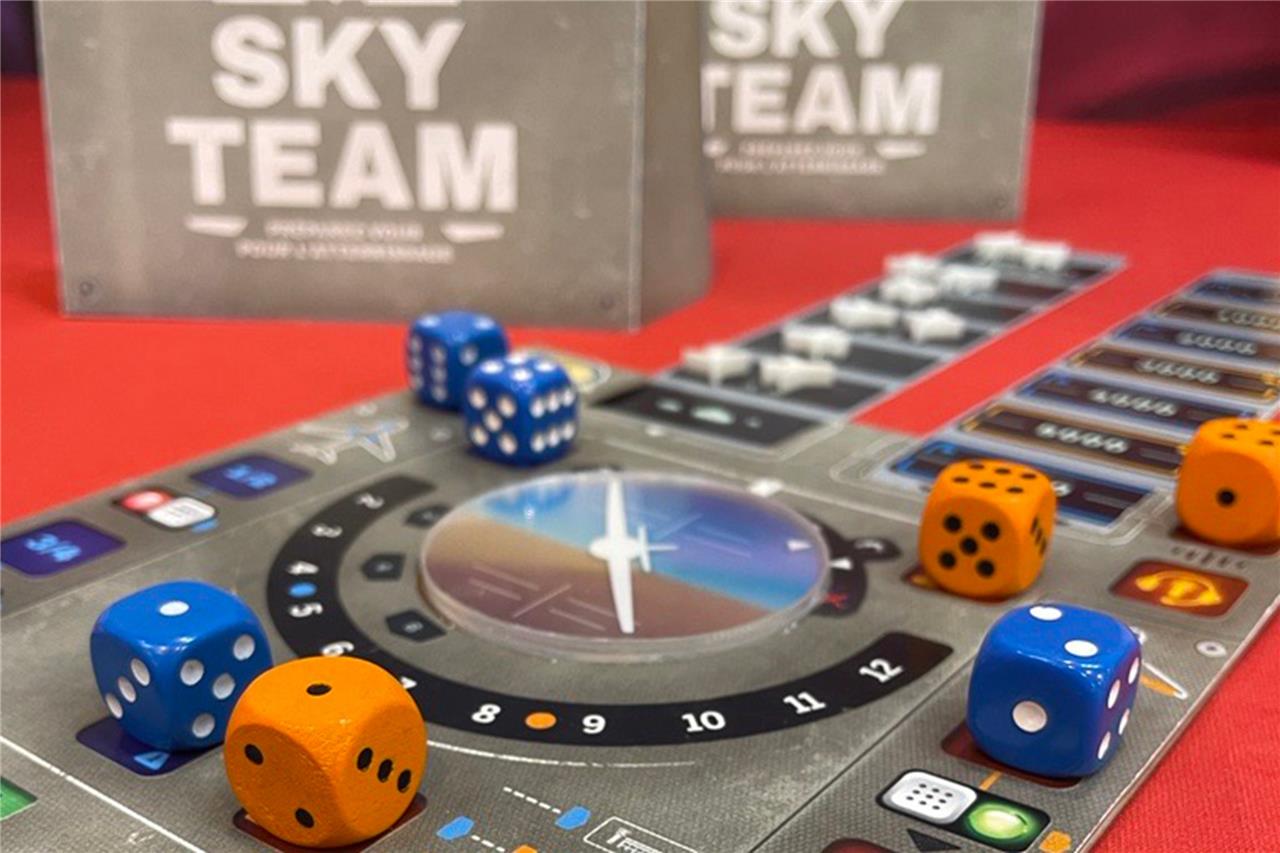
This two-player design from Scorpion Masqué hasn’t even been announced yet, but this design studio continually delivers unique and offbeat titles such as Decrypto and Turing Machine. Their latest is a cooperative limited-communication game where a pilot and co-pilot work to fly and successfully land a modern jet. Over the course of a campaign up to two players will use dice placement to control the pitch and yaw, open the flaps, and engage the landing gear.
Pre-orders are not yet available, as it’s expected to be released in fall 2023.
Legacy of Yu
Set in ancient China, Legacy of Yu tells the story of Yu the Great as he builds flood defenses and unites scattered tribes. This solo campaign game mixes storytelling with strategic resource management, where each session permanently shapes the next. Players balance construction, exploration, and defense against invading enemies, creating a narrative that evolves as Yu’s legend grows.
Shem Phillips, creator and lead designer at Garphill Games, is best known for his series of worker placement games, including Paladins of the West Kingdom and Raiders of the North Sea. Legacy of Yu is his next release, and it’s something entirely different – a solitaire design where you take on the role of legendary Chinese hero Yu the Great (circa 2000 B.C.).
Over the course of a nonlinear campaign, solo players will work to build a canal network in order to thwart the oncoming chaos of a massive flood. Your village will also require protection from neighboring barbarians, splitting your attention. This is the first exclusively solitaire legacy game, which is exciting in its own right.
Legacy of Yu is currently set to be released in July.
Arcs
Arcs blends narrative depth with strategic decision-making as players command starfaring civilizations rebuilding after a galactic collapse. Each session weaves political intrigue, resource management, and tense combat into a compact structure that rewards foresight and adaptability. With its modular campaigns and branching storylines, the game offers rich replayability while keeping every move meaningful and connected to the evolving fate of your cosmic empire.
Cole Wehrle is one of the most fascinating board game designers in the industry. We fell in love with his experimental title Oath: Chronicles of Empire and Exile, and I’ve personally come to regard his newest release – John Company: Second Edition – as the best game of 2022. Arcs is his 2023 effort, another unique and avant-garde work brimming with potential.
In Arcs, three to four players compete over galactic dominance in a fast-moving, spacefaring 4X tabletop design. Wehrle has mostly worked in historical and high fantasy settings, so seeing him get into sci-fi is already enticing. But the magic here is in the game’s three-arc campaign. This abbreviated campaign structure allows a group to actually follow through on their commitment, something rare in a world overflowing with 50-hour-plus games. It also leaves plenty of room for replayability.
Arcs is currently available for late pledge direct from Leder Games.
Thunder Road: Vendetta
Thunder Road: Vendetta brings high-octane chaos to the tabletop as rival crews race, ram, and blast their way across a post-apocalyptic highway. Players manage vehicles, dodge hazards, and sabotage opponents while maneuvering through unpredictable terrain. With its mix of racing tactics, combat, and luck-driven mayhem, it captures the thrill of survival at breakneck speed.
Restoration Games worked magic reviving Return to Dark Tower in 2022. I’m hoping it pulls it off again with a reworking of the classic 1980s car combat game Thunder Road. This new iteration looks to have a wealth of content, increased depth, and a much more vivid and stylized presentation.
Up to four players will compete for dominance on a winding post-apocalyptic road full of debris and wreckage. You can engage in combat, maneuver your team of vehicles, and swerve to avoid obstacles. Unlike the original edition, this one will have several expansions to fill it out, including a large big-rig to tear up the highway.
Thunder Road: Vendetta is expected to be available in limited quantities at Gen Con in August, with the full release occurring shortly thereafter.
The Dark Quarter
Set in the eerie streets of New Orleans, The Dark Quarter blends mystery, storytelling, and cooperation into a rich narrative experience. Players take on roles as investigators exploring supernatural crimes, guided by a digital companion app that adds atmosphere and tension. Each choice affects how the story unfolds, rewarding teamwork and moral decisions. The game’s mix of atmospheric art, branching stories, and strategic investigation makes every session feel unpredictable and immersive.
This is an interesting game as it’s being released through a joint effort between publisher Lucky Duck and Van Ryder Games. The former is known for its app-integrated mystery titles such as Destinies and Chronicles of Crime. The latter is responsible for the enormous solitaire hit Final Girl, as well as the underrated Detective: City of Angels.
The Dark Quarter takes place in 1980s New Orleans, focusing on a fantastical noir adventure of mystery and violence. Players cooperate as detectives in this app-driven experience over multi-session campaign scenarios. You will walk the magic-filled streets and peer into the dark recesses of this esoteric world.
Rules and how to play Unconscious Mind
Unconscious Mind is a 1-4-player strategy game set in Freud’s Vienna, where you play psychoanalysts competing for reputation, clients, and research. Below is a concise overview of the core rules and how to play (base-game level; expansions add extra layers).
1. Setup
-
Each player picks a professor (e.g., Jung, Adler, Spielrein) and takes their dial, ink pot, insights, and starting markers.
-
Place Freud’s professor and marker on the city map; set the Victory Point track and Reputation track.
-
Shuffle the Meeting Table deck, Research deck, and Latent Dream deck; place the four Routine Client overlay tiles in a random order under the office.
2. Game goal
-
Win by having the most Victory Points at the end of the game, earned from:
-
Treating clients (therapy points).
-
Completing Location Goals (district-based objectives).
-
Publishing Treatises (notebook tiles).
-
The game ends when Freud’s reputation marker reaches the final space on the Reputation track; you then play one last full round.
3. Round and turn structure
Each round has two phases: Action Phase and End-of-Round Phase.
On your turn, you:
-
Move your ink pot along the Meeting Table to choose an action.
-
Place ideas (from your dial) on the selected action space.
-
Resolve the action (e.g., treat a client, gain research, move Freud, etc.).
Players take turns clockwise; after all players have acted, the round ends.
4. Key mechanics
Meeting Table & ideas
-
The Meeting Table is a central board with action spaces tied to Freud’s current location.
-
You place ideas (small tokens) on the table to pay for actions; each action has a cost in ideas and may require specific colors or numbers.
Clients and therapy
-
Clients sit in your office rooms; each has a therapy-point requirement to cure them.
-
You generate therapy points via heart-shaped boxes on your dial or via research cards, then apply them to active clients.
-
When a client reaches their required therapy points, they are cured, you gain Victory Points, and often a bonus (e.g., reputation, coffee).
Research cards
-
Draw and play Research cards to gain powerful one-time effects or persistent bonuses (extra actions, extra therapy, scoring boosts).
-
Some cards trigger Location Goals; if you meet the conditions (e.g., certain notebook-tile configuration), you claim the goal and gain reputation and points.
Notebook tiles (Treatises)
-
As you progress, you unlock and place notebook tiles in rows on
Unconscious Mind winning strategies and tips
In Unconscious Mind, winning usually comes down to efficient therapy-point generation, tight notebook-tile planning, and timing your Location Goals and Treatises correctly. Below are concrete strategies and tips that top-level players lean on.
1. Prioritize therapy-point engines early
-
Focus on dial-spaces and Research cards that generate or multiply therapy points, since curing clients is your most reliable scoring path.
-
Try to complete at least one Routine Client early to unlock its bonus (often extra therapy or reputation) and stabilize your engine.
2. Plan your notebook rows (Treatises)
-
Treatises give big Victory-Point bursts, so build toward full rows instead of scattering tiles.
-
Pay attention to row-tags (e.g., coffee, reputation, extra actions); match them to your preferred scoring style (e.g., reputation-heavy vs. coffee-driven).
3. Control Freud’s movement and location goals
-
Moving Freud opens new Meeting Table actions and triggers Location Goals; try to activate goals you can realistically complete (e.g., notebook-tile patterns or therapy-point thresholds).
-
Avoid letting opponents “ride” your Freud-movement; if you push Freud too fast, you may help them claim goals before you can.
4. Balance clients vs. research vs. reputation
-
Don’t over-commit to too many clients at once; it clogs your office and blocks new ones.
-
Use Research cards to either:
-
Boost therapy output, or
-
Lock in scoring (e.g., extra points for certain client types or notebook configurations).
-
5. Manage your Meeting Table efficiently
-
Think in chains: place ideas so you can reuse leftover ideas on adjacent actions next turn.
-
Watch opponents’ ink-pot positions and try to block or slow their access to key actions (e.g., moving Freud or clai
