
Addison’s fixation on keeping those wobbly signs upright has gone from quirky side quest to full-blown obsession-and somehow, it’s both hilarious and painfully relatable.
Addison’s boss is Hudson, president of Hudson Construction. Like Bolson in Breath of the Wild, Hudson will help you build a house later in the game, but from the moment you arrive in Hyrule, you’ll feel his presence. After the Upheaval, Hudson is generously sponsoring the rebuilding of the kingdom by leaving caches of building materials everywhere (which you can use to turn into weird vehicles or Korok torture devices to your heart’s content). And Hudson wants everyone to know about his generosity, so he’s sent Addison out there to erect a sign with his face on it next to almost every cache.
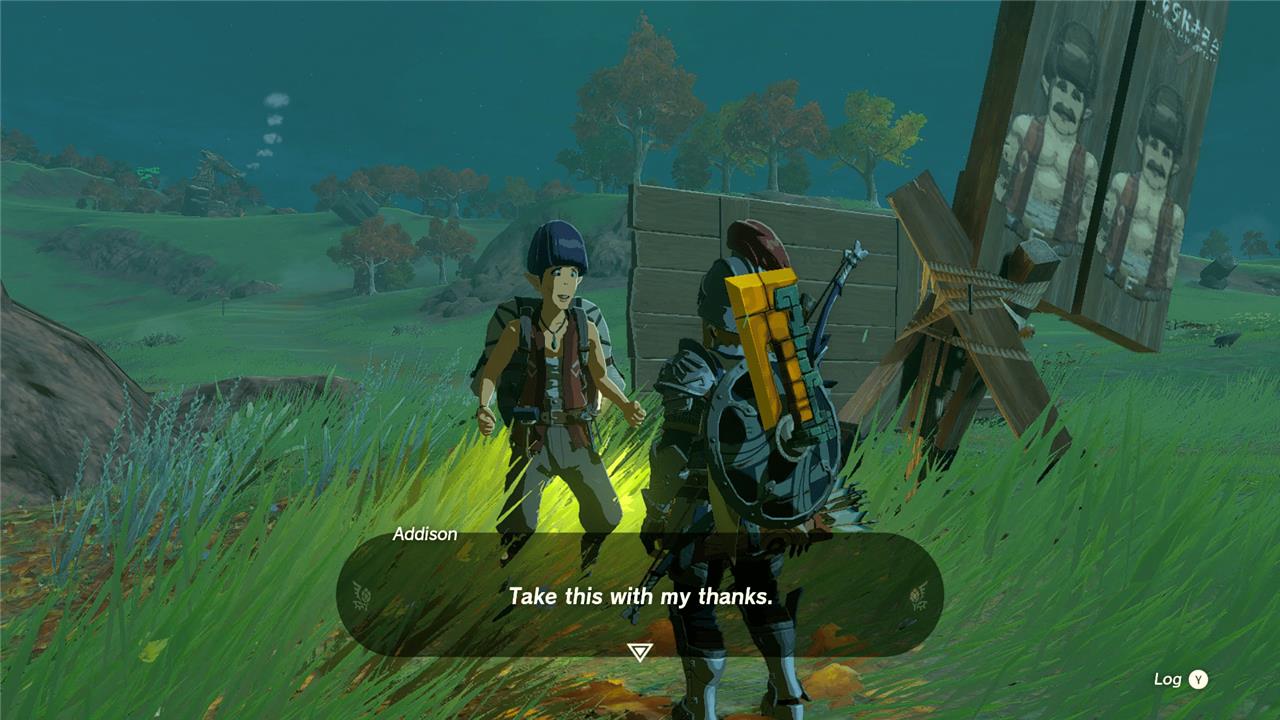
Addison is one of my favorite characters in Tears of the Kingdom, for several reasons. He’s absurd and funny, and he’s the pretext for some simple, fun little physics puzzles. If he lets go of the sign, it’ll fall over, so it’s up to Link to prop it up with a glued-together Ultrahand assembly before Addison can lash it in place. Every sign is a different shape, which presents a different challenge, but also serves as a clue for how to solve it. The puzzles are lovely little palate-cleansers that break up Link’s travels, without getting as elaborate or messy as helping a lost Korok get back to his friend.
Addison’s refreshing in another way, too. He’s a reminder that Zelda games, as fantastical and mechanically ornate as they are, are also about real life.
The Zelda series has long been Nintendo’s foremost outlet for saying something about the world we live in. Majora’s Mask, which has an entire clockwork soap-opera ticking away at is center, is the most famous example. But think of any Zelda town and you’ll find memorable examples of the petty jealousies, sad dreams, and quirky peccadilloes of the townsfolk. Remember Skyward Sword‘s preening meathead, Groose? Or Ingo, the put-upon employee at Ocarina of Time‘s Lon Lon Ranch, who sells his lazy boss Talon out to Ganondorf? The series is scattered with dozens of these little dramas that poke fun at everyday human vanities.
Addison and his signs are a classic example of Zelda’s pocket-sized satire. He’s an overeager, hapless worker, exploited by the hubris of his boss. The image of him straining to hold up the huge, imbalanced sign couldn’t be more pointed. Hudson can’t do a good deed without using it as a vehicle for self-promotion – you’ve got to think he has political ambitions – but Addison, so desperate to please, shares some blame for his own humiliation. There’s surely a specific dig intended at sycophantic Japanese workplace culture here, but anyone can relate.
It’s a tart little vignette, perfectly reinforced by the puzzle gameplay. The contraptions you come up with to prop up the sign are invariably huge, wasteful, and elaborate; Addison’s eventual fix, meanwhile, is sloppy and looks like it won’t last two minutes. The two of you step back and admire your handiwork – all that over-engineered effort in the name of nothing but corporate vanity. Then, it’s on to the next one. In Hyrule, the world has ended, a chasm has opened, and the sky is literally falling – but life, and work, go on.
Why Addison’s signs appear across Hyrule explained
Addison’s signs appear across Hyrule as part of Hudson Construction’s aggressive post-Upheaval advertising campaign.
Hudson’s Strategy
Hudson Construction aids Hyrule’s rebuilding by scattering Hyrule Restoration Materials near supply caches, and the signs proclaim “President Hudson” to credit his generosity. Addison, a devoted employee, positions one beside nearly every cache-81 total on the surface world-to boost brand visibility amid the chaos of chasms and sky islands. This ties into Hudson’s broader influence, seen later in Tarrey Town housing quests.
Game Design Purpose
The signs create repeatable Ultrahand puzzles, encouraging creative use of nearby materials like boards, hover stones, or boulders to stabilize them before Addison adds a crude stand. Players earn consistent rewards: 20 rupees, attribute-boosting rice balls, and extras like Bomb Flowers or Sleepover Tickets. Their ubiquity (from Hebra snowfields to Gerudo deserts) reinforces exploration while satirizing corporate self-promotion.
Narrative Satire
Addison’s zeal reflects blind loyalty to a self-titled “president” who’s really a savvy businessman, parodying exploitative work culture-Link diverts world-saving efforts to prop up ads. Fans note the irony: elaborate fixes for flimsy signs highlight misplaced priorities in a crumbling kingdom.
Who is Hudson and what is his role in Hyrule reconstruction
Hudson leads Hyrule’s reconstruction as the head of Hudson Construction, a firm pivotal to post-Calamity and post-Upheaval recovery efforts.
Background
Hudson first appears in Breath of the Wild as a carpenter for Bolson Construction in Hateno Village, demolishing houses before spearheading Tarrey Town’s creation in Akkala with Link’s aid in gathering materials and diverse workers ending in “-son.” By Tears of the Kingdom, he has married Gerudo tailor Rhondson, fathered daughter Mattison, and rebranded his outfit as Hudson Construction, self-styling as “President Hudson.”
Reconstruction Role
His company builds essential infrastructure like Lookout Landing-Hyrule’s central recovery hub-and all 15 Skyview Towers for mapping the Surface, skies, and Depths. Hudson supplies Hyrule Restoration Materials (wood, rocks, Zonaite) at over 80 Surface caches, advertised by Addison’s signs to claim credit amid Princess Zelda’s absence. Employees like the “Sign Sons” promote his brand while Link aids rebuilding, tying into quests like “Mattison’s Independence.”
Narrative Impact
Hudson’s ambition satirizes corporate opportunism: he profits from disaster recovery, plastering his name everywhere despite collaborative efforts by Purah’s team and others. Tarrey Town thrives as a multiracial haven, symbolizing unity, while his signs fuel player memes about exploitative bosses.
