
Step into the Pantheon, Destiny 2’s electrifying new raid gauntlet where fireteams face a relentless succession of iconic raid bosses, each battle escalating in difficulty week by week. From the haunting depths of King’s Fall to the dark corners of Root of Nightmares, this limited-time challenge tests your skills, strategy, and teamwork like never before-offering exclusive raid weapons, exotic loot, and the coveted “Godslayer” title for those who conquer its trials.
In this Destiny 2 Pantheon guide, I’ll walk you through how Pantheon works, the Pantheon rewards you can get out of it, and what the week-to-week schedule looks like.
The Pantheon guide: What is Pantheon and how does it work?
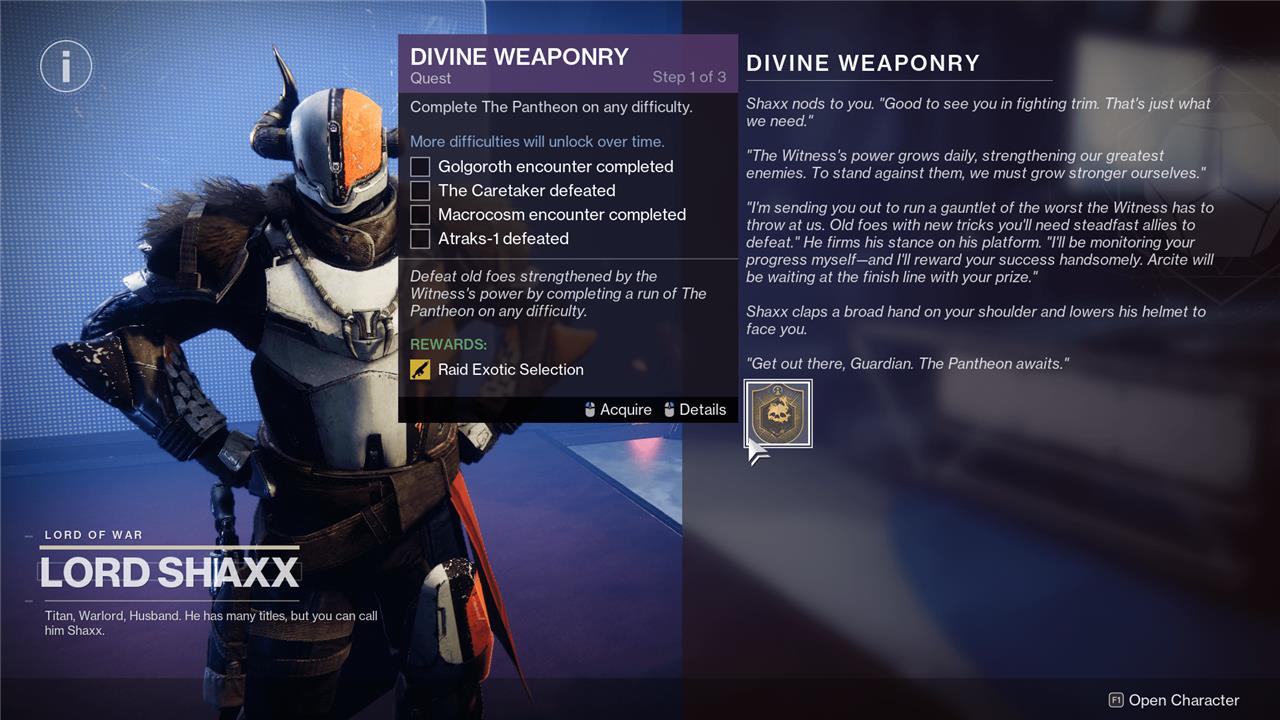
The Pantheon in Destiny 2 is a limited-time raid boss gauntlet introduced with the Into the Light update. It challenges fireteams of six to face a series of raid bosses from previous Destiny 2 raids in succession, with increasing difficulty each week. Starting with four bosses and eventually expanding to eight, players must adapt to unique twists in each encounter and work strategically to overcome them. The activity offers exclusive rewards, including raid weapons and exotic gear, with a special quest allowing players to earn Raid Exotic Weapons. To participate, players pick up the quest from Lord Shaxx in the Hall of Champions and access the Pantheon node on the Director.

The Pantheon is a raid gauntlet that also acts as a raid catch up mechanic. There are four different difficulty levels of The Pantheon, which release one week after the other. The lowest difficulty version of The Pantheon starts on April 30, and will put you at a five Power disadvantage, whereas the final difficulty on May 21 will put you at a 20 Power disadvantage.
Pantheon starts with only four raid bosses, gathered together from a variety of different Destiny 2 raids. You’ll start in the Golgoroth encounter from King’s Fall. Once you kill him, you’ll receive your rewards before getting teleported to the Caretaker encounter from Vow of the Disciple. This continues until you beat the final boss for that week.
If you want to see the first Pantheon activity (Atraks Sovereign) in action, you can watch a complete playthrough from Esoterickk on YouTube:
In addition to an increased difficulty, subsequent weeks also gain more bosses. So while week one starts with four bosses, week two will take you through the original four and then ask you to kill a fifth. There will be a sixth boss on week three, and then week four adds two more bosses, tasking you with killing eight endgame bosses in a row. Each boss also has a few tweaks to them to make them even more difficult than before.
That might sound tough – and it looks like it will be – but there are some great boons in Pantheon to help you succeed. Like Master raids, The Pantheon has burns, meaning certain elements are more powerful and deal bonus damage. There are also some modifiers that are unique to Pantheon that will help increase your damage and survivability, like giving your Fireteam a buff when someone uses their class ability nearby.
Destiny 2 Pantheon rewards
Destiny 2 Pantheon rewards include a variety of valuable items that make tackling this raid boss gauntlet highly rewarding. Players can earn legendary raid weapons, high-stat armor pieces, and Spoils of Conquest from each encounter. Completing the Divine Weaponry quest within Pantheon guarantees access to exotic raid weapons such as Touch of Malice, One Thousand Voices, and Collective Obligation. Additionally, exclusive emblems, Tokens of Bravery, and the prestigious Godslayer title are available for completing all Pantheon triumphs. The rewards scale with difficulty and weekly challenges, offering both Adept and Harrowed versions of weapons for those who achieve high scores.
As for why you’d want to subject yourself to The Pantheon, the rewards are pretty substantial. Each time you kill a boss, raid loot from the raids featured in Pantheon practically rain from the sky. This is a great way to get some raid weapons you’ve been missing, or even fill out your crafting patterns.
But the best part of The Pantheon activity is the “Divine Weaponry” quest. If you manage to complete all the bosses in Atraks Sovereign Pantheon, you can choose from a collection of raid Exotics you might be missing. You can guarantee yourself one raid Exotic as part of completing this quest – weapons that have always been random in the past, and can take dozens of clears to earn.
Here’s the full list of Exotics you’ll be able to choose from in Week 1 of Pantheon:
- Eyes of Tomorrow rocket launcher, Deep Stone Crypt
- Touch of Malice scout rifle, King’s Fall
For completing the week 3 or 4 Pantheon, you’ll be able to select a second Exotic from this pool:
- Collective Obligation pulse rifle, Vow of the Disciple
- Conditional Finality shotgun, Root of Nightmares
- One Thousand Voices fusion rifle, Last Wish
Finally, there’s the Godslayer title, which will require you to not only kill all the Pantheon bosses before June 3, but kill them quickly. Each boss also has a bonus timer, and if you kill them with enough points, you’ll get a Platinum medal, netting you a Triumph you need for Godslayer and a free Adept raid weapon once per week.
The Pantheon bosses list in order
The Pantheon bosses in Destiny 2 appear in a specific order that increases in difficulty as you progress through the challenge. The sequence begins with Golgoroth from King’s Fall, followed by The Caretaker from Vow of the Disciple, then Macrocosm (also known as Zo’aurc) from Root of Nightmares. Next is Atraks-1 from Deep Stone Crypt. As the challenge intensifies, additional bosses join the lineup: Oryx from King’s Fall, Rhulk from Vow of the Disciple, Riven from Last Wish, and finally Nezarec from Root of Nightmares. Each Pantheon difficulty variation adds more bosses to the gauntlet, culminating in an eight-boss run at the highest level.

The Pantheon will add a new encounter each week leading up to The Final Shape, headlined by the final boss in the run, and will include all previous encounters alongside a Power difficulty increase.
Here are the bosses you’ll need to clear in each The Pantheon encounter, as well as the most noticeable changes you can expect:
- Golgoroth (all Pantheon encounters) – Golgoroth now inflicts two Guardians with Unstable Light at once, spawns additional enemies for gaze holders to deal with
- Caretaker (all Pantheon encounters) – Taken Phalanx now spawn near Caretaker to harass the tanks
- Macrocosm (all Pantheon encounters) – Zo’Aurc spawns additional fire tornadoes during the planet moving phase, a Tormentor spawns after all planets are in place
- Atraks Sovereign (all Pantheon encounters) – A Tormentor can spawn in the lower or upper part of the map during the buff gathering stage
- Oryx Exalted (Oryx Exalted playlist onwards) – There are additional Light-Eater Knight spawns per-phase, a Tormentor spawns after the damage dealing phase, plate Knights are now boss-level enemies with Solar shields, and there are now multiple Oryx shades in his between-phase prison
- Rhulk Indomitable (Rhulk Indomitable playlist onwards) – Tormentors now spawn in opening phase, and a second Rhulk will appear in the end arena. This Rhulk takes no damage and does not use the beam attack. It will, however, chase you and your Fireteam around and literally kick you to death.
- Riven of a Thousand Voices (Nezarec Sublime only) – Riven now takes far less damage on any floor that isn’t the top floor, meaning the infamous Riven cheese is dead and you’ll need to do the fight “correctly.”
- Nezarec Sublime (Nezarec Sublime only) – Nezarec’s big change is that you can no longer deal damage from the platforms, meaning the damage phase plays out a lot more like Rhulk from Vow of the Disciple: running and gunning with fusion rifles, rocket launchers, or grenade launchers. The Centurions that appear during the running phase also have temporary immunity shields.
How do the increasing difficulty levels affect my chances of loot in Pantheon
In Destiny 2’s Pantheon, increasing difficulty levels directly impact your loot potential by offering better rewards as you tackle harder challenges. Starting from the base difficulty with standard drops, progressing through Eternity Mode and up to Ultimatum Mode (comparable to Contest Mode), the raid introduces score-based encounters where higher scores-achieved by fewer deaths and better performance-unlock superior loot, including weapons with double perks and Adept variants. Thus, the tougher the difficulty, the greater your chances of earning top-tier and exotic rewards, incentivizing mastery of the raid’s escalating challenges.
Do higher difficulty levels increase or decrease my loot drop chances in Pantheon
Higher difficulty levels in Pantheon generally increase your chances of loot drops by providing more loot rolls at the end of encounters. Players report that on higher difficulty spheres, they receive more individual loot rolls, which statistically improves the chance of rare drops since each roll has an independent chance to yield rare items. Additionally, higher difficulty enemies tend to drop higher-level and more powerful gear. However, the increase in drop rate is often modest and may not drastically change the length or number of rooms in the instance. Some players suggest that for speed farming, lower difficulties might be preferable, but for better loot quality and quantity, higher difficulties offer an advantage.
In summary, higher difficulty increases the quantity and quality of loot rolls, thereby slightly improving your chances of rare drops in Pantheon.
