
While many titles have tried to capture that perfect blend of myth, puzzle, and adventure, Okami still outshines its peers with artistry and ambition that feels untouched-painting its story across the screen like no other action-adventure has since.
In Okami, you play as the Japanese sun goddess, in the form of white wolf Amaterasu, on a mission to save the blighted land of Nippon. In 2008, with its myriad regions and sizable map, the game gave me my first taste of unimpeded movement within a virtual world. Exiting Kamiki Village and entering Shinshu Field, the first new region, revealed space vast enough for me to go from a loping run into an all-out sprint, and yet was not so large as to make me feel hopelessly lost. There was only one thing to do with all of this space: explore.
In 2023, AELGAMES is embarking on a Zeldathon. Join us on our journey through The Legend of Zelda series, from the original 1986 game to the release of The Legend of Zelda: Tears of the Kingdom and beyond.
This would become a theme: entering a new area with the drive to dig, with my grubby little paws, into its secrets. Okami constantly teased this idea of more – that behind any barrier, there might exist a dungeon, or even an entirely new map segment. Just one more boss, and one more unlocked power, might be the key to another mysterious swath of land. With its loop of exploration, discovery, and more exploration, Okami has often been compared to the Zelda games (especially Twilight Princess, thanks to Link’s lupine form). Because I played Okami long before I ever played a Zelda game, it became my watermark for the kind of action-adventure in which discovery is a driving force.
Okami‘s expansive move set comes in the form of Celestial Brush powers that Amaterasu wields to revitalize the land and fight the demons plaguing it. As I played, I’d pause to manually draw a slash, loop, or other shape using a calligraphy-style brush, creating a tornado or a fire. Outside of combat – you’re also given the option to fight with a giant JRPG-style sword – brushstrokes modify the world by healing plants or summoning rain. Though the game was initially released for PlayStation 2 in 2006, I played it on Nintendo Wii in 2008. (I beat it again on the Wii in 2020, and started a new run of Okami HD last year.) At the time it was released, a number of critics called the Wii’s motion controls a great fit for Okami‘s Celestial Brush mechanic. But I found the Wii to be notoriously finicky, hard to manage, and liable to misread any shake of the wrist.
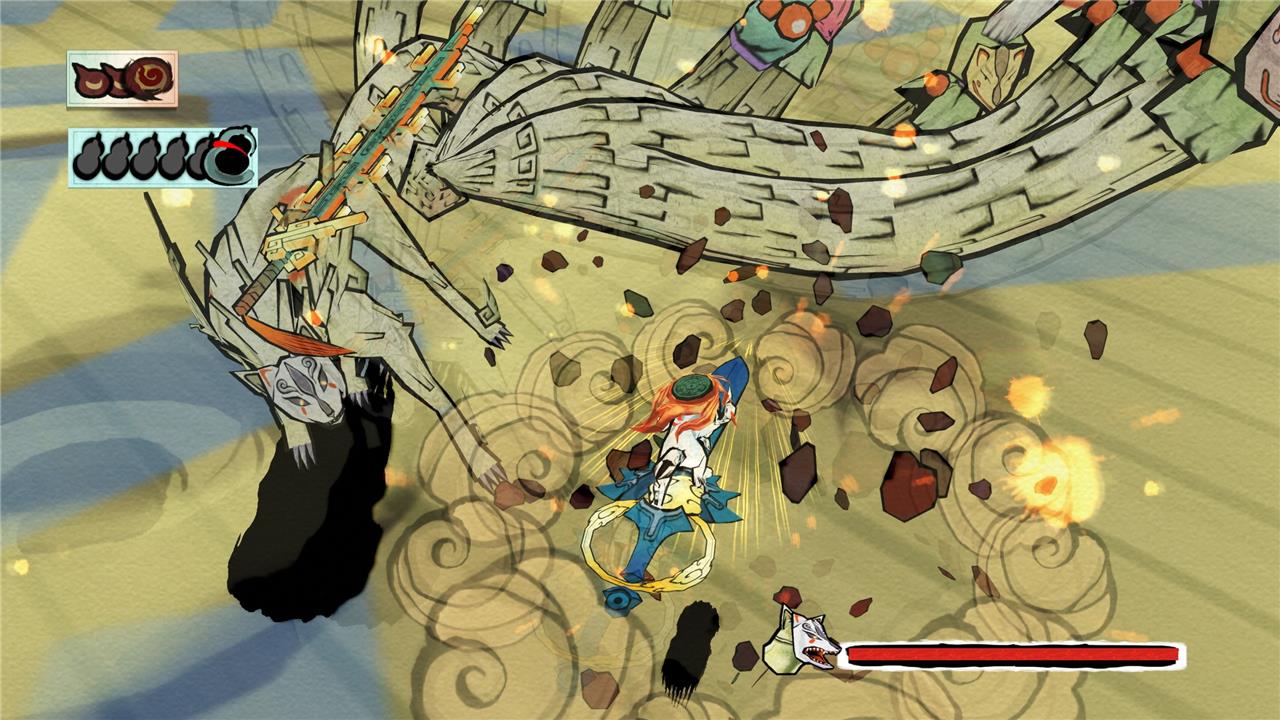
It was a pain in the ass. Amaterasu’s ever-expanding palette of moves meant learning how to execute a new motion on the finicky Wiimote with perfect accuracy and timing. I would flail my arms about with all the gracelessness of a child holding a crayon in their sweaty fist. On more than one occasion, I nearly battered my parents’ TV. (My dad would check my wrists to make sure I had the straps on before I was allowed to play.) Imagine a boss battle that you have to repeat ad nauseam, because the controller won’t let you draw a straight line across the screen, and then rewatching the cutscene again and again every time you fail. Okami‘s boss fights aren’t hard. Its paintbrush mechanics were.
I would flail my arms about with all the gracelessness of a child holding a crayon in their sweaty fist
But I didn’t care. These brushstrokes yielded such gorgeous results in Okami‘s mutable world. An “O” around a tree’s naked branches made it burst with cherry blossoms, a vision of abundance. A curlicue in the air created a zephyr that gently riffled through the sky. The world was my sketchbook, and I wanted to beautify the game’s gorgeous woodblock and sumi-e ink art style. Each of these little actions brought the wolf one step closer to healing desiccated soil or restoring the enormous Guardian Saplings that anchored each region. I was also always snorting with laughter; Celestial Brush tornadoes could sweep up enemies as if in a blender. Drawing the sun in the sky instantly triggered daytime, waking up villagers – sorry to all the shopkeepers I forced into constant clopenings.
In a world before internet access gave me all the answers, I never knew whether hidden passageways would yield a small, buried treasure or entirely new regions blanketed with snow. Every boss fight, and every new Celestial Brush move, meant more of the world to unravel. A well-placed cherry bomb might reveal a chest with an extra ink pot. A cavern brimming with water – just too long for the wolf’s swimming stamina to breach – became a portal to another region, once I had the power to make lily pad platforms to traverse it.
I was also pulled into the game’s dungeons, each with a unique gimmick that taught me how to wield a new brush power. Even now, after hundreds of hours spent across Metroidvanias, these puzzles still strike me as unique. I summoned vines to jump from point to point in a swamp dungeon, drew lines from enchanted cat statues to invoke cat climb powers – which allowed me to scale up towers – and even used the brush to turn back time. Like in Zelda games, dungeons had elemental themes: I used levers to lower the waterline in a cursed pirate ship, and fire powers in a lava-themed dungeon. Though Okami‘s puzzles are less open-ended than those of Breath of the Wild – it’s pretty obvious which brushstrokes you use to solve things – I was still wowed by the powers I amassed, and how they let me modify the world.
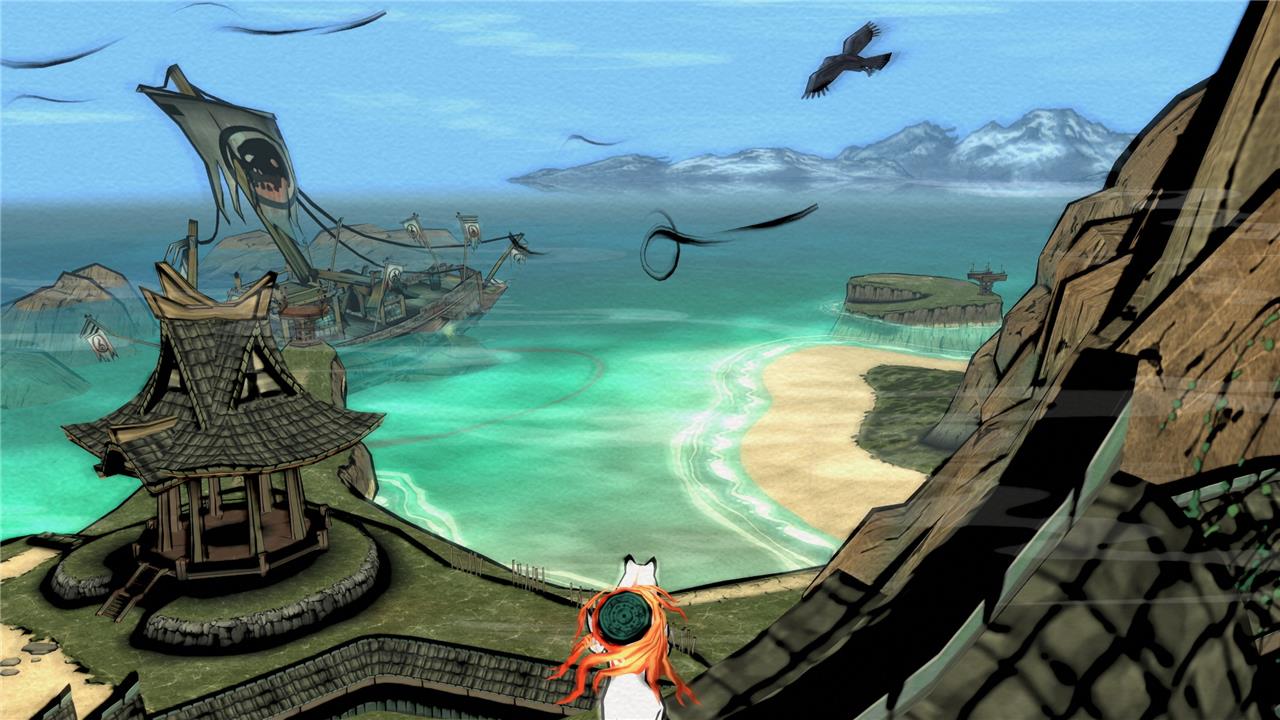
Playing Okami HD after playing a handful of Zelda titles has only revitalized my appreciation for the cult favorite. Okami‘s woodblock art style in particular has remained beautiful over the course of numerous remasters (most recently, the Okami HD rerelease for PS4, Xbox One, and PC, which came to Nintendo Switch in 2018). I expected a larger gulf between the visuals of the relatively underpowered Wii and last-gen consoles, but it speaks to the whimsy and enduring vision of the game’s art style that it remains gorgeous today.
Sure, it’s a bit awkward to take your hand off of the Switch’s joystick in order to draw the brushstrokes on a touch screen, but it’s still leagues ahead of the finicky Wii controls. Okami‘s gentle level design and open plains are not so new to me anymore, and yet this new, tactile way of playing has renewed that childlike sense of wonder.
Okami has become synonymous, for me, with that sense memory of newness – a particular pocket of adventure video game “firsts,” which felt novel as a kid who had only played Game Boy SP platformers and PC edutainment point-and-click titles before. It was a sensation awakened again when I played Breath of the Wild, a game with shocking scope, ambition, and whimsy, one that remade the notion of exploration and creative problem solving. In BOTW you can climb tall peaks and spires – gliding gently from such perches – tame an unruly horse, and fly into the sky using inane bomb physics. Okami‘s toolkit is comparatively lightweight. And yet, the games are linked in my mind for the impression they left. I am always chasing this motivation to explore, and I hope to feel it again when Tears of the Kingdom arrives.
What are the best other Zelda-like games besides Okami
Tunic and Immortals Fenyx Rising stand out as top Zelda-likes besides Ōkami, capturing exploration, puzzles, and combat in fresh ways. Other strong contenders include Hollow Knight for metroidvania depth and Hyper Light Drifter for atmospheric 2D adventures.
Top Recommendations
-
Tunic: Isometric action with cryptic manuals mimicking Zelda manuals, tight combat, and discovery-driven progression.
-
Immortals Fenyx Rising: Open-world Ubisoft take on Breath of the Wild-style freedom, Greek mythology puzzles, and climbing everything.
-
Hollow Knight: Vast bug world full of secrets, boss fights, and ability-gated exploration; more challenging than Zelda.
-
Kena: Bridge of Spirits: Stunning visuals, spirit companions, and combo-based combat in a linear yet magical realm.
Comparison Table
| Game | Style Match | Key Strengths | Platforms (Common) |
|---|---|---|---|
| Tunic | Classic top-down Zelda | Puzzle manuals, fox protagonist | PC, Switch, Xbox |
| Immortals Fenyx Rising | BOTW open-world | Mythic bosses, gear upgrades | PC, PS, Xbox, Switch |
| Hollow Knight | 2D metroidvania | Interconnected map, lore depth | PC, Switch, PS |
| Hyper Light Drifter | Pixel art action | Precise combat, silent story | PC, Switch, PS |
| Darksiders series | 3D dungeon crawler | Hacking puzzles, apocalypse vibe | PC, PS, Xbox |
These picks emphasize Zelda’s essence-world traversal, hidden rewards, and heroic quests-while innovating. Recent discussions highlight Tunic’s nostalgia and Fenyx Rising’s accessibility as frequent favorites.
Why is Hollow Knight considered the best Zelda-like
Hollow Knight earns high praise among Zelda-like fans primarily for its masterful blend of exploration, combat, and atmospheric world-building that rivals or exceeds Zelda’s formula in depth and cohesion. While not always labeled the absolute “best” universally, it’s frequently celebrated for perfecting metroidvania elements in a way that feels interconnected and rewarding, much like Zelda’s open worlds but with greater challenge and mystery.
Core Strengths
-
Vast, non-linear Hallownest map encourages backtracking with new abilities (dash, double jump), uncovering secrets organically without hand-holding.
-
Precise, skill-based combat demands pattern recognition in epic boss fights, blending Zelda’s puzzle-combat with Souls-like tension.
-
Environmental storytelling via cryptic NPCs, item lore, and haunting visuals creates a lore-rich bug kingdom more immersive than many Zelda entries.
Why It Stands Out vs. Zelda
Hollow Knight’s difficulty feels fair and purposeful, pushing players to master mechanics rather than grind, while its charm system adds build variety absent in core Zelda titles. Recent player discussions note its replayability through pathing choices and expansions like Godmaster, outshining Zelda’s linearity in some views.
Comparison Snapshot
| Aspect | Hollow Knight Edge | Zelda Counterpoint |
|---|---|---|
| Exploration | Interconnected, secret-dense | Guided freedom (BOTW-style) |
| Combat | Demanding bosses, fluid moves | Approachable, versatile |
| World/Lore | Subtle, player-discovered | Narrative-driven quests |
| Challenge | High skill ceiling | Balanced accessibility |
Its enduring acclaim stems from excelling across genres-metroidvania, action, narrative-making it a benchmark for indie Zelda-likes.
