
Samurai or Ninja: which path best defines your Nioh 3 fate, and which class will tip the scales in brutal, blade-flush combat?
Nioh 3 Samurai explained
Nioh 3 Samurai explained: The Samurai class excels at balanced offense and defense, pairing solid melee techniques with reliable ki management and strong crowd control, making it versatile for both frontline skirmishes and disciplined blade work.
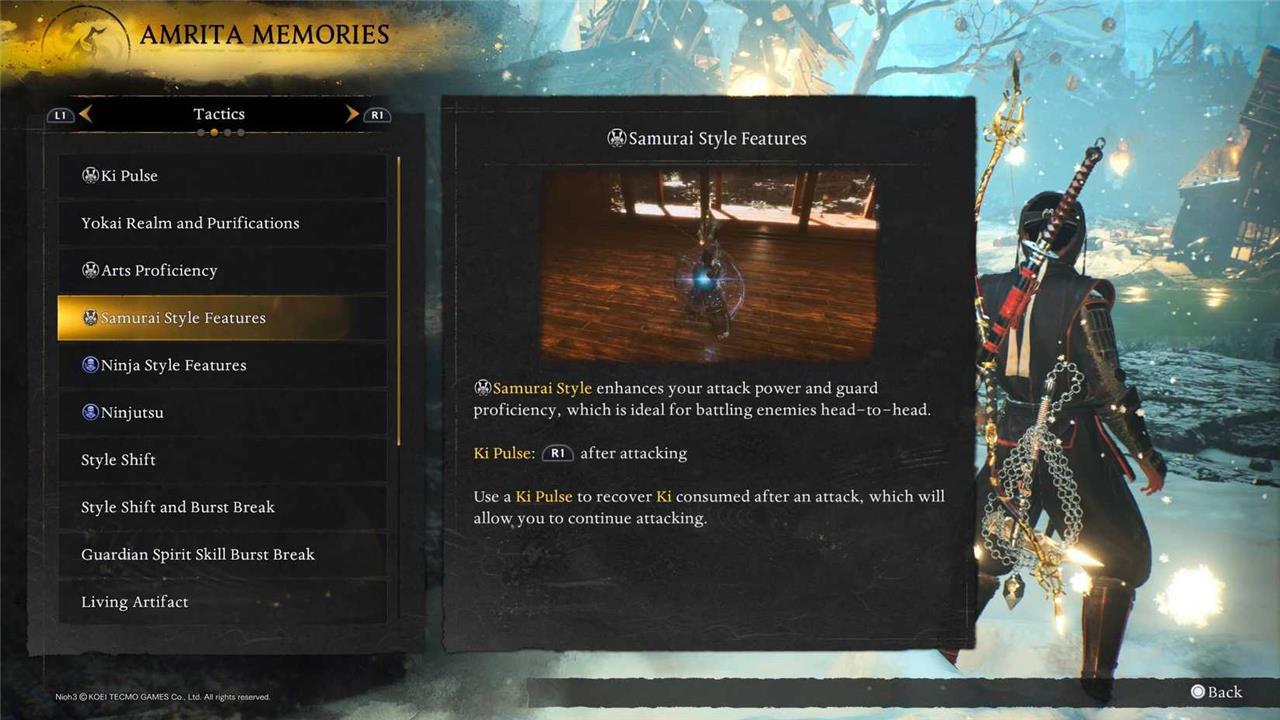
The Samurai style is all about heavy melee attacks, managing your Ki (stamina, essentially) consumption, and countering your enemy. This will be more familiar to anyone who has played either the first or second Nioh game. Here are some of the key aspects of the Samurai style:
- Ki Pulse: After attacking, you can instantly recover a portion of the Ki spent on that attack by timing a button press correctly.
- Stances: You can hold your weapon in either a high, mid, or low stance, which determines the type of attack you can use, how strong it is, and how much Ki it consumes. High stance is typically for more offensive attacks, while low stance is for defensive.
- Deflect: Deflecting is more or less the same as parrying, where you can guard as an enemy attacks to negate damage, recover Ki, and replenish the Arts and Ninjutsu gauges (more on that shortly).
- Arts gauge: When you fill the Arts gauge, you can activate Arts proficiency, which enhances both strong attacks and martial arts. As a result, Ki consumption is reduced, damage dealt is increased, and different martial arts can be used consecutively.
Nioh 3 Ninja explained
Nioh 3 Ninja explained: this class emphasizes stealth, agility, and precision, favoring swift strikes, evasive movement, and trickery over brute force. Masters weave through danger with rotatable tools, shadow steps, and misdirection, exploiting openings to nail quick, decisive takedowns.
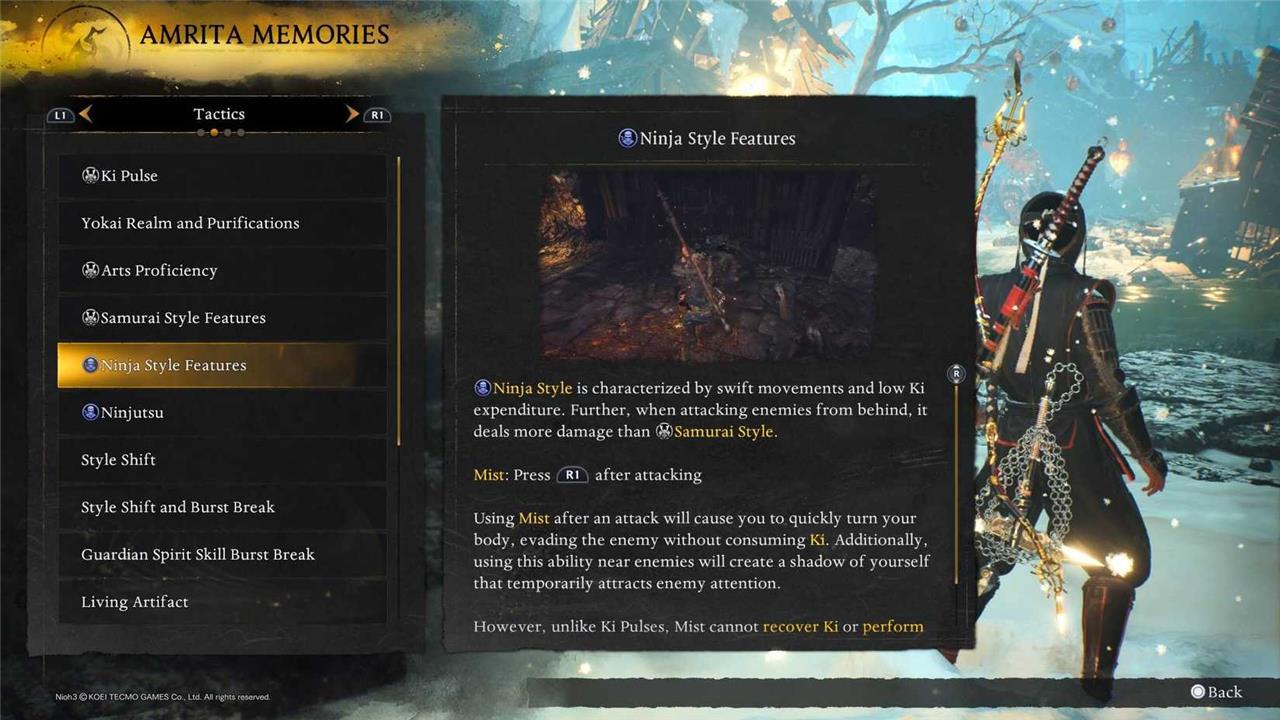
Meanwhile, the Ninja style is focused on playing in a more agile manner, which means it excels at dodging, mobility, and using ranged attacks, not to mention Ninjutsu. Getting behind your opponent and attacking will deal more damage as a Ninja, and you can attack while in midair. Here are the key aspects of the Ninja style:
- Mist: Press a button after attacking to perform a quick dodge, often ending up behind the enemy for increased damage opportunities. This also restores Ki if an enemy comes into contact with the afterimage left behind.
- Evade: If you dodge right before an enemy attack is about to connect, you’ll recover Ki and replenish the Arts and Ninjutsu gauges. Evading successfully also grants invulnerability for a short period.
- Ninjutsu: Various abilities and actions, such as long-range attacks or traps you can lay. Equippable via the menu, with more unlocked via skill points.
- Footstool Jump: If you jump while in midair near an enemy, you’ll bounce off them and can land behind, opening them up for damage opportunities.
Best weapons for Ninja style in Nioh 3
For Ninja style, the standout weapons people consistently rate highest are Tonfa, Kusarigama, and Ninja Sword, with Talons and Dual Ninja Swords as strong alternatives for more advanced players.
Top picks for Ninja
-
Tonfa – Best overall “meta” Ninja weapon: extremely high Ki damage, rapid blunt hits, and great when you’re circling behind enemies. They fit an aggressive, in-your-face style where you constantly pressure stamina and stagger foes.
-
Kusarigama – Flexible chain weapon that excels at hit-and-run and controlling space at both close and mid-range. It’s perfect if you like staying mobile, poking from a distance, and then darting in when the enemy is open.
-
Ninja Sword – Easiest Ninja weapon to learn, with balanced speed and damage and no weird mechanics. Great as a “fundamentals” weapon while you learn bosses and Ninja movement.
When to pick the others
-
Talons – Claw-style weapons for very fast, combo-heavy play, with strong air and follow-up attacks but shorter range and higher execution.
-
Dual Ninja Swords – Super fast, aggressive twin blades that shred but have weaker defense and require good Ki and dodge management.
-
Hatchets / Splitstaff – More niche: Hatchets for risky throw-based, high-skill play, Splitstaff for complex stance and range tech once you already know the game well.
Simple recommendations
-
New to Nioh or Ninja: Ninja Sword first, then try Tonfa.
-
Comfortable with action games and want power: Tonfa main, with a backup Ninja Sword or Kusarigama.
-
Love very fast, flashy combos: Talons or Dual Ninja Swords, once you’re used to Ninja dodging and Ki control.
If you tell me whether you prefer safer mid-range or aggressive in-your-face play, I can suggest a specific weapon + stat focus to start with.
Best build for Tonfa Ninja in Nioh 3
For a Tonfa Ninja, you want a Ki-break, Water status, and evasive build that lets you live right in the enemy’s face while shredding their stamina.
Core stats and focus
-
Prioritize Constitution and Skill as your main damage stats for Tonfa, with some Magic for talismans and elemental support.
-
Keep enough Stamina to wear light or medium armor without going over your preferred equip load tier, then sprinkle extra points wherever a set or item requires it.
Example early allocation (rough idea, not rigid): Constitution ≥ Skill > Magic ≈ Stamina.
Weapon, element, and guardian spirit
-
Use Tonfa with imbue Water (e.g., White Bone Spirit / spirit Tonfa or any early Tonfa that rolls Water).
-
Build around Saturation (Water status) so your multi-hit Tonfa strings rapidly debuff enemies and boost your damage.
-
Pick a Guardian Spirit that boosts Ninjutsu, Ki recovery, or Water damage; Kusanagi or a Water-leaning spirit is ideal if you’re going hard into Water, while a Ki-recovery spirit like Nekomata is great for constant pressure.
Armor and passive effects
-
Aim for light to light-medium armor with high Ki recovery, Dodge Ki consumption reduction, and some Toughness so you can stay close without getting deleted.
-
Early on, armor with Defense, Toughness, Ki Recovery Speed, and Melee Ki Damage will do more for you than chasing perfect named sets.
If you find Heir’s Shinobi or similar pieces with Dodge Ki Consumption reduction, they are excellent for a Tonfa Ninja.
Tonfa skills to prioritize
Focus on skills that chain fast hits to crush Ki and keep you on target.
-
Core Tonfa arts:
-
Heavenly Chain, Sweeping Kick, Storm of Strikes, Mountain Breaker as your main combo / gap-close tools.
-
Mystic Arts that improve animation cancels and sustained DPS (e.g., those that synergize with Demon Dance and Apocalypse in Nioh-style Tonfa play) once they unlock.
-
-
Playstyle: quickly strip Ki, punish with grapples and final blows, then reset spacing with dodges rather than blocking.
Ninjutsu and Onmyo picks
Use Ninjutsu for defense and chip, and Onmyo for elemental support.
-
Ninjutsu to invest in:
-
Evade and Cicada Shell for emergency repositioning and insurance when you mistime a dodge.
-
Shuriken / Kunai as cheap ranged pressure and finishers on low-Ki enemies.
-
1-2 Uncanny element ninjutsu if you want extra Water or other status, but keep in mind your best elemental scaling will be from Magic.
-
-
Onmyo staples:
-
Water talismans (e.g., Water Familiar / Geyser Shot-style options) to rapidly apply Saturation on top of your multi-hit strings.
-
Power / Extraction / Ki buffs where available from soul core or talisman slots to keep your pressure going.
-
Soul cores and effects to chase
-
Prioritize soul cores that give Water damage, Ki damage, Ki recovery, or life drain on Water damage.
-
Examples from early recommendations:
-
Jakotsu-baba for Water damage and supporting Water talismans.
-
Yasha for martial arts Ki consumption reduction and life drain on Water damage.
-
A defensive core such as Yoki for extra defense and Purification bonus if you’re mixing Purity into your setup.
-
How to actually play it
-
Stay in close, use quick Tonfa strings to break Ki first, not to race HP.
-
Keep Water buffs up; once Saturation is applied and Ki is low, fish for grapples and final blows to cash out huge damage.
-
Rely on dodging + Evade/Cicada Shell rather than blocking, and use your high Ki recovery to reset out of danger after every big string.
If you tell me whether you’re still early-game or already in higher difficulties, and whether you prefer glass-cannon or tanky Ninja, I can turn this into a very specific stat line and skill order.
