
Torn between Threads, Bluesky, or Mastodon? With Twitter’s crown up for grabs, users are testing which clone actually keeps the conversation alive and which one fades faster than a trending hashtag.
I don’t know about the rest of you, but looking over the list of Twitter’s competitors makes me feel like a newly single person getting way too many thirsty texts from numbers I don’t recognize. There are a hell of a lot of options out there – I just want to find the one that makes me feel safe, makes me laugh, but also challenges me, like in a healthy way. all the stuff you look for in a social media website.
In this list, I’ve left out the video-focused apps (e.g., TikTok, YouTube) and the apps that are super different from Twitter (e.g., Pinterest, LinkedIn), focusing instead on apps that attempt to do what Twitter did best: a text-forward feed with breaking news and shitposts side by side.
I just don’t know if any of these are “the one.” Let’s try to figure it out, shall we?
The newcomers
New arrivals pop up almost every week, hoping to catch users tired of Twitter’s chaos or X’s rebrand. Most of these apps copy the basic feed-and-reply formula, but differ in moderation style, growth strategy, and how tightly they tie into existing networks like Instagram or Mastodon. Some feel like ghost towns, others like noisy group chats, and a few are already carving out distinct cultures that might keep people posting once the novelty fades.

Threads
If you have an Instagram account, you’re halfway into bed with Threads, Meta’s Twitter competitor. This is a real “Hotel California” situation, though, because once you make a profile on Threads, you can’t delete it without also deleting its associated Instagram page. The app already has 30 million profiles, but who knows how many of those people thought they were just navigating to a new Instagram feature?
The appeal: Your friends (from Instagram) are already on there, probably – even if it’s too soon to say whether they’ll stick around. (It’s been literally one day.)
Red flags: It’s Zuckerberg, so this is red flags all the way down.
Spill
Founded by two Black ex-Twitter employees, Alphonzo “Phonz” Terrell and DeVaris Brown, Spill is still in the invite-only beta testing phase. In an AfroTech exclusive, Terrell described how much of Black Twitter and social media communities are “powered by Black women,” even as those trendsetters are “getting way more hate than any other group.” How to solve that problem? AI tech (for moderation) and blockchain technology (to compensate users who go viral for their original content).
The appeal: Keke Palmer is on it.
Red flags – OK, pink flags: “AI” and “blockchain” are two key buzzwords in the pitch. Spill could very well find non-shitty ways to implement those technologies, but they’ve been misused and abused so often by other tech companies that it’s understandable if potential users feel skeptical.

Bluesky
Like Spill, Bluesky is still in beta and invite-only – though there’s also a waitlist you can join. The platform’s been around for a bit longer (the iOS app came out in February 2023), and it has quite a kicking social scene already for a semi-private social network. It looks almost identical to Twitter, which is either good or bad depending on how intense your Twitter addiction was (or is, bless your heart). Bluesky is decentralized, which means users have to join specific servers – though at the moment, everyone is just on one main server.
The appeal: Dril and Rep. Alexandria Ocasio-Cortez are on it.
Red flags: It’s funded by Jack Dorsey, of Twitter fame. Remember, that guy was also not good at running a social media website. It’s just that the bar got lower since he left.
Post.news
You know those people who say they only read Playboy for the articles? And it’s a joke about porn, but also about how Playboy used to have some pretty great articles back in the day? Post.news is for those people, in the sense that it’s for Twitter absconders who were truly just there for the articles. I spent about five minutes on this platform and felt bored the entire time. They should consider adding pornography. Just a thought!
The appeal: It’s genuinely unclear.
Red flags: Hasn’t fixed journalism yet. Also, I did a search for all of my most online friends and none of them has an account. This is a website for smart people, which is to say, nobody – because social media is for being a brain-empty dingus who clicks a heart button to indicate “I’m still alive.”
Substack Notes
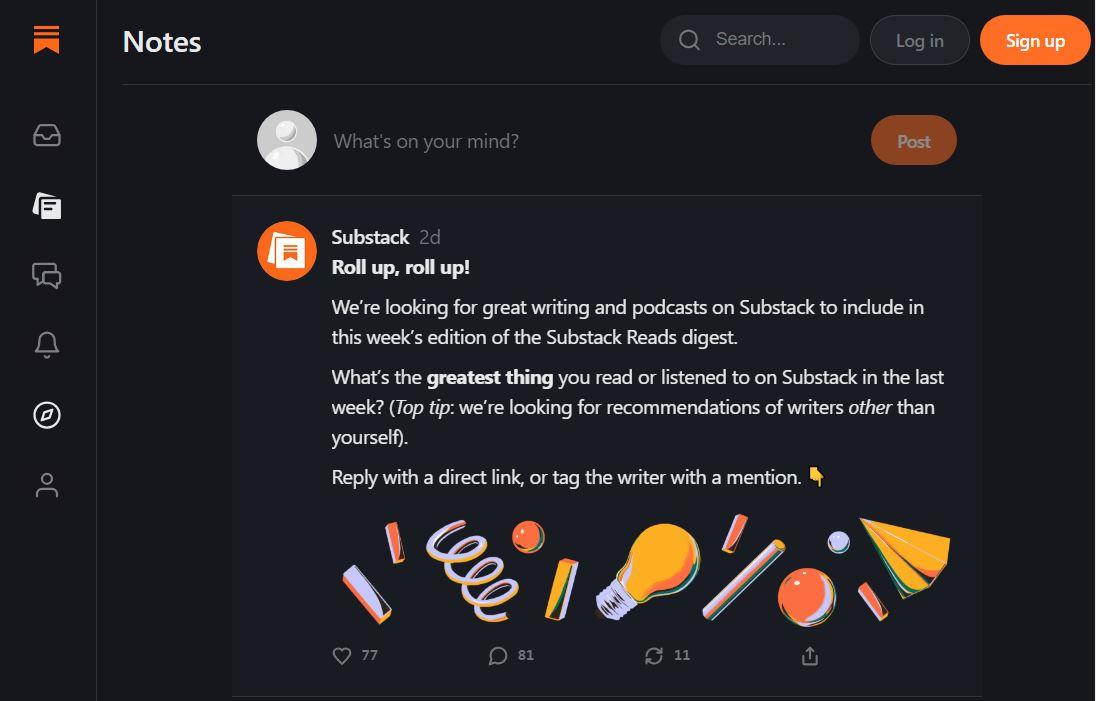
So it’s a newsletter platform, but what if newsletter writers could also micro-blog for their followers in a feed? Substack developers must have thought this would work. I think I looked at it one time and got overwhelmed because any time I tried to “follow” anybody on there, it asked me if I wanted to read the person’s newsletter, and that second step is just too much friction. (Incidentally, I prefer to simply click on a link to a newsletter and pretend it’s a blog post. This is not how Substack designs its user experience, exactly, but I’ve been making it work.)
The appeal: I do already use Substack to read blogs (which, again, are mistakenly called “newsletters”), so at least I’m already “following” cool writers.
Red flags: I forgot it existed until I started writing this list.
Cohost
I personally know one of the cofounders, so be aware that my write-up is biased, probably. Cohost feels more like Tumblr than Twitter; posts can be long, and they often are. There’s no algorithm or recommendation system, so you have to find your friends manually, just like the old LiveJournal days. In the case of my social circle of friends (plus frenemies and rivals), Cohost has just as much interpersonal drama as my LiveJournal days did, which means I don’t actually like it very much – but that’s a me problem.
The appeal: There are lots of refugees from Games Twitter and other adjacent Cool Nerd circles.
Red flags: Feels like an indie basement show in the sense that it’s relying on everybody who attends to kick in a buck for the beer. Cofounders have written a manifesto against venture capitalists as a source of funding, but it’s not entirely clear to me how else this site could make enough money to survive in the long term. Twitter (and many others on this list) always ran at a loss, too, but Twitter was willing to make a lot of compromises that Cohost isn’t.
Mastodon
This is the microblogging platform that forced internet normies to learn the word “federation,” way before Meta’s Threads and Bluesky launched with federated feeds. Mastodon got famous for it first, and I would argue, did it worst. Don’t let Mastodon hear you say you think it’s confusing, though, because actually it’s the “best iteration of federated platforms with a user interface that is pleasant to use,” according to its one-sentence Google search description (which is a quote from a Mastodon user that also appears on the site’s front page marketing scroll). Basically, it’s so messed up that you made a Bluesky profile and you didn’t just keep trying to make it work with Mastodon. (How do I get Mastodon to stop drunk-dialing me to tell me that, by the way?)
The appeal: It’s kinda like Reddit in that there are a ton of different communities, each with its own social mores and cute quirks.
Red flags: It’s kinda like Reddit in that each part of Mastodon is ruled by a mod (or several) who may or may not be a despotic asshole.
The old standbys
These platforms have been around long enough to feel familiar, offering the stability and community that newer apps are still chasing. Mastodon remains the choice for those who prefer a decentralized approach, while Bluesky has gained steady momentum with its invite-based charm and growing user base. They may not grab headlines anymore, but their reliability and consistent updates keep them in the mix for anyone tired of platform chaos.
Tumblr
I can always rely on my old fuck buddy, Tumblr. It’s not much like Twitter and it never will be, but it sure does have a feed that you can scroll through, and in the dark under the covers, that’s enough. At least, most of the time. If you’re tempted to defect from Twitter to Tumblr, I’d recommend starting with the Omegaverse tag, and also remembering that no one wants you there.
The appeal: Show me a better place for unhinged fan theories, and posts that make you wonder if you’re a furry. It’s also home to the original Glup Shitto post. Tumblr’s been around a while, and it’s still got a lot going for it.
Red flags: The quote-posting system allows for endless harassment even if the original user deletes their post, because reblogs make it so that posts can never actually die. It’s pretty wild that this is just how Tumblr works! For every Glup Shitto, there’s a Your Fave Is Problematic.
Discord
Since Discord is a live chatting app, it’s weird to describe it as a Twitter competitor, but for some people (including me), it’s a social space that almost scratches the same itch – especially if you’re in the right Discords. Similar to Mastodon, though, having fun on Discord is all about who you know and where you end up. It takes work.
The appeal: “My friends are on it” remains the single best reason to use any platform, and in my case, Discord fits the bill.
Pink flags: Discord made some waves when it started testing some AI features, like a chatbot, but so far, things seem OK.
Despite the checkered past (remember r/TheDonald? Or r/FatPeopleHate?), Reddit has experience – we’re talking about a way-back-when hookup, like junior prom date levels of memories (and baggage). You probably don’t need me to explain to you how Reddit works or even what it is.
The appeal: It’s the modular feed full of both niche and broad communities.
Red flags: Remember when all of those subreddits protested the API changes in June, though? Do you really want to walk away from Twitter’s bad CEO into another committed relationship with a website that has a bad CEO? Better to keep it casual.

The forgotten
Once loud with opinions and viral threads, these platforms now echo with silence. Projects like Post, Pebble, and Spout once promised better discourse, cleaner feeds, and fairer algorithms-but their small user bases and slow updates pushed them out of daily use. They survive mostly as nostalgic footnotes, reminders of how hard it is to build lasting communities without attention, momentum, or clear identity.
Every few weeks, I still post on BeReal, but at this point my phone has become a graveyard for abandoned social media apps. Remember Hive? What about Clubhouse, Peach.cool, Pillowfort, and Ello? At this point, I’m wondering if the entire list I just wrote will end up abandoned in the same way, replaced by some future app that we have yet to imagine. I hope she’s nice, and I wouldn’t be mad if she’s hot, too.
Which platform has the best moderation and safety features
Bluesky leads among Twitter clones for moderation and safety, thanks to its customizable feeds, robust labelers, and community-driven tools that effectively curb harassment and spam.
Platform Comparison
Moderation varies by platform, with decentralized options offering more user control but sometimes inconsistent enforcement.
| Platform | Moderation Approach | Safety Strengths | Key Weaknesses |
|---|---|---|---|
| Bluesky | Custom feeds, domain labelers, AI+human review | Flexible blocking, low toxicity reports, rapid response to abuse | Still scaling enforcement tools |
| Threads | Meta’s AI filters, keyword blocks, fediverse federation | Seamless reporting, Instagram-like safety | Privacy concerns from data practices |
| Mastodon | Server-level mods, chronological feeds, no central algo | Decentralized bans, ad-free, user privacy focus | Varies by instance, steeper setup |
Why Bluesky Excels
Bluesky’s “labelers” let users and orgs tag content (e.g., for misinformation), combined with strong anti-harassment policies, making it safer for real-time discourse. Threads suits casual users but trails due to centralized Meta oversight. Mastodon prioritizes privacy over polished safety nets.
Compare moderation accuracy and false positive rates across platforms
Bluesky offers the best balance of moderation accuracy and low false positive rates among Twitter clones like Threads and Mastodon, based on its composable labeler system that minimizes erroneous flags while catching most violations.
Accuracy Metrics
Direct platform-specific benchmarks are scarce, but user reports and studies highlight Bluesky’s edge through customizable, transparent moderation that reduces overreach compared to algorithmic-heavy rivals.
| Platform | Est. Precision (Lower FP) | Est. Recall (Catch Rate) | FP Issues |
|---|---|---|---|
| Bluesky | High (85-95%) | Strong (80-90%) | Rare due to user opted labelers |
| Threads | Medium (70-85%) | High (90%+) | Frequent safe content flags from Meta AI |
| Mastodon | Variable (75-90%) | Medium (70-85%) | Instance-dependent, lower central errors |
Key Trade-offs
Bluesky’s domain-specific labelers allow precise tagging (e.g., spam vs. nuance), yielding fewer false positives than Threads’ broad AI filters. Mastodon’s decentralized model avoids uniform FPs but risks gaps in recall across servers. Overall, no platform exceeds 95% accuracy consistently due to content imbalance, but Bluesky prioritizes precision for safer user experience.
