
Picture this: a rickety village overrun by chainsaw-wielding maniacs, their guttural roars echoing as you fumble for your handgun. Resident Evil 4 thrusts you into that nightmare-question is, can you stomach it?
There’s a very good reason why Resident Evil 4 became a breakout hit for the franchise: Horror is a niche genre, and RE4 isn’t a straightforward horror game. It’s an action-shooter with horror elements, meaning it’s more accessible to a much wider audience. I’m not saying that RE4 isn’t scary at all, but upon its first release, the game did get pushback from hardcore horror aficionados who wished that it had been less of an action-shooter and more of a tense trek through a dark, foreboding mansion like the original Resident Evil.
<
Those hardcore fans weren’t entirely off track in their complaints. RE4 signaled an action-forward trend for the franchise that lasted for years afterward; Resident Evil 5 and 6 are often described as the franchise’s least scary entries, skewing more toward bland, repetitive zombie cleanup duty and further away from slow, creeping dread. Resident Evil 7 was a return to form for many fans, including yours truly (I can barely play it). But let’s get back to RE4, a game that is not too scary for me – and probably won’t be for you, either.
When you first boot up Resident Evil 4, whether you’re playing the 2023 remake or the original game, you might feel as though I’ve betrayed you. The first 30 minutes are by far the scariest section of the game. Of course, horror is subjective, since your response to it depends on personal experience and what you’ve been desensitized to. Still, there are some situations that inspire just about any human to experience discomfort – darkness, tight spaces, jump scares, scarce resources – and the beginning of RE4 uses all of the above.
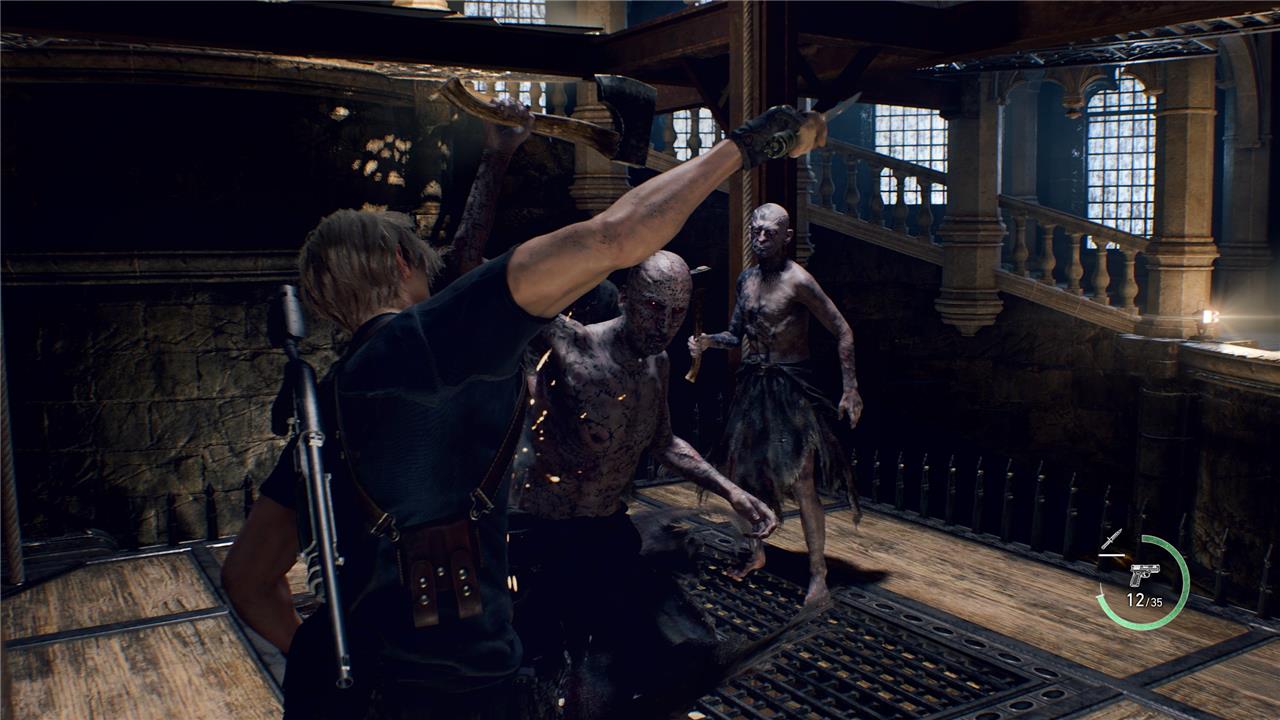
After a brief car ride and a little walk through the wilderness surrounding a remote village in Spain, protagonist Leon S. Kennedy comes upon a small, dimly lit cabin. Naturally, he has to go inside and investigate. Even though he’s a special forces officer, he doesn’t assume every problem can be solved with a gun. (Some of them can be solved with a well-placed clockwork gear, for example.) Leon’s an investigator first and foremost, so in this opening sequence, he doesn’t draw his firearm – nor does he assume that the first person he meets will be aggressive or violent. Before you even run into that first enemy, though, you’ll have to guide Leon through dark hallways, hearing his footsteps over creaking floorboards, all the while aware that certain doom lies around the next corner. Or maybe the next one. Which corner will it be? Ugh!
The introduction to Leon’s first enemy isn’t exactly a jump scare. It’s a slow, drawn-out reveal. “Don’t open that door,” you might yell at Leon, even as you yourself press the button to open the door and meet your first red-eyed, infected villager. The man doesn’t attack right away, though; he sways on his feet, unresponsive as Leon attempts to interrogate him in both English and Spanish. This doesn’t work. Eventually, Leon must fight him off, after which point he must explore the rest of the cottage and clear it of enemies (and loot).
<
The slow, methodical exploration of a small, decrepit house is a classic horror trope, and it still just works. The house feels claustrophobic and aimless; there’s no rhyme or reason as to which doors are locked or unlocked, or which ones have an enemy behind them as opposed to the safety of silence. Though Leon is armed, he has barely any bullets, so spraying them in a wild panic isn’t a good option. He has to be careful, keeping all of his senses on alert – along with yours – to meet the challenge ahead of him with limited resources and knowledge about what’s next.
But that’s not actually how it feels to play RE4. Not the entire time. The rest of the game has its moments, but none have you as underprepared as you will be during this very first section. And after you successfully escape from this cottage, the next few enemies you encounter will be walking through the woods in broad daylight. In other words, you’ll be able to see and hear them coming with ease.
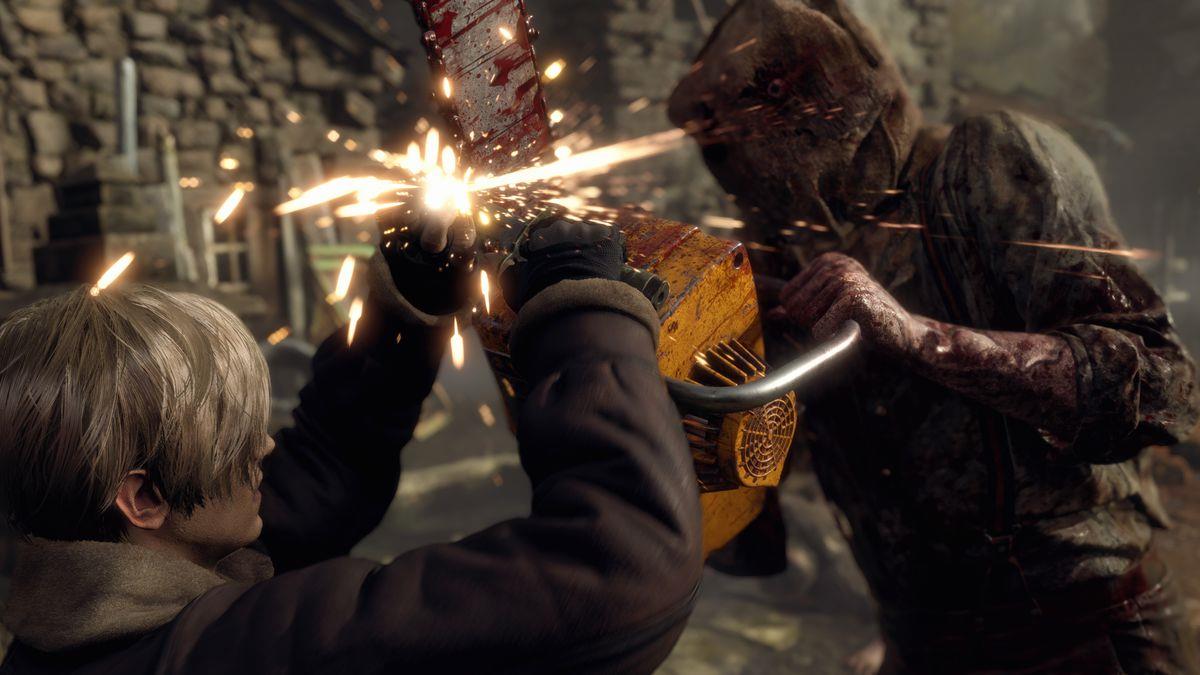
Then you’ll hit the first significant challenge in the game – an entire village of infected people (one of whom has a very loud and intimidating chainsaw). Even so, the challenge of this village isn’t the same as the one dished out in that first cottage. By this point, you’ve collected more bullets, maybe even some health items. More importantly, this village is expansive, and in this wider, more open area, you’ll notice how slow the game’s zombies actually are – and how easy it is to outrun them. You can head to higher ground, or even create a bottleneck for oncoming enemies.
The rest of the game isn’t going to be that easy. There will be moments when RE4 dishes out some of its old horror standbys. But many of the battles that Leon faces take place in open areas, with enough light to see what’s coming, and a steadily increasing stockpile of weaponry and healing items. Best of all, RE4‘s remake has autosaves, so dying doesn’t suck as much as it used to in the original game.
All this to say, don’t be fooled by the opening sequence in RE4‘s cottage. It’s not necessarily indicative of how the rest of the game will feel to play. That doesn’t mean that you might not find RE4 scary, perhaps even too scary to play – after all, these judgments are subjective, and what rolls off my back might stick a chainsaw into yours. But it’s got a lot more open areas and action-packed moments than its predecessors, and it’s definitely not all dim hallways and creaky doorways. Perhaps most importantly, Leon is very pretty, and that should keep you distracted if all else fails.
How scary is Resident Evil 4 compared to RE2 Remake
Resident Evil 2 Remake is generally scarier than Resident Evil 4.
RE2 emphasizes vulnerability and classic survival horror, while RE4 shifts to action-horror with empowerment through combat.
Key Differences
RE2 Remake builds dread via tight spaces, scarce resources, and relentless pursuers like Mr. X, making players feel weak and trapped. RE4 starts tense but evolves into horde battles where skillful play (parries, melee) reduces fear.
Player Consensus
Most agree RE2 delivers psychological horror and jump scares, rating higher on fright (e.g., Lickers, chases). RE4 focuses on intensity and atmosphere, with scares like Regenerators but less overall terror-more “panic” than “horror.”
Scariness Comparison
| Aspect | RE2 Remake | RE4 Remake |
|---|---|---|
| Vulnerability | High-limited ammo, fragile combat | Lower-powerful weapons, parry system |
| Pursuers | Mr. X/Lickers: constant dread | Chainsaw man/Regenerators: occasional |
| Atmosphere | Claustrophobic, dark | Tense ambushes, action ramps up |
| Overall Rating | 8-10/10 scary | 4-6/10 scary |
RE2 suits horror fans seeking fear; RE4 thrills with action if scares aren’t your priority.
What are the scariest moments in RE2 Remake
Resident Evil 2 Remake features intense, standout horror moments that amplify its survival horror roots.
Players often cite Mr. X pursuits, Licker encounters, and grotesque cutscenes as peak frights.
Top Scariest Moments
-
Mr. X’s debut: He crashes through a wall, squeezing Ben’s eyeballs out in a brutal, shocking intro.
-
Licker chases: Dual Lickers in the Umbrella lab or kennels slash unpredictably; their ceiling crawls and tongue attacks terrify.
-
Tyrant wall smash: Mr. X bursts into the clock tower, footsteps echoing as he invades safe spaces.
-
Chief Irons’ death: A larva erupts from his chest in an Alien-like gore fest after abusing Sherry.
-
Ripped jaw corpse: Lifting a police officer’s mangled face reveals mushy, gum-like innards.
-
G-Spawn sewers: Mumbling, singing embryos from orphanage experiments haunt the fleshy hive.
Why They Scare
These blend jump scares, body horror, and relentless tension from scarce ammo and chases, peaking in RPD and NEST labs.
