
Your legendary haul isn’t just treasure-it’s raw material for power. Salvaging gear in Diablo 4 can turn trash loot into rare resources, upgrade paths, and new crafting options that push your character’s limits far beyond dropped gear alone.
In this Diablo 4 guide, we’re going to go over why salvaging loot is important, and how to do it.
Why should you salvage your gear?
Salvaging your gear is one of the fastest ways to gather crafting materials and keep your inventory clear. Dismantling unwanted items provides valuable resources like iron chunks, leather, and rare upgrade materials that you’ll need for enhancing better gear. It also helps you avoid wasting gold at vendors while ensuring that nothing goes to waste from your loot runs. Over time, consistent salvaging makes upgrading and refining your gear much easier.
Crafting and upgrading gear is a big part of Diablo 4. You’ll need special materials (as well as gold) to craft powerful new items, make Legendary gear with Aspects, and upgrade your existing weapons and armor. And the only way to get these materials is to salvage stuff you pick up on your journey.
Each rarity of item (Common, Magic, Rare, Legendary, etc.) consists of a different type of crafting material, which you can get by using the blacksmith to destroy gear of that type, both freeing up your inventory and lining your bag with materials you’ll need later.
Even if you’re not doing a lot of crafting in the early game of Diablo 4, you will eventually be using these materials for something when you’re working to perfect your build. And since you can acquire gold elsewhere – like by killing monsters or riding around the open world on your mount opening chests – it’s best to salvage all of your items until you are either desperate for gold, need to respec your chosen class, or have built up a healthy supply of Veiled Crystals, Iron Chunks, and other crafting components.
It’s worth noting here that, as of season 2, Blizzard removed the need to salvage rare or worse items in World Tier 3 and above. Instead of low-tier items dropping, you’ll instead gain bonus crafting materials (and gold) in order to reduce inventory clutter. In World Tier 4, you’ll only get Ancestral Rare items or better in your inventory and everything else will simply drop as crafting materials.
How do you salvage your gear in Diablo 4?
To salvage your gear in Diablo 4, visit any Blacksmith in a major town or outpost. Interact with them and open the Salvage menu, where you can break down unwanted weapons and armor for crafting materials. You can choose to salvage items individually or by rarity tier, making it easy to clear inventory space quickly. Salvaging not only provides resources for upgrading and crafting equipment but also helps you manage your storage and focus on building a stronger character setup.
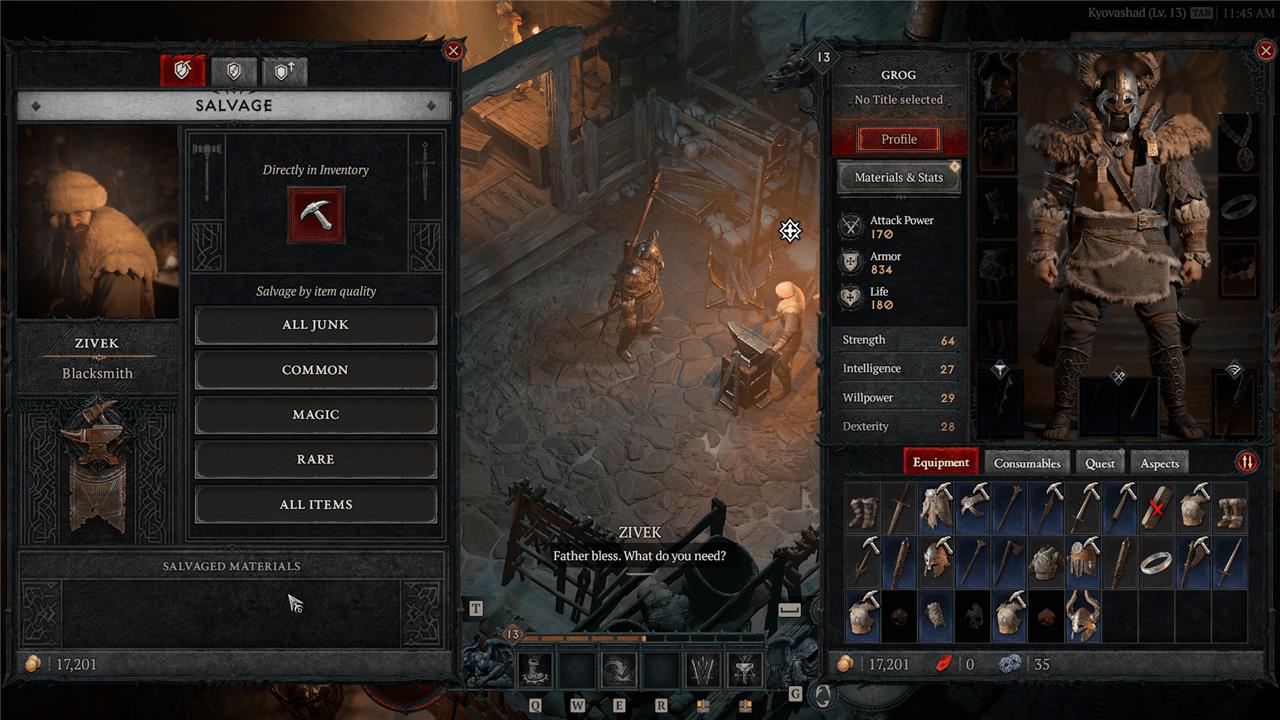
Once you’ve decided to break down your fancy new loot into parts, all you need to do is find a blacksmith (denoted by an anvil on your map). You can find one in any major town and almost all small villages.
When you speak to the blacksmith, you’ll be able to tell them exactly what you want broken down. If you only want to salvage a few specific items, use the hammer button in the blacksmith menu to pick individual weapons and armor pieces from your inventory. You can also choose to instantly salvage all types of a given item rarity (such as all rare items), and you can even tell the blacksmith to break down all items currently in your inventory.
Hitting the “all items” button is definitely the fastest, but you can never get any of your salvaged weapons back, so be sure before you hit yes.
If you want to methodically manage your loot on the go, you can mark certain items in your inventory as “junk,” which you can then easily sell or salvage the next time you’re in town without worrying that you’ve accidentally given away a priceless upgrade. As of season 2, Blizzard also added the ability to “favorite” items, which allows you to quickly pick items not to salvage – even if you hit the “all items” button in the salvage menu. This is significantly faster than the junk tag if you’re planning on dumping most of your inventory.
What materials come from salvaging Rare vs Legendary gear
Salvaging Rare (yellow) and Legendary (orange) gear in Diablo 4 yields different crafting materials, with higher rarities providing rarer resources vital for gear upgrades, enchanting, and imprinting.
Materials from Rare Gear
Rare items primarily drop Veiled Crystals (for armor/jewelry upgrades from Rank 3+), Coiling Wards (weapons/jewelry), Blackened Bones (weapons), and basic fillers like Iron Chunks, Rawhide, or Scattered Prisms depending on gear type and item level. These support mid-game progression but become less critical later.
Materials from Legendary Gear
Legendary gear yields the same base rares as above but adds Forgotten Souls (especially from high-item-level or Ancestral pieces) for Rank 4+ upgrades across all slots, plus higher quantities overall; imprinted Legendaries may drop Bound Resin Sigils or similar endgame mats. Salvaging also updates your Codex of Power with the item’s Aspect at its rolled power level.
Comparison Table
| Rarity | Key Materials | Best Uses |
|---|---|---|
| Rare | Veiled Crystals, Coiling Wards, Blackened Bones | Mid-tier upgrades (Ranks 3-4), enchanting |
| Legendary | Veiled Crystals + Forgotten Souls, higher yields | Endgame upgrades (Ranks 4-5), imprinting Aspects |
How do item level and type affect salvage yields
Item level and gear type significantly influence salvage yields in Diablo 4, with higher item power (e.g., Sacred at 800+, Ancestral at 925+) producing greater quantities and rarer materials from the same rarity.
Impact of Item Level
Higher item levels yield more materials overall and unlock premium resources like Forgotten Souls from Ancestral Legendaries (item power 925+), which low-level items cannot produce. For example, salvaging a level 100 Ancestral Rare might drop 2-3 Veiled Crystals plus fillers, while a level 50 equivalent yields only 1-2 with no premium mats.[conversation_history]
Impact of Gear Type
Salvage outputs vary by slot category: weapons drop ore-based mats (e.g., Iron Chunks, Blackened Bones), armor yields leather (Rawhide) or crystal types (Veiled Crystals), and jewelry/offhands provide wards or sigils. Rings and amulets favor Coiling Wards, while helms/chest pieces emphasize Rawhide.[ from prior]
Yield Comparison Table
| Factor | Low Item Level (e.g., 50-800) | High Item Level (e.g., 925+) |
|---|---|---|
| Rare Gear | 1-2 Veiled Crystals + basics | 2-4 Veiled Crystals + Souls chance |
| Legendary | Basic rares + 1 Soul possible | 3+ rares + 2-5 Souls [conversation_history] |
| Weapons | Iron Chunks/Blackened Bones | Higher stacks + Neathiron |
| Armor | Rawhide/Scraps | Baleful Fragments + extras |
